


When people search for “Buy with AI Shopify”, they’re usually imagining something very simple: a magical button where an AI shows up, adds products to the cart, and checks out for the customer. Very sci-fi. But it’s not how it actually works.
In Shopify, AI is not a single button you click on. It’s an entire capability stack that supports customers throughout their buying journey. This is a part of the era of agentic commerce. These AI agents browse stores, compare options, and make purchasing decisions for people.
And, just like humans, they’ll naturally prefer stores that are easier to read, more reliable, and less likely to break. That’s why Shopify stores that prepare early and know what they’re doing will win in the era of AI commerce.
In this guide, we’ll break down what “Buy with AI Shopify” actually means and the practical steps you can take to prepare your store for AI-driven shopping. Plus, we’ll show you how automation plays a key role in this, and how tools like AutoDS help you keep your store fast, reliable, and AI-ready.
“Buy with AI” isn’t a Shopify feature. It’s an entire store setup. AI agents choose stores based on clean data, simple checkout, real-time inventory, and reliable fulfillment.
AI changes how buyers arrive at your store, not who controls it. You’re in charge of your site, and Shopify remains the transaction engine. AI agents simply choose where to buy from.
Automation helps get your store AI-ready. Real-time syncing, stable pricing, and consistent fulfillment are essential for being picked by AI buying agents.
What Does “Buy With AI” Actually Mean for a Shopify Store?

Let’s reset expectations first, because this is where most confusion starts.
When we talk about “Buy with AI Shopify”, we’re not talking about some hidden AI checkout switch you forgot to turn on. Your store still exists. Your product pages still matter. Your checkout is still important.
What it does mean is more subtle (but still relevant). “Buy with AI” means your store is readable by AI buying agents. Let’s break it down a bit further. An AI-ready store means:
- AI can clearly understand what you’re selling. It can analyze how much it costs, if it’s available or not, how long shipping takes, and what happens after the purchase.
- Your products are AI-discoverable. This means they can be surfaced, compared, and assessed by systems acting on behalf of shoppers.
- Your checkout is agent-compatible. Nothing breaks when a bot tries to move through it logically and predictably.
In just a few words? Buy with AI = AI buying agents can easily explore your store and make purchases. This means a Shopify dropshipping store that’s clear, structured, optimized, and reliable for both humans and AI to buy from.
How Agentic Commerce Interacts With a Shopify Store
To understand how agentic commerce works, it helps to zoom out and look at the flow from the AI’s point of view, not the customer’s.
It usually starts with a goal. A user tells an AI buying agent something like: “Buy me the best standing desk under $600” or “Reorder the supplements I always get, but cheaper”. From there, the agent does what humans normally do, just faster. Here’s what the flow usually looks like:
- The AI evaluates products from different stores by reading product data, comparing prices, and checking stock. Nothing too different from what a normal person would do.
- It looks for trust signals like shipping speed, return policies, and consistency.
- Once it finds the best option, it picks a store and either completes the checkout itself or helps the user in finishing the purchase.
You’ve probably heard about this already. In 2025, ChatGPT partnered with Shopify to start discovering products and assisting shoppers in their purchases.
Shopify is a key player in this AI buying workflow. It gives agents pretty much all they need to make a decision: structure. Your product catalog is where the agent learns what you sell. Your cart and checkout allow them to move forward without friction. Your payment setup lets them know if transactions are secure. And your fulfillment confirmation closes the loop.
This is exactly why Shopify works so well for AI buying. The structure is already there, and agents don’t have to guess. The clearer the setup, the easier it is for an AI agent to choose your store and follow all the way to the purchase.
Step 1: Prepare Your Shopify Store for AI Discovery
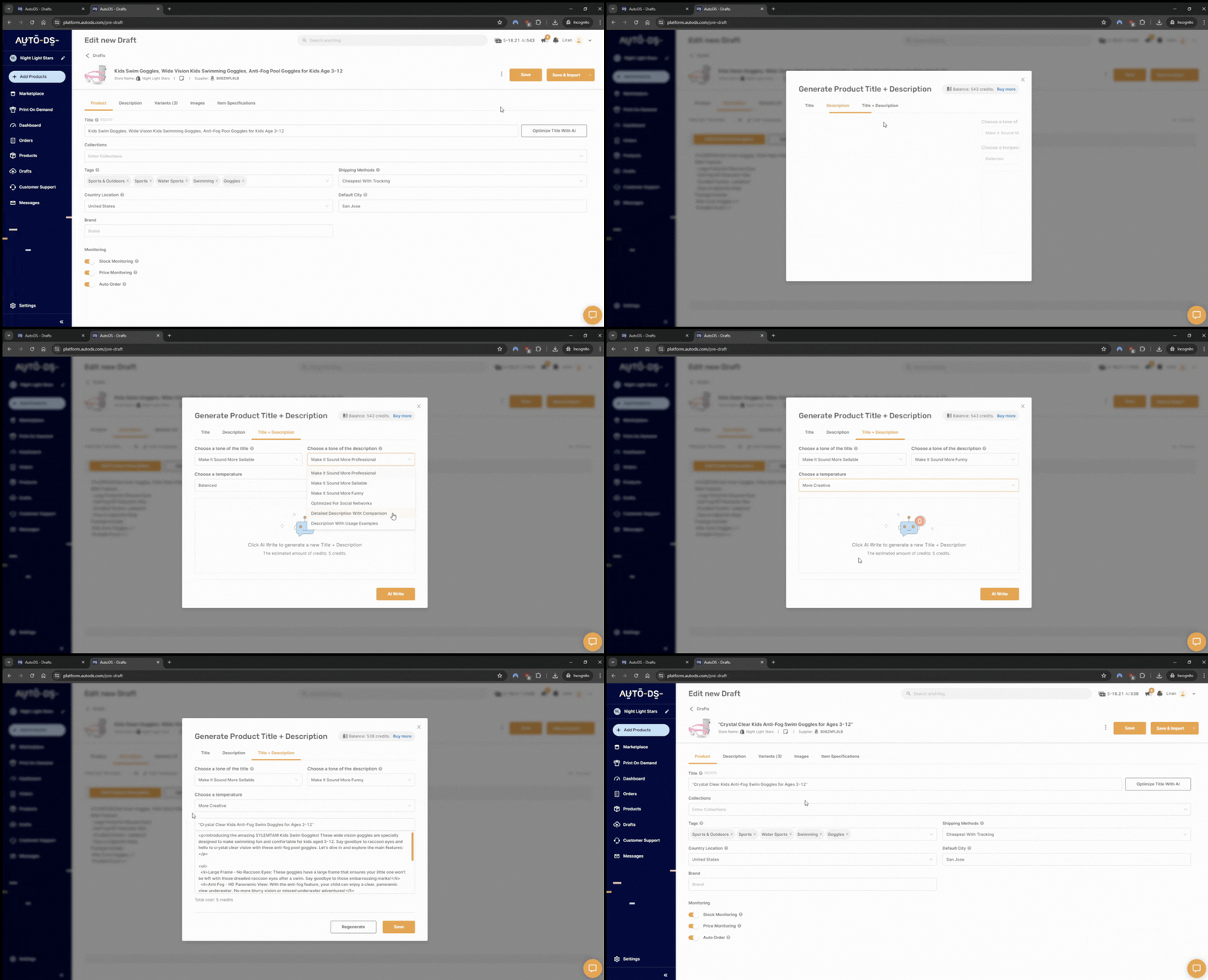
If there’s one thing you need before anything else, it’s this: clean product data. For AI agents, messy data isn’t just annoying… It’s just impossible to read.
AI systems don’t interpret vibes, like nice pics and cool fonts. They read structure. That means:
- Your product titles need to be consistent and descriptive.
- Your descriptions need to be bulleted, SEO-friendly, and clear, highlighting how features lead to benefits.
- Images have to clearly show the product in use, differentiate variants properly, and match the product. Avoid misleading mockups, exaggerated lifestyle shots, or images that contradict the descriptions.
- Variants should be clearly defined.
- Pricing must be accurate.
- Stock must be reliable.
💡 Pro Tip: AutoDS’s AI Product title & description generator helps keep your listings clean, SEO-friendly, and easy for AI agents to understand (without turning them into keyword soup).
If one page says a product is in stock and another says it isn’t, or if pricing changes in the middle of a session, forget it. AI buying agents get confused and choose another store. They need predictability to trust you.
Most Shopify stores aren’t ‘AI-unready’ because of technology. They’re not ready because their product data is sloppy, and no one wants to clean it. Many product descriptions are written to ‘sound convincing’ rather than to be understood.
You know… long paragraphs, vague claims, and keyword stuffing might look pro, but they’re actually confusing. Humans can handle it, but AI agents can’t.
What works better is clarity. Make sure the entire listing has direct language that explains exactly what the product is, who it’s for, and what problem it solves. And if the visuals don’t line up with the data, that inconsistency becomes another signal against you.
It all comes down to simplicity. If your store is easy for a machine to understand, it will also be easier for humans to buy from. AI discovery simply forces Shopify stores to do what great stores should’ve been doing all along: be clear, consistent, and honest.
Step 2: Make Your Shopify Checkout Agent-Friendly

For AI agents, checkout isn’t just the final step. It’s the risk assessment phase. This is where things either go well… or fall apart.
AI agents want checkout to be simple. Fewer steps mean a higher chance of completing the purchase. And fewer surprises mean they’re more confident. Every extra page, pop-up, or unexpected prompt introduces uncertainty. And AI agents hate uncertainty.
On Shopify, that means keeping your AI checkout as clean and predictable as possible. To do this, you can:
- Enable accelerated checkout options whenever you can. They reduce friction and standardize the buying process.
- Avoid forced upsells or last-second cross-sells that interrupt the flow. Especially ones that block progress or require additional decisions.
- Make sure your checkout works well on mobile.
- Be transparent with payment and offer multiple methods. Clearly show taxes, shipping costs, and total pricing upfront. Hidden fees or surprise charges at the final step can get your store flagged as “unreliable” in future decisions.
An agent-friendly checkout is boring in the best possible way. It’s fast, clear, and free of surprises. If a purchase can be completed without friction or unexpected logic, AI agents will love it.
Step 3: Ensure Inventory, Pricing & Fulfillment Are Real-Time

When a store looks slightly unreliable or something weird pops up, AI buying agents won’t wait around. They’ll just move on. Here are the biggest red flags:
- Products that appear in stock but aren’t.
- Prices that change between listing and checkout.
- Vague or missing shipping information.
These make your listing look risky. And from an AI’s perspective, risk equals a lower chance of picking your store.
For a Shopify store to be AI-ready, inventory, pricing, and fulfillment need to stay in sync (all the time!). That means you should update inventory levels in real time, adjust costs when they change, and confirm orders as soon as they’re placed. All automatically and immediately.
For example, an AI agent might see a product listed at $79, add it to the cart, then hit checkout and see $92 after shipping and taxes, with no explanation. A human might still continue, but an AI won’t. It flags the store as inconsistent and moves on.
Same with shipping fees. For example, if Shop Pay is enabled but shipping rates only calculate at the final step, that uncertainty can make an AI agent drop the checkout.
💡 Pro Tip: This is usually where stores break. Supplier stock changes, prices change, and no one notices. Tools like AutoDS exist mainly to prevent that chaos. Its Price & stock monitoring feature keeps track of supplier prices and inventory. Plus, it updates your listings 24/7.
Tracking information also matters. If an agent can’t verify that orders move from paid to shipped, again: major red flag.
Doing this manually doesn’t scale. And, more importantly, it doesn’t stay consistent. Human delays, missed updates, and occasional errors are normal. But AI agents don’t care. They only see a store that’s unreliable.
This is where automation becomes essential, not as a growth hack, but as the infrastructure that keeps your store predictable, accurate, and trustworthy at all times.
Step 4: Enable AI-Readable Signals Beyond Your Store
Now, there’s one more thing to consider. AI buying agents don’t stop working once they’ve read your product pages. They actually look outside of it as well, scanning for signals that confirm your store is legit.
Reviews and social proof play a huge role here. To make sure these help you in your agentic commerce Shopify strategy, make sure you have:
- As many reviews as possible. Quantity matters to establish a pattern.
- Recent reviews. Outdated feedback doesn’t reflect your current performance. Make sure you have a constant stream of reviews.
- Consistent feedback. Mixed signals make it hard for an AI agent to assess risk. A steady stream of positive, believable reviews is far more valuable than a sudden spike that looks weird and artificial.
🆕 Beginner’s Tip: Thinking about using AI-generated product reviews? Discover the risks, rules, and smarter alternatives for 2026.
Policies are another major evaluation point. AI agents actively assess refund rules, shipping times, and how easy it is to contact your business. Clear, readable policies reduce confusion and increase trust. Vague wording, missing timelines, or buried contact details = friction = hesitation.
Finally, make sure to highlight trust signals. This includes clear branding, legitimate business information, consistent messaging, no sudden changes in tone, and an easy customer experience. All of these help reinforce that your brand behaves like a real, stable business.
AI agents look at the whole picture. They don’t just look at the product. They assess your entire store. The more consistent your signals are, both on and beyond Shopify, the easier it is to make a purchase.
Step 5: The Role of Automation Tools in “Buy With AI”
Here’s the harsh truth: manual stores have a hard time keeping up in the era of AI.
Humans are great at filling in gaps. If a price looks slightly off or inventory feels uncertain, a person might still take the risk and click “Buy”. AI agents won’t. They don’t guess, they don’t assume, and they don’t hope it works out. If the data doesn’t feel reliable and predictable, the store simply gets filtered out.
This is where automation stops being a “nice-to-have” and starts becoming an AI compatibility layer. It helps keep product data stable, fulfillment predictable, and error rates low. All things AI agents really care about. When inventory syncs automatically, prices update in real time, and orders move smoothly from checkout to fulfillment, AI systems can trust it.
In this final step, automation is what ties everything together. On Shopify, this means choosing tools that help your store be more reliable. The right setup supports Shopify-native integrations, works across multiple suppliers, syncs data in real time, and scales without introducing chaos as order volume grows.
What “Buy With AI” Will Look Like on Shopify in the Near Future
It’s not as if agentic commerce and AI shopping on Shopify are going to change everything overnight. It’s a trend that will start growing quietly. And then, one day, it will just feel normal.
So, what can we actually expect in the near future? AI assistants will probably…
- Start purchases based on simple user requests.
- Build carts automatically.
- Compare prices or options without the shopper ever visiting multiple stores themselves.
Keep in mind that a lot of those decisions will happen outside your site. If an AI assistant chooses your store and places an order from you, it means it has already scanned hundreds of other stores to make the choice.
Now, what won’t actually change much? First, Shopify will continue working as it already does, handling all transactions. Your store will still control products, pricing, margins, payments, and fulfillment rules. AI isn’t taking over your entire business. It’s just changing how buyers get there.
That means the biggest shift is the path to purchase. If users are used to Google and click on a result, now they’re just having conversations with AI systems and letting them handle the research.
Stores that are clear, reliable, and easy to work with will naturally get picked more often. And for Shopify sellers who already do this right, agentic commerce Shopify dynamics won’t really change much. It will just feel like a new stream of orders coming from new places.
Common Mistakes That Block AI Purchases
AI agents don’t try again later. If something looks off, they leave and move on. That’s why small setup issues that humans might overlook can completely block purchases coming from AI.
- Inconsistent product data. Mismatched titles, unclear descriptions, or confusing prices make it harder for AI to understand what’s actually happening. Same with broken or poorly defined variants. If sizes, colors, or options don’t make sense, agents can’t select the right one.
- Slow or unreliable fulfillment. AI agents pay close attention to shipping speed, order confirmation, and delivery consistency. If something looks uncertain or delayed, the store gets flagged as risky. Overly saturated checkout flows can also stop purchases. Avoid pop-ups, forced upsells, and extra steps.
- Manual inventory management. No stock levels and prices synced in real time? Yup, expect AI agents to run away from your store. Small errors can lead to inconsistencies, and inconsistencies are the best way to scare AI away.
Frequently Asked Questions
Can I enable “Buy with AI” directly in Shopify?
No, “Buy with AI” is not a switch you can just turn on on Shopify. What you can do is prepare your store so AI agents can read your data, trust your checkout, and complete purchases without friction. For example, you can enable accelerated checkout options on Shopify, optimize your listings, and have structured product pages.
Do I need a chatbot to support agentic commerce?
No, agentic commerce doesn’t mean replacing your store with a chatbot. Most AI agents interact with your product data, checkout, and fulfillment systems. They don’t need conversational interfaces to gather information.
Will AI agents replace Shopify stores?
No, AI agents won’t replace Shopify stores. Shopify remains the transaction layer and the visible side of your business. AI changes just change how buyers get to your store, not who owns it or controls pricing, products, and margins.
How does AI choose which store to buy from?
To choose which store to buy from, AI agents assess clarity and reliability. This means clean product data, accurate pricing, real-time inventory, predictable shipping, transparent policies, and low checkout friction. Stores that look uncertain get flagged and skipped.
Is this relevant for small or beginner dropshippers?
Yes, “Buy with AI” is definitely relevant for small businesses. AI agents don’t favor brand size, only reliability. If done right, it can become a new source of traffic and income.
When will AI agents actually start buying autonomously?
AI agents are already starting to buy autonomously. It’s starting in limited ways and will increase over the next few years. The transition will be slow, and stores that prepare early will benefit before it becomes obvious to everyone else.
Start Your Dropshipping Journey with AutoDS
“Buy with AI” isn’t about a huge futuristic Shopify update. It’s about building a store that’s clear, reliable, and easy to attract AI buying agents. Clean product data, simple checkout flows, real-time inventory, and predictable fulfillment are the starting points. The fastest way to think about “Buy with AI” is this: build your store so nothing ever needs to be explained.
This is exactly where automation fits in. AutoDS helps you automate inventory syncing, pricing updates, order fulfillment, and tracking. In other words, it handles all the busy work that makes AI agents trust you.
“It’s kind of like having your product pipeline on autopilot so that your store doesn’t run into these major fulfillment hiccups”, says dropshipping expert Andy Stauring.
👀 Ready to get your store AI-ready? Start your $1 trial today with AutoDS and build a dropshipping business that’s ready for the next wave of commerce.
In the meantime, check out these articles about Shopify dropshipping:
- What Does “Buy With AI” Actually Mean?
- How Agentic Commerce Interacts With A Store
- Prepare Your Shopify Store For AI Discovery
- Make Your Shopify Checkout Agent-Friendly
- Check Inventory, Pricing & Fulfillment
- Enable AI-Readable Signals Beyond Your Store
- The Role Of Automation Tools
- What “Buy With AI” Will Look Like
- Common Mistakes That Block AI Purchases
- FAQ
- Conclusion