



E-commerce is projected to reach $155.98 trillion by 2033. That growth means opportunity, but it also means more stores competing for the same customers, the same search rankings, and the same ad placements. A good product gets you in the game. A real marketing system is what keeps you there.
Digital marketing for e-commerce is the discipline of building that system through tactics that attract the right traffic, convert it efficiently, and retain customers. The stores that scale are the ones that connect those three things deliberately. That’s also why the operational side matters. Tools like AutoDS handle product sourcing, fulfillment, and price monitoring automatically, so you actually have the bandwidth to execute the marketing plan you’re building.
In this guide, you’ll learn:
- The digital marketing strategies with the strongest return on investment (ROI) for e-commerce.
- Why they matter more than ever in 2026.
- How to sequence them based on where your store is right now.
Standing out in a competitive landscape like e-commerce requires a deliberate digital marketing strategy.
Digital marketing for e-commerce refers to the strategic methods that an online store uses to draw, convert, and hold shoppers.
The best digital marketing strategies for e-commerce include SEO, email, social media, paid advertising, content marketing, and AI-driven personalization.
Building a successful marketing plan goes beyond choosing the right channels: it involves systematically linking them, tracking the performance of your spending, and turning the process into a cycle.
Automating product sourcing, fulfillment, and testing with AutoDS frees up the hours you need to execute real marketing strategies for your store. 👇
7 Digital Marketing Strategies That Drive E-Commerce Growth
When it comes to selling online, every marketing channel has a purpose. Some attract new customers, others help turn visitors into buyers, and a few encourage existing customers to return. Stores that grow steadily are not the ones spending the most. Instead, they understand what each channel is meant to do and use them together in the right way.
These seven strategies cover the full customer journey, from the first search to post-purchase loyalty. Each one works on its own, but their real value compounds when they’re connected into a calculated process.
Search Engine Optimization
SEO (Search Engine Optimization) is the process of optimizing your store so that it appears when buyers search for products on Google and other platforms. It’s the highest-leverage long-term channel in e-commerce because the work you do today can keep generating traffic without ongoing spend.
Think about what that means in practice: a product page you optimize this month can rank for a relevant search query and bring in buyers six months from now, without constant reinvestment. Paid ads stop the moment you pause the budget. SEO builds over time. That compounding starts with intent. Organic traffic often converts at higher rates than paid traffic because the buyer arrived actively searching for what you sell. The decision process was already underway before they reached your store.
Capturing that moment means optimizing product pages with:
- Keyword-rich, clear, intent-driven titles.
- Meta descriptions that mirror how people actually search.
- Clean URLs that signal relevance to both search engines and users.
Beyond traditional search, there’s a second layer most stores are still underestimating: AI-powered tools like Google AI Overviews, ChatGPT, and Perplexity are increasingly answering shopping queries directly, pulling from well-structured, authoritative content before a user ever clicks a link. This is where many stores are starting to lose ground. Strong rankings alone are no longer enough if your content isn’t structured in a way AI systems can extract and surface. In 2026, writing for search means writing for both humans and machines that answer on their behalf.
Technical fundamentals deserve the same attention as the words on the page. Site speed, mobile responsiveness, and structured data (like product schema) directly impact conversions. Even small delays in load time can measurably reduce purchase intent, turning a slow page into both a lost visitor and a missed sale.
💡 Pro Yip: Use AutoDS’s AI title & description generator to create structured, search-optimized descriptions that both search engines and AI tools can easily surface, while keeping your brand voice intact.
SEO is a long-term asset. The stores that invest in it early are the ones that stop paying for every visitor later.
Email & SMS Marketing

Email is the most cost-effective marketing channel to an online store by a significant margin. In retail and e-commerce, email delivers $36 for every $1 spent. That efficiency has a reason: email reaches people who have already chosen to hear from you, which fundamentally changes the conversion dynamic compared to any cold acquisition channel.
As a growth strategy, the real leverage doesn’t come from newsletters; it comes from automation. The highest-performing emails are behavioral triggers: flows that activate based on what a customer does (or doesn’t do). Cart abandonment flows, welcome series, post-purchase sequences, win-back campaigns: these run without manual intervention, capturing intent at the exact moment it appears.
Once automation is in place, segmentation becomes the multiplier. Segmented campaigns drive 760% more revenue than non-segmented blasts. The reason is simple: relevance scales. As your list grows, the gap between personalized and generic messaging gets bigger.
SMS adds a faster, more immediate layer to the same retention logic. With near-instant open rates, it’s particularly effective for time-sensitive touchpoints like cart reminders, back-in-stock alerts, or post-purchase updates. This way, it drives a disproportionate share of revenue relative to send volume, rewarding the same discipline that makes email work: automation and relevance over volume.
Email and SMS together build a retention engine designed to capture, nurture, and reactivate demand over time. And at scale, retention is where e-commerce profitability is built.
Social Media Marketing

Social media is where product discovery happens now: fast, algorithm-driven, and increasingly frictionless. With over 5.4 billion people worldwide spending an average of 141 minutes per day across platforms, the attention is already here. The real question is whether your items are positioned to convert it.
From a strategy standpoint, the role of social media in eCommerce has fundamentally shifted. It’s no longer just a top-of-funnel channel where awareness happens and conversions follow elsewhere. Platforms like TikTok Shop, Instagram Checkout, and Facebook Marketplace have collapsed the entire journey into a single environment. Discovery, consideration, and purchase now happen in the same scroll. As a result, your content is more than just marketing: it’s your storefront.
Within that system, format becomes a growth lever. According to HubSpot’s State of Marketing 2026, the highest-ROI formats are all video, with short-form content leading at 49%, followed by long-form video and live streaming. A well-executed Reel or TikTok can create and capture purchase intent in the same session.
Just as important is who creates the content. UGC (user-generated content) and micro-influencer collaborations consistently outperform polished brand creatives because they embed social proof into the experience. A real person using a product in a real context reduces friction, builds trust, and shortens the path from discovery to decision.
📢 Marketing Tip: If speed is the game, don’t wait for creators to validate an idea. Tools like CreateUGC let you turn a product link into a native-looking UGC video in minutes. Which means you can test angles, hooks, and formats while the trend is still hot.
Social media, at its core, rewards speed, authenticity, and consistency. Treated as a system — not just a posting channel — it becomes one of the fastest ways to validate products, generate demand, and convert attention into revenue.
Paid Advertising (PPC & Paid Social)
Paid advertising gives you something no organic channel can match: traffic from day one. The trade-off is control. Without rigorous testing, paid ads can underperform and quickly drain margins.
As a growth system, paid ads start with disciplined experimentation. Industry benchmarks show that median Google Ads ROAS has been declining as costs rise and conversion rates tighten across most verticals. And those averages are often skewed by mature, optimized accounts. In practice, new campaigns rarely start there. The real entry point is smaller, controlled budgets per ad set — just enough to generate statistically meaningful data — and a clear testing framework where only one variable changes at a time.
Retargeting is where paid budget tends to work hardest. Many marketing‑research aggregations suggest that retargeted visitors are around 70% more likely than cold audiences, precisely because the intent signal already exists: they visited your store, viewed a product, or abandoned a cart. You’re closing a gap, not opening a conversation. For dropshippers, cart abandonment retargeting and product-view sequences are the highest-leverage starting points before scaling prospecting spend.
Channel diversification matters as much as channel selection. Concentrating spend on a single platform means one algorithm change or auction spike can collapse your traffic overnight. Meta, TikTok, and Pinterest each reach different buyer mindsets and respond to different creative approaches. What works as a Google Shopping ad rarely translates directly to a TikTok video. Running across two or three platforms also generates the cross-channel data you need to understand where your best customers actually come from.
As campaigns mature, the optimization layer shifts. The focus moves from cost-per-click to customer quality, using lifetime value (LTV) as the guiding metric, prioritizing customers who generate more revenue over time.
Paid advertising performs best when it follows a clear sequence: test to validate, retarget to convert, and scale what proves profitable. Treated this way, it shifts from unpredictable spend to a structured growth driver.
🔍 Research Tip: Before you spend a dollar testing creative, check AutoDS’s Ads Spy Tools. Seeing which ads are already converting across TikTok, Facebook, and Instagram tells you where to aim, saving you from running experiments the market has already run for you.
Content Marketing
Content marketing is the channel that makes every other channel work better. A well-ranked buying guide pre-sells the reader before they reach a product page. A YouTube review builds the kind of trust that a retargeting ad can’t manufacture. A product comparison article earns backlinks that strengthen SEO for months. None of that requires ongoing spend once it’s live.
Website, blog, and SEO are the top ROI-generating marketing channels overall, and blog posts rank among the top five highest-ROI content formats. The formats that drive that ROI are specific:
- Buying guides.
- Product comparisons.
- How-to content.
These match high-intent search queries from people already in a buying mindset, deciding where or what to purchase. That’s the audience worth writing for.
Video is the format with the broadest reach. 91% of businesses now use video as a marketing tool, and 93% consider it a critical part of their strategy. Short-form content on TikTok and Instagram Reels drives discovery with cold audiences. Longer YouTube content builds the kind of credibility that converts a first-time visitor into a repeat buyer. I’ve found that the most effective content strategies treat these two formats as separate jobs (short-form for reach, long-form for trust) rather than trying to make one format do both.
There’s also a timing advantage that most stores miss. In 2026, with AI-generated content flooding every niche, the stores producing genuinely useful, specific content (real product experience, honest comparisons, niche expertise) are building authority that generic AI output can’t replicate.
Content marketing is a long-term asset. Every piece that ranks or circulates keeps generating traffic and trust without additional spend, which is what makes it the foundation every other channel builds on.
💡 Pro Tip: Use AutoDS’s product research tools to identify trending products before you create content around them. Writing a buying guide for a product that’s already gaining traction gives your content a head start — you’re building authority on demand that’s already forming.
Conversion Rate Optimization (CRO)
Conversion Rate Optimization (CRO) is the practice of turning more of your existing visitors into customers. It’s the only growth lever that doesn’t depend on increasing traffic or ad spend. While most strategies focus on getting people to your store, CRO focuses on what happens once they’re already there.
The numbers make the opportunity clear. The average eCommerce conversion rate sits around 1.8%, meaning most stores convert fewer than 2 out of every 100 visitors. Even small improvements have an outsized impact: moving from 1.5% to 2.5% on the same traffic can increase revenue by 67%. That’s why CRO deserves its own dedicated attention.
In practice, performance is usually limited by friction. Slow load times, unclear navigation, overly complex checkout flows, or poorly placed trust signals all create hesitation at the exact moment users are ready to act.
Many of the most effective improvements are straightforward:
- Simplifying checkout steps.
- Placing reviews and guarantees where doubts naturally arise.
- Treating page speed as a revenue factor rather than a technical detail.
Google has consistently shown that even small delays in load time can reduce the likelihood of completing a purchase, which makes decisions like hosting, image optimization, and site design directly tied to performance.
A/B testing is what turns these improvements into a repeatable process. By testing one variable at a time and measuring results with enough data, you replace guesswork with evidence. Over time, this creates a compounding effect: each improvement raises your baseline, making every visit more valuable and every marketing effort more efficient.
AI-Powered Personalization

AI personalization is what makes every other marketing channel more effective. Simply put, it’s about adapting the shopping experience to each individual, based on what they do. And in 2026, it’s no longer a capability reserved for large enterprises. The tools are accessible at every level. The real gap now is execution.
In practice, personalization shows up across the entire funnel:
- Product recommendations shift based on browsing behavior instead of static bestseller lists.
- Emails trigger based on real actions rather than fixed schedules.
- Ads adapt creative to different audience segments instead of relying on a single message.
The common thread is relevance. Stores that see the strongest results aren’t necessarily using the most advanced tools, but the ones that feed them clean, usable behavioral data.
The best way is to start with focused, high-impact uses: AI-generated descriptions aligned with search intent, subject line optimization for email campaigns, and recommendation logic on cart or post-purchase pages. These use cases require minimal setup and deliver measurable improvements without adding operational overhead.
AI personalization acts as a multiplier. Every channel (SEO, email, paid ads, content) performs better when the experience it leads to is tailored to the individual.
What Is Digital Marketing for E-Commerce?
Digital marketing for e-commerce covers every online tactic used to reach customers and drive sales for an online store. That means SEO, social media, paid advertising, content, and AI-driven personalization — all working toward a single measurable outcome: revenue.
What sets it apart from general digital marketing is its direct tie to transactions. Every campaign, piece of content, or ad connects back to product pages, cart flows, and checkout completion — performance you can measure at every stage. Whether you are running a traditional online store or exploring Shopify dropshipping, the same logic applies.
The scale of the opportunity is significant. With global e-commerce projected to reach $39.70 trillion by 2026, demand has never been higher, and so is the competition fighting for the same slice of it. That’s why stores that treat marketing as a structured discipline consistently outperform those that treat it as an afterthought.
That discipline starts with understanding integration: no single channel wins on its own. SEO drives discovery. Email builds loyalty. Paid ads accelerate growth. Content earns trust. The businesses that become successful are the ones that connect them into a coherent strategy rather than running disconnected experiments.
Why Digital Marketing Matters More Than Ever for Online Stores
Digital marketing matters more than ever because the rules of online retail have fundamentally changed. Stores that haven’t adapted yet are already paying the price.
Start with acquisition costs. In 2025, Google Ads cost per lead rose 5.13% to $70.11, continuing a five-year upward trend with no signs of reversing. That’s the paid channel most e-commerce stores rely on, and it’s getting structurally more expensive every year. Depending on a single traffic source under those conditions is a recipe for a margin problem.
The way consumers discover products is also evolving. AI-powered search tools — Google AI Overviews, ChatGPT, Perplexity — are increasingly answering shopping queries directly, before a user ever clicks a link. I’ve seen store after store with strong organic rankings lose meaningful traffic because their content wasn’t structured for how AI surfaces answers. Optimizing only for conventional search in 2026 means optimizing for a version of the internet that’s already changing underneath you.
Add mobile to that picture. Nearly 80% of retail website visits worldwide now come from smartphones, meaning most of your potential customers are browsing on a 6-inch screen, with one thumb, probably while doing something else. If your store is not built for a mobile-first experience — fast load times, thumb-friendly navigation, streamlined checkout — you are converting only a fraction of the traffic you could be.
And even when you do get someone to your store, expectations are higher than ever. I think about this every time I shop somewhere new — within seconds, I’m comparing the experience against Amazon’s personalization, speed, and checkout flow. Generic pages, one-size-fits-all emails, and slow checkout flows have a measurable cost in abandoned carts and lost repeat purchases.
Taken together, these shifts point to the same conclusion: digital marketing is the baseline. The stores that treat it as optional are the ones that exist entirely at the mercy of marketplace algorithms they cannot control. A real marketing strategy means owning the relationship with your customer, not renting access to them through a platform that can change its terms overnight.
How To Build Your E-Commerce Marketing Plan
Before you choose your marketing channels, you have to make sure you have a strong foundation. You need a mobile-friendly store, GA4 analytics set up, and a way to capture emails. These are not just tactics — they are essential prerequisites. Without them, every campaign you run leaks data, and what appears to be a strategy is simply unmeasured spending.
Once those foundations are in place, the next step is sequencing investments by your actual constraint.
- If your traffic is low, focus on SEO and paid ads.
- If your traffic is sufficient but conversions are poor, focus on improving your conversion rate and email marketing.
- If it costs too much to get new customers compared to what they spend, invest in retention and loyalty programs to protect your margins.
Set your marketing budget based on your business stage, not just on industry averages. Established stores often allocate 7–12% of revenue to marketing, while newer stores may require up to 20% o collect enough data for improvement. Either way, the exact percentage matters less than making sure your spending is tied to key metrics like:
- CAC: Customer Acquisition Cost, which tells you how much it costs to gain a new customer.
- CLV: Customer Lifetime Value, or the total amount a customer is expected to spend with you.
- AOV: Average Order Value, or how much a customer typically spends per purchase.
- Conversion rate.
- Cart abandonment.
These are the numbers that show how your marketing affects your business. Remember, impressions and follower counts alone do not bring in revenue.
After that, the process becomes a cycle: build, measure, improve, and repeat. Each time you go through this loop, you get better data, which helps you make smarter and more cost-effective decisions next time.
How AutoDS Fits Into Your Marketing Plan
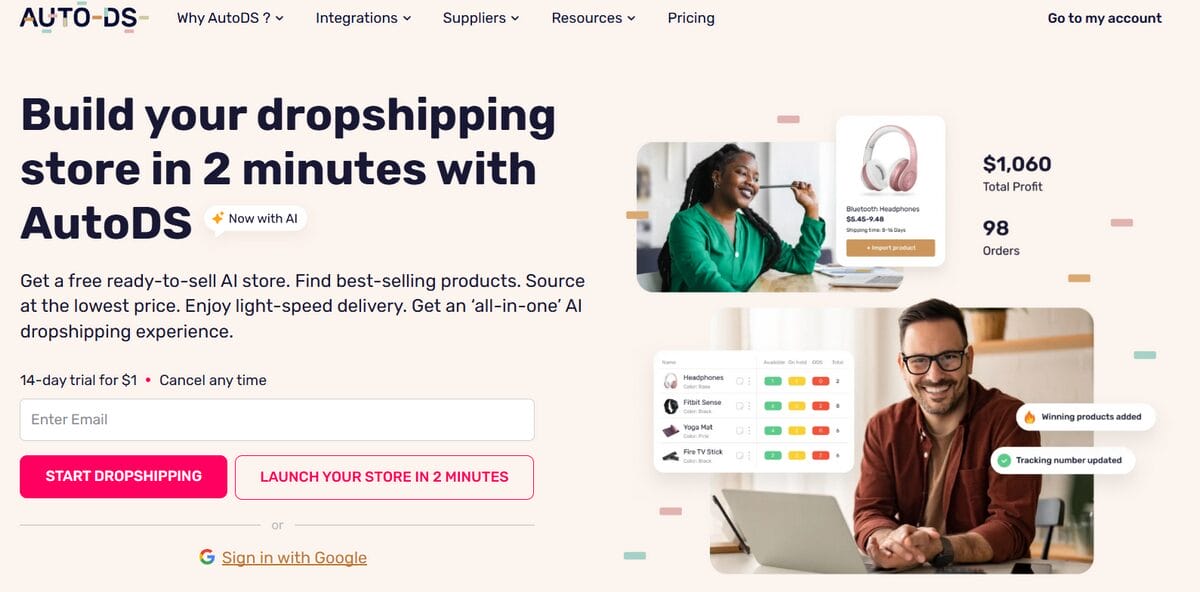
The biggest obstacle to consistently executing a marketing plan is the behind-the-scenes work. Finding winning products, testing them before committing budget, tracking performance, and making sure orders go out smoothly: all of that takes time that would otherwise go toward marketing.
That’s the problem platforms like AutoDS solve from the ground up. AutoDS handles that infrastructure, so by the time you’re ready to execute, the foundation is already in place.
In practice, that looks like this:
- Fulfilled by AutoDS: AutoDS manages end-to-end order processing automatically, with no manual intervention required. The hours that used to go into placing orders now go into building email flows, testing ad creatives, or publishing content.
- Product Research Tools: AutoDS lets you browse a marketplace of top products, curated picks, and up-to-date trends. This means you can choose products based on real demand, not just guesses. It also helps shape your content and ad strategy, since you know what people want before you start promoting.
- Ads Spy Tools: AutoDS surfaces top-performing ads on major social media platforms, so you can spot trends before they peak and understand what creative is actually converting.
- AI-Powered Tools: From SEO-optimized titles and descriptions to conversion-ready pages, AutoDS provides AI features that ensure your store is structured for search and built to convert, before you’ve run a single campaign.
Together, these features create the operational conditions for your marketing plan to actually work.



Frequently Asked Questions
What is the difference between digital marketing & e-commerce?
Digital marketing is the set of online tactics used to reach and persuade customers, while e-commerce is the actual infrastructure for selling products online. Put simply, digital marketing is what drives traffic and demand to an e-commerce store, not a separate business model.
What is the best digital marketing strategy for a new online store?
The best digital marketing strategy for a new store is email capture combined with SEO-optimized product pages. It gives you the fastest path to owned traffic without a big budget. Paid ads can validate a product faster, but without a retention mechanism, you pay for every customer twice.
How much should I budget for e-commerce marketing?
It depends. New stores typically need to allocate 15–20% of revenue to e-commerce marketing to build enough traction to optimize from. Meanwhile, established stores often operate effectively at 7–12%. The right number is the one tied to a specific CAC target, not an arbitrary percentage.
Does digital marketing work for dropshipping stores?
Yes, digital marketing works for dropshipping stores. However, the constraint changes. Because dropshipping margins are thinner, channels with lower CAC and stronger retention ROI (email, SEO, content) tend to outperform pure paid acquisition at scale.
What KPIs should I track for e-commerce marketing?
For e-commerce marketing, track CAC, CLV, AOV, conversion rate, and cart abandonment rate as your core set. Together, they tell you whether you are acquiring the right customers, keeping them, and extracting full value from each transaction.
Start Marketing Smarter, Not Harder
Stores that win in e-commerce combine marketing execution with operational efficiency. Every hour spent manually placing orders, tracking inventory, or correcting fulfillment errors is an hour not spent building SEO content, optimizing email flows, or testing ad creative.
AutoDS ties the operational side together: AI-powered product sourcing, automated fulfillment, real-time price and stock monitoring, and a product research marketplace covering millions of trending items. When your backend runs itself, your time goes where it actually moves the number.
The strategies presented in this guide consistently prove their effectiveness. The question is whether you have the bandwidth to execute them consistently. The answer? Automation.
👨💻 You can start your trial with AutoDS for $1, test winning products with AutoDS and build the marketing strategy your store actually has time to run.
Continue your learning journey! These reads can help you make the next move: