


If you’re managing an Amazon dropshipping business, you probably already know this: with so many moving parts, it can get complicated fast. You’re researching products, tracking prices and stock, managing orders, watching margins, optimizing listings, and so on.
You can go full Superman and try to handle everything yourself. Or you can assemble your own Avengers-style team (and make your life easier) with specialized tools taking care of different parts of the workflow, letting each one handle what it does best.
In this guide, I’ll share the best Amazon dropshipping software for 2026 and what each tool is actually good at, from automation and product research to competitor analysis, marketing, analytics, and keywords.
For example, AutoDS integrates with Amazon to automate dropshipping operations, AMZScout helps you research products, and Seller Labs focuses on Amazon marketing. And those are just a few examples. I’ll cover more tools for each part of the workflow throughout this guide.
Amazon dropshipping software can help with much more than automation, including product research, competitor analysis, marketing, analytics, and keyword research.
You don’t need every tool at once. Start with the biggest weakness in your workflow and build your stack around that.
Free tools can be enough for basic research, but paid platforms become more valuable as your catalog, order volume, and data needs grow.
AutoDS stands out as an all-in-one option because it combines automation, product management, monitoring, order tools, analytics, and research in one platform.
What Is Amazon Dropshipping Software?
Let’s start from the basics: what is dropshipping software, and why is it relevant in the first place?
Amazon dropshipping software is any tool that helps sellers manage, automate, or improve some part of their workflow when dropshipping on Amazon. Depending on the platform, that can mean finding products, monitoring stock and prices, importing listings, processing orders, tracking profit, researching keywords, analyzing competitors, or managing marketing.
Think of each tool as a different superhero on your team: they all have their own powers, and each one is better suited to a different mission.
Now, the word “software” is a broad category. It isn’t one single type of tool for one specific task. Some platforms are built for end-to-end automation, while others solve one specific problem extremely well. As you’d imagine, a product research tool, for example, won’t manage your orders, and an analytics dashboard won’t necessarily help you source products.
That’s why it makes more sense to think of these tools as a tech stack. You choose the software based on which parts of your operation need the most support, then combine tools where necessary instead of looking for one platform to do it all.
The goal is simple: to reduce repetitive manual work, get better data, and make it easier to manage your store without losing visibility over what’s actually happening.
What You Can (and Shouldn’t) Automate
Now, when you start looking for software, you’ll come across thousands of options. And yes, it might be tempting to automate everything and think the whole business can run on its own. Sounds too good to be true? Well, it is.
The truth is, automation works best when you give software the repetitive, rules-based tasks and keep the decisions that require context, judgment, accountability, and empathy for yourself.
Here’s what you can (and should) automate:
- Order fulfillment: Routing orders to your supplier and updating fulfillment information.
- Inventory syncing: Keeping listings aligned with supplier stock so you’re not selling products that have disappeared overnight.
- Price monitoring: Tracking supplier price changes and adjusting your pricing rules accordingly.
- Tracking updates: Syncing shipment and tracking information once an order is on its way.
- Product research: The final decision should still be yours, but software can automate a big part of the research process by pulling real-time market data on demand, competition, pricing, sales trends, and product performance.
- Analytics: And hopefully you’re not still tracking performance in notebooks and spreadsheets. Analytics tools can automatically pull together sales, profit, fees, traffic, and product performance so you can see what’s working without updating everything by hand.
Then there are the jobs where you probably don’t want to put the robots fully in charge:
- Customer service judgment calls: Automation can answer routine questions, but refunds, complaints, unusual requests, and unhappy customers often need an actual human.
- Policy-related tasks: You’re still responsible for making sure orders comply with Amazon’s dropshipping policy, including being identified as the seller of record and ensuring another retailer or supplier doesn’t appear on packing slips, invoices, or external packaging.
- Supplier vetting: Software can surface data, but it can’t fully judge whether a supplier is reliable, consistent, and actually suitable for your business.
- Business strategy: Tools can tell you what’s happening. Deciding what to sell, where to compete, and when to change direction is still your job.
Knowing what to automate and where to intervene yourself is part of your strategy. Specifically on Amazon, that distinction is important: automation doesn’t eliminate compliance.
💡 Pro Tip: Amazon allows dropshipping when its requirements are met, but you remain responsible for the customer experience, returns, your suppliers, and following Amazon’s policies. And that’s where you, and your judgment, step in.
Think of automation more like autopilot on a plane, not a fully self-driving system. Would you jump on a plane with no human pilot at all? Probably not. Same for your business.
Best Amazon Dropshipping Software at a Glance
Before we zoom in on each tool, here’s a quick overview of the tools I’ll cover:
| Tool | Best For | Starting Price (billed monthly) | Free Trial |
|---|---|---|---|
| AutoDS | All-in-one Amazon dropshipping automation | $64.90/month (Import plan) for Amazon-specific features | $1 trial |
| Jungle Scout | Amazon product research and market validation | $49/month | No — 7-day money-back guarantee |
| AliExpress Dropshipping Center | Free secondary product and supplier research | Free | Free tool |
| Helium 10 | Advanced Amazon research plus a broader seller toolkit | Platinum from $129/month | No |
| AMZScout | Amazon dropshippers and resellers using data and AI for product research | $59.99/month | Only 5 free searches |
| AliInsider | AliExpress product and competitor spying as a second research layer | Premium from $19.95/month | Free plan available |
| Dropship Spy | Competitive intelligence and product spying | $29/month | No |
| Google Lens | Quick visual product, competitor, and sourcing searches | Free | Free tool |
| Seller Labs | Amazon PPC, reviews, and seller feedback | Free for eligible smaller sellers (up to 2K in monthly revenue), then starts at $19.99/month. | Yes — 14 days |
| Brevo | Email and multichannel marketing outside Amazon | Limited free plan; Starter from $9/month | Free plan available |
| SellerBoard | Amazon profit and performance analytics | $19/month | Yes — 1 month |
| Google Analytics | Tracking off-Amazon traffic and website behavior | Free | Free tool |
| SellerApp | Amazon keyword research and rank tracking | Limited free plan; Pro from $99/month | Free plan available |
Amazon Dropshipping Automation Software
If we’re assembling the ultimate Amazon dropshipping superhero team, we need to start with the one keeping the tech, systems, and day-to-day operations under control. I’m talking about automation software, which in this scenario would be something like… Iron Man.
These tools typically handle the repetitive operational work behind the scenes, from monitoring stock and prices to managing listings and helping process orders, so the rest of your tech stack can focus on more specialized missions.
AutoDS
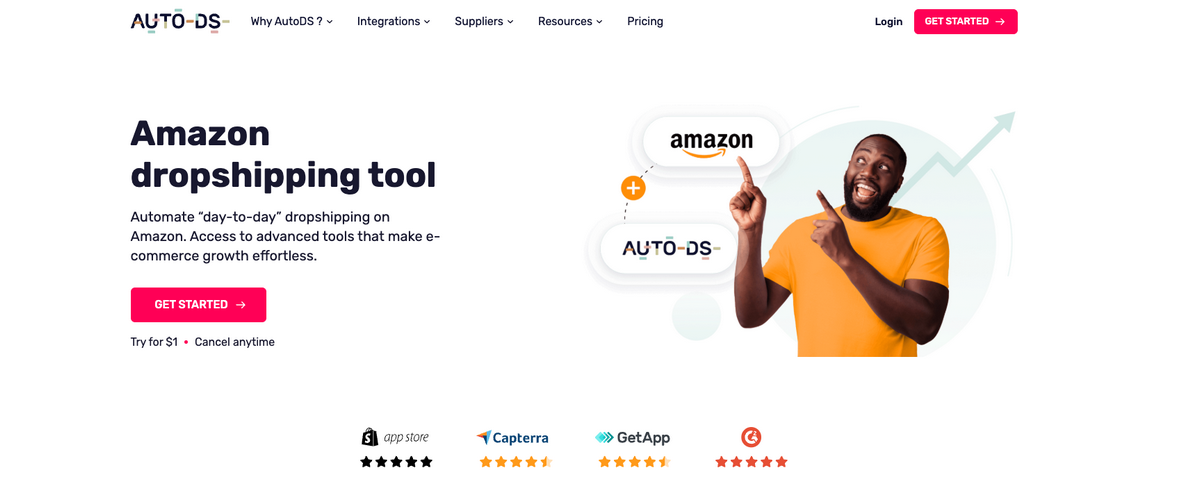
AutoDS is an all-in-one dropshipping automation platform that integrates directly with Amazon, making it a strong option if you want to manage most of your day-to-day operations from one dashboard.
Once your store is connected, the AutoDS to Amazon workflow helps you with:
- Product research and discovery: AutoDS also includes product-finding tools and a marketplace for spotting products, checking supplier details, and importing them into your workflow.
- Product importing and listing management: Add products, edit details, manage pricing, stock, descriptions, and monitoring settings from AutoDS.
- Fulfilled by AutoDS: AutoDS can place orders through its own managed buyer accounts, handle returns, and reduce the need to maintain separate supplier accounts, helping you stay compliant with Amazon.
- Price and stock monitoring: Track supplier changes automatically and update your listings when prices or availability change, which can help reduce overselling and margin surprises.
- AI tools: Use AI to improve titles and descriptions, generate product-page content, and create marketing assets without jumping into a separate AI tool every time.
- Multi-store management: If Amazon isn’t your only channel, AutoDS can also centralize multiple supported stores and marketplaces under the same account.
This is exactly the kind of repetitive work that our Iron Man metaphor comes here to save you from, especially as your catalog grows. Think about it: checking whether 10 products are still in stock? Manageable. But doing it across hundreds of listings every day? That’s your origin story for burnout.
That’s exactly where AutoDS stands out from many of the other tools on this list. Most of them specialize in one job: research, analytics, keywords, marketing, or spying on competitors.
AutoDS covers the dropshipping workflow end-to-end from a single platform, so you may not need to stack as many separate subscriptions to keep your store running. You can still add specialized tools when you want deeper data in a particular area, but the core operation can live in one place.
You can try this with the AutoDS $1 trial. Just create your account, pick your plan, enable the Amazon integration (it takes a couple of minutes, max), and see how all the features work together. Then, pricing starts at $64.90/month (billed monthly) for Amazon-specific features (or $26.60/month for other selling channels).
🏆 Best For: Dropshippers looking to centralize their operations in one place and automate repetitive tasks to scale.
Amazon Product Research Software
Next: software for Amazon product research. In our superhero lineup, this would be Doctor Strange. The metaphor here is pretty straightforward: before you launch a product, it helps to have someone looking at all the possible outcomes first.
These tools help you assess demand, competition, sales estimates, pricing, trends, and potential profitability before committing to a product. They won’t literally tell you which of the 14,000,605 possible futures makes you rich, but they can help you find the best things to sell on Amazon based on real market data (instead of guesswork).
Here are some of the best options.
Jungle Scout
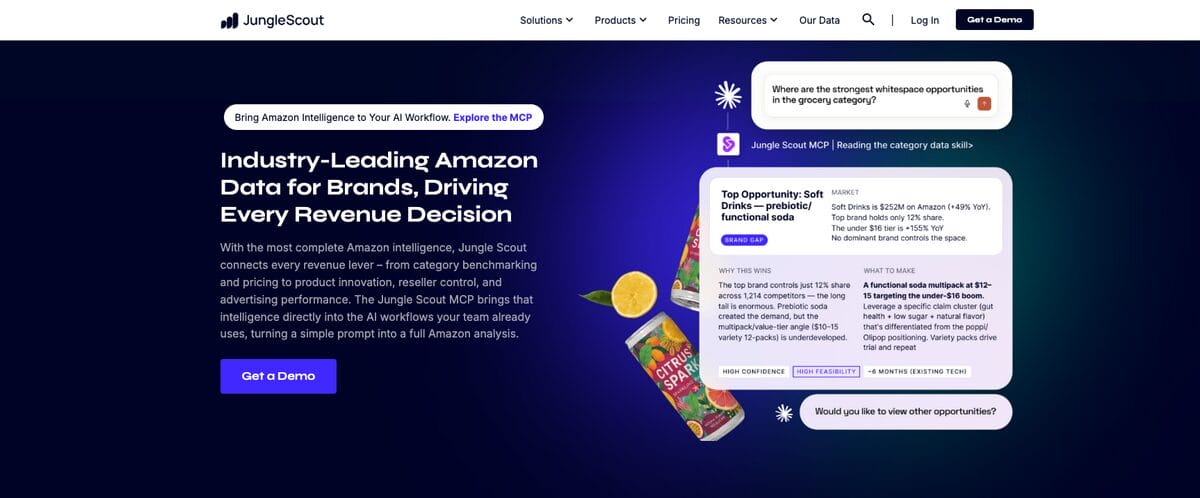
Jungle Scout is one of the best-known Amazon research platforms, with a toolset built specifically around Amazon marketplace data. Its product research features include the Product Database, Opportunity Finder, Product Tracker, Category Trends, and sales estimation tools, so you can move from a broad idea to a much more data-backed shortlist.
For dropshippers, its biggest strength is market validation. You can research niches, estimate demand, assess competition, track products over time, and compare opportunities before deciding what deserves a place in your catalog.
Pricing starts at $49/month (billed monthly) for the Starter plan in the Jungle Scout Catalyst model, the version built for individual and growing Amazon sellers. Cobalt is the enterprise product for larger brands and agencies, with deeper market and competitive data, so Catalyst is the more relevant option for dropshippers.
🏆 Best For: Amazon sellers who want deep Amazon-specific market and product data before choosing what to sell.
AliExpress Dropshipping Center
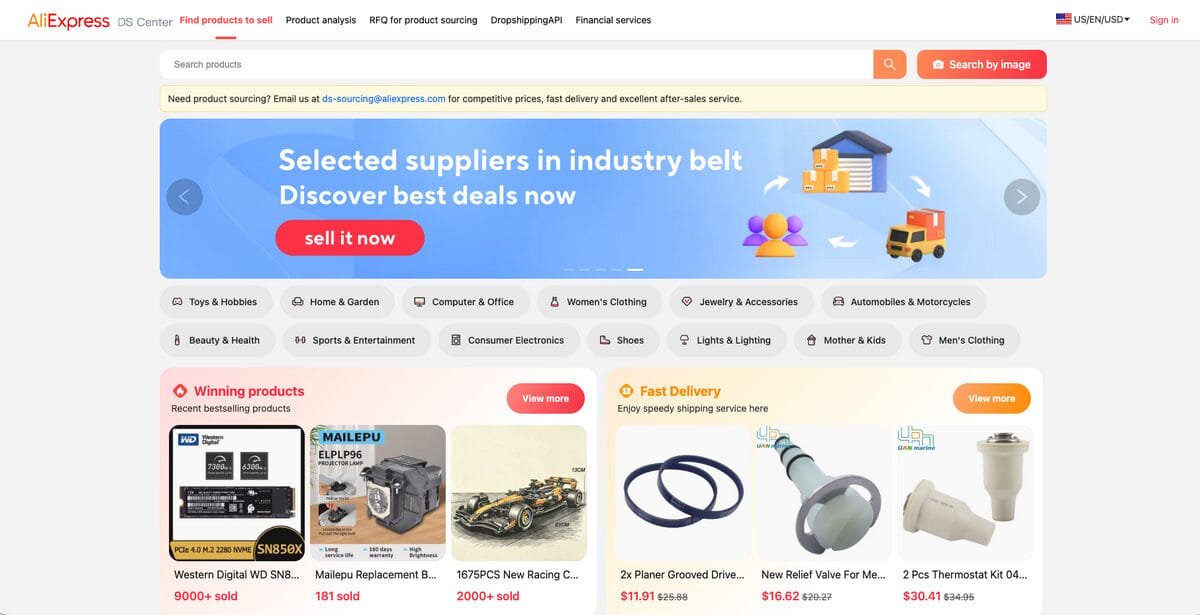
Another player in this category is the AliExpress Dropshipping Center, which approaches research from the other side of the equation: instead of showing you what’s happening on Amazon, it helps you investigate products and suppliers available specifically through AliExpress.
Its tools let you search for products using filters such as category, price, shipping conditions, and warehouse location, and then analyze individual listings using sales volume trends. That makes it useful for seeing whether a potential supplier-side product is actually getting traction before you decide to test it.
For Amazon dropshipping, I’d treat it as a second layer of research for a very simple reason: something selling well on AliExpress doesn’t automatically mean there’s demand for it on Amazon, but it still gives you a broader idea of what’s happening in the market. Something with rising demand on AliExpress can definitely give you a few hints of what can sell well on Amazon, but it isn’t the most definitive data.
Having said that, the AliExpress Dropshipping Center is free to use. There are no paid plans, which makes it particularly useful as an extra research layer alongside your Amazon-specific tools.
🏆 Best For: Dropshippers who want an alternate free way to research products while also pairing it with Amazon-specific data.
Helium 10
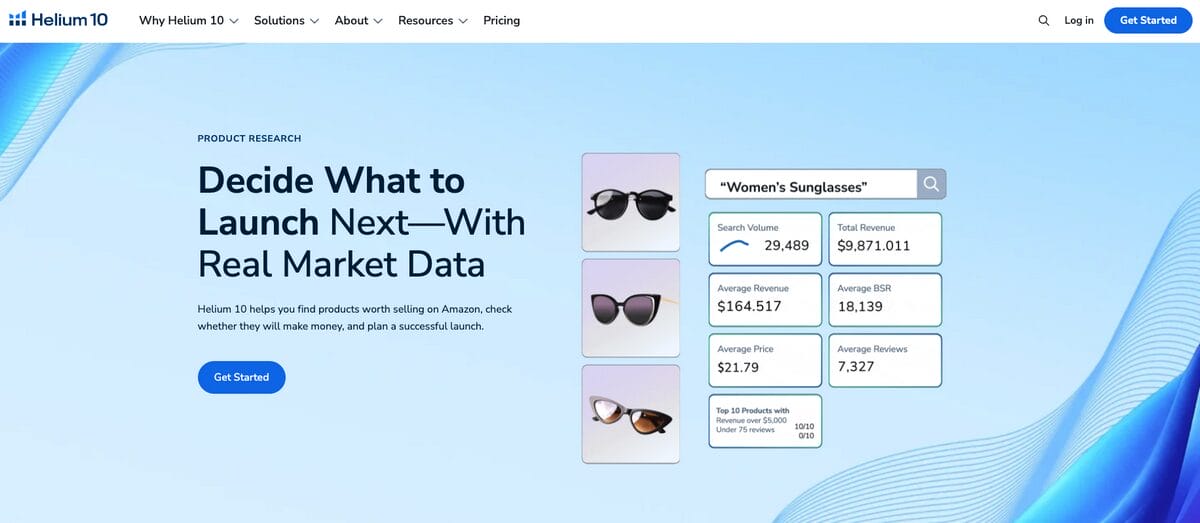
Helium 10 is less of a single research tool and more of a full Amazon seller suite, but product research is one of its strongest areas.
Its Black Box tool lets you filter millions of product listings using criteria such as price, sales, revenue, reviews, competition, and category. Then there’s Xray, a browser extension, which overlays estimated sales, revenue, pricing, competitor data, and other market signals directly onto Amazon search results.
Helium 10 also includes keyword research, listing optimization, analytics, advertising, and other Amazon seller tools to help you with marketing and paid and organic traffic.
That’s why Helium 10 is considerably pricier than other tools: its Platinum plan costs $129/month (billed monthly), while Diamond costs $359/month. So, it makes the most sense if you’re planning to use more of the suite beyond product research alone.
🏆 Best For: Sellers who want advanced Amazon product research as part of a larger Amazon-focused software suite.
AMZScout
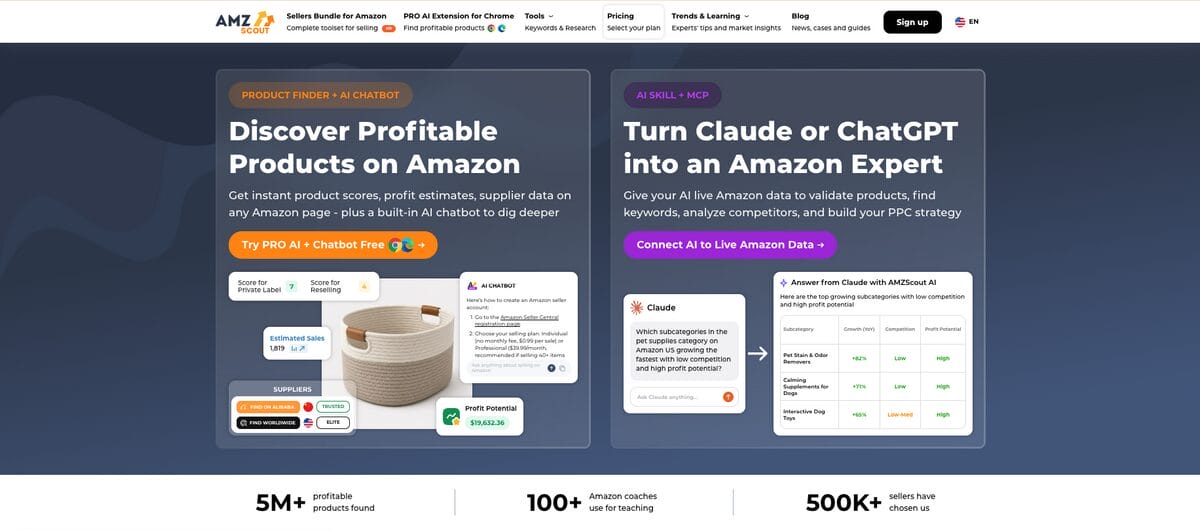
AMZScout is another Amazon-focused research platform, especially built for dropshipping, arbitrage, and wholesale sellers.
Its main research tools include the Product Database, PRO AI Extension, and Product Tracker. Together, they help you find product ideas, assess demand and competition, review sales and price history, monitor competing products, and explore sourcing options. The PRO AI Extension also adds an AI layer that helps you spot potential risks and opportunities faster.
AMZScout has also been adding more AI features in 2026, including a built-in research chatbot and an MCP connector that lets compatible AI tools pull from its Amazon data. If AI is already part of how you research products, that can be a pretty useful extra.
AMZScout’s current AI Bundle starts at $59.99 for one month, with a three-month option at $169.99 and a 12-month plan at $399.99. All three include their core product research tools, including the PRO AI Extension.
🏆 Best For: Amazon dropshippers who want product research tools with features specifically for reselling models, and for anyone bringing AI deeper into their research workflow.
Amazon Dropshipping Spy Software
Of course, every superhero team needs someone who knows what everyone else is up to, the sneaky one gathering intel behind the scenes. In our lineup, that’s Black Widow.
Or in dropshipping terms, Amazon dropshipping spy software: tools that help you look beyond your own store and see what products are getting attention, where they’re being sold, what competitors are doing, and where there might still be room to enter the market. Think less actual espionage, and more smart online detective work.
Dropship Spy
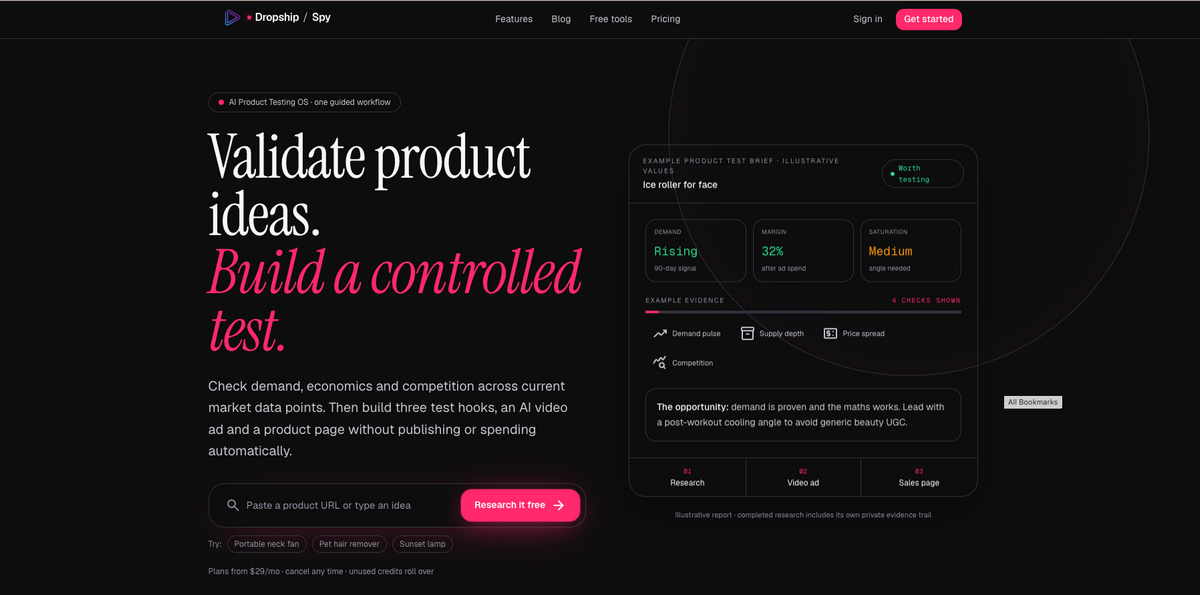
Dropship Spy is built around one very useful idea: before you sell a product, see what everyone else is already doing with it.
Its spy-style tools help you look at competition, pricing, current demand, saturation, buyer intent, and how a product is already being positioned online. That gives you a clearer picture of whether you’re spotting an opportunity or arriving after the whole internet has already left the party and turned off the lights.
For Amazon sellers, it works best as an additional competitive intelligence layer. You can use it to assess a product idea, analyze market saturation, and confirm the opportunity with Amazon-specific tools before listing it.
Pricing starts at $29/month (billed monthly), with higher tiers available depending on how many credits and AI features you need.
🏆 Best For: Sellers who want to spy on the market before jumping into it, rather than choosing products in a vacuum.
AliInsider
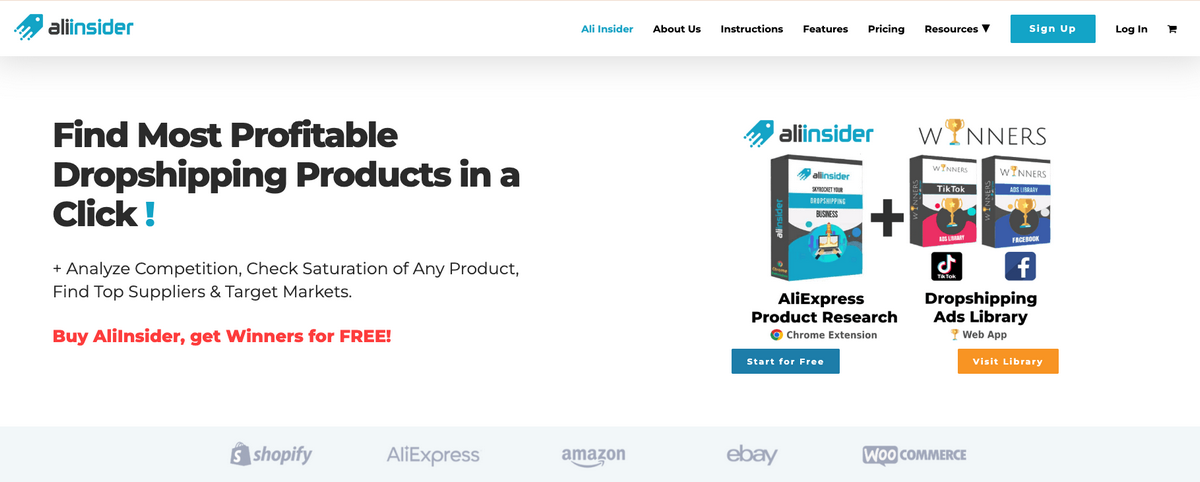
AliInsider is a spy and product research tool built around AliExpress products, but it also has features specifically useful for Amazon competitor research.
Its Chrome Extension lets you analyze products directly on AliExpress, check sales data, find suppliers, track products, and spot fast-growing items. More importantly for this list, its Competition Insider shows you which sellers are already offering the same product on Amazon, Shopify, and eBay, along with details like pricing, product descriptions, and when they started selling it.
So, while the product and supplier data still come mainly from AliExpress, AliInsider can work as a useful bridge between AliExpress sourcing and Amazon competitor research. You can spot a promising product, then immediately see how crowded the Amazon side of the market already is.
There’s a free version, while the Premium plan is currently listed at $19.95/month.
🏆 Best For: Sellers who source from AliExpress and want extra clues about products, suppliers, and competition before validating those ideas on Amazon.
Google Lens

And then there’s Google Lens, which proves your superhero gadgets don’t always need a monthly subscription (yes, it’s free to use!).
Just upload a product image or take a screenshot, and Google Lens can find visually similar products across the web. For dropshippers, that makes it surprisingly handy for finding other sellers carrying the same item, comparing prices, identifying possible suppliers, and seeing how widely a product is already being sold.
Google has also expanded Lens’ shopping features, so results can include product details, prices across different retailers, reviews, deals, and places to buy the item.
For Amazon research, the workflow is pretty simple: see an interesting product or competitor listing, run the image through Lens, and find out where else that exact (or very similar) item appears online. It won’t give you a deep Amazon sales estimate, but it’s excellent for spying.
🏆 Best For: Sellers who want a fast, free way to investigate products across the wider web before bringing in more specialized tools.
Amazon Dropshipping Marketing Software
Every superhero team needs someone who can handle the PR side of things: someone who can win people over and make sure you’re not accidentally coming across as the villain of the story. In our lineup, that’s Star-Lord: charismatic, a little chaotic, and very good at turning a group of misfits into something people want to be part of.
That’s basically what good Amazon dropshipping marketing software does, too. It helps you attract attention, build relationships with your audience, and give people a reason to keep coming back.
Here are the best tools to help your business get more traffic, reach the right audience, and turn that attention into sales.
Seller Labs
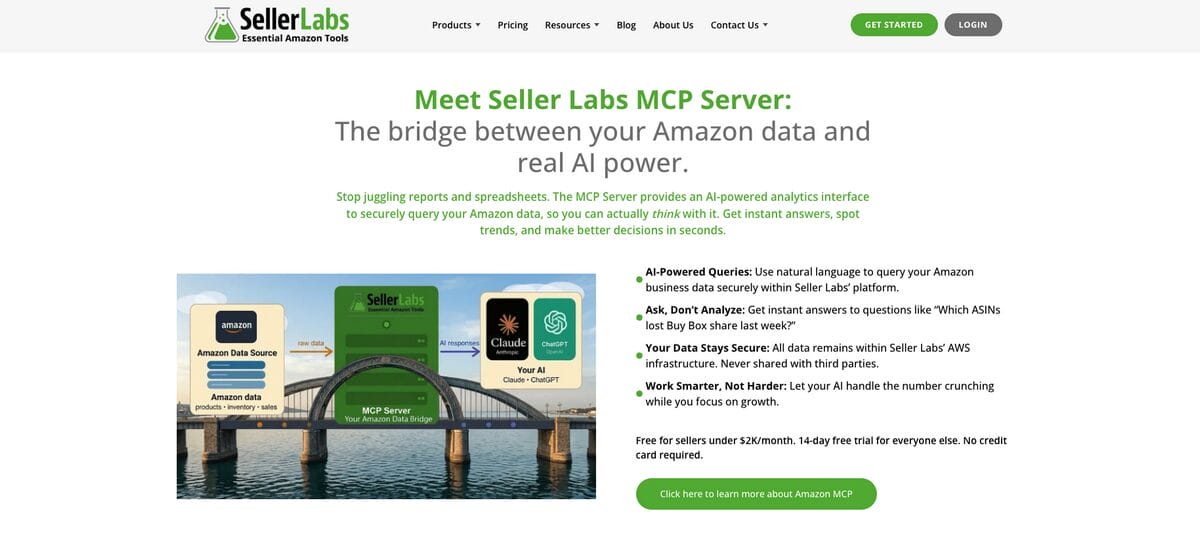
Seller Labs is built specifically for Amazon sellers, which makes it one of the most relevant tools in this category.
Its marketing side is mainly split between Ad Genius and Feedback Genius. The first one helps you manage Amazon PPC campaigns, spot optimization opportunities, and improve ad scheduling. Feedback Genius, on the other hand, focuses on reviews and seller feedback, with automated review requests and tools to track what customers are saying about your products.
Seller Labs also offers Profit Genius for analytics, and you can bundle all three together if you want the full package without paying for each one separately.
Pricing is based on your Amazon revenue. Seller Labs is currently free for your first $30,000 in Amazon sales while your monthly revenue stays under $2,000, then moves into paid tiers as your store grows, starting at $19.99/month. There’s also a 14-day free trial.
🏆 Best For: Sellers and marketers who want Amazon-specific marketing tools, especially for PPC campaigns, reviews, and seller feedback.
Brevo
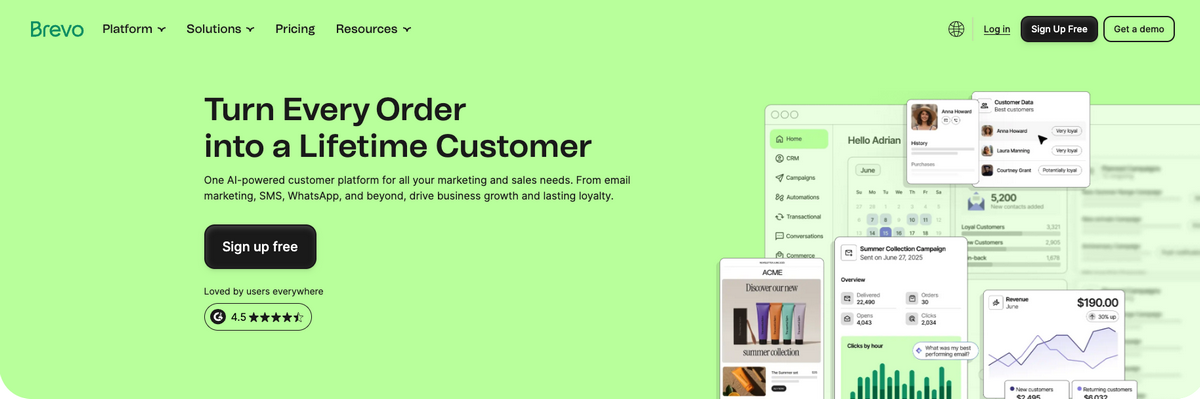
Brevo, formerly known as Sendinblue, takes a very different approach. It isn’t built specifically for Amazon. Instead, it’s a broader marketing platform for email, SMS, WhatsApp, automation, landing pages, and customer relationship management.
For Amazon dropshippers, Brevo makes the most sense when you’re also building an audience outside Amazon. For example, through your own website, newsletter, landing pages, social campaigns, or another channel where customers have actually opted in to hear from you.
That last part matters. You shouldn’t export Amazon buyer information and start dropping people into a Brevo campaign. Amazon only allows seller messages that are needed to complete an order or to answer customer service questions, not promotional emails.
Brevo has a free plan with up to 300 email sends per day. Paid marketing plans currently start at $9/month for Starter and $18/month for Standard (both billed monthly), with pricing increasing based on your email volume and contact needs.
🏆 Best For: Sellers who want to build a marketing engine beyond Amazon, especially through email and multi-channel campaigns.
Amazon Dropshipping Analytics Software
At some point, every superhero team needs someone who can look at everything that’s happening and make sense of it. I’m talking about Vision: calm, analytical, and usually looking at the bigger picture.
Amazon dropshipping analytics software gives you that clearer view of your business: what’s selling, what’s actually making money, where your costs are going, and which parts of your strategy need work. Because a store can look busy and still lose money in the background if fees and expenses eat into your margins.
Here are two tools that can help you keep an eye on the numbers.
SellerBoard
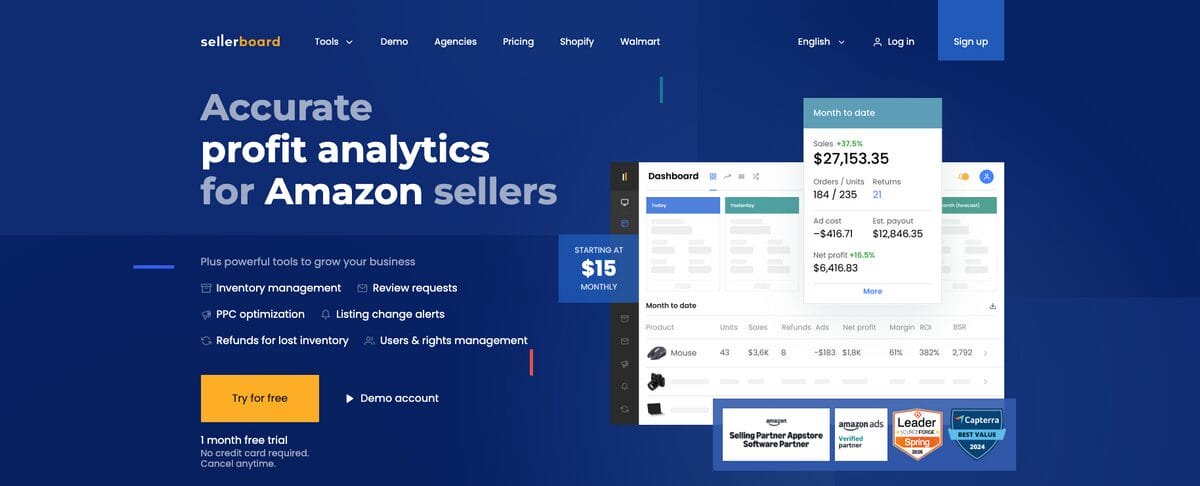
SellerBoard is built specifically for Amazon sellers and focuses heavily on one thing: knowing your real profit, not just your sales.
Its Profit Dashboard pulls together Amazon fees, ad spend, refunds, shipping costs, taxes, and COGS (cost of goods sold) so you can see what you’re actually earning (and spending). You can break that down by account, product, or even individual order, which makes it much easier to spot products that sell well but leave you with barely any margin.
It also includes PPC analytics, inventory tracking, refund data, listing alerts, automated reports, and customizable dashboards. SellerBoard has kept adding features in 2026, too, including better P&L views and Amazon Attribution data for tracking how external marketing turns into Amazon sales.
Pricing starts at $19/month (billed monthly) for the Standard plan. There’s also a one-month free trial with no credit card required.
🏆 Best For: Amazon sellers who want a clear, straightforward way to know if they’re actually making money.
Google Analytics
Google Analytics is a different kind of tool. It won’t show you what’s happening inside your Amazon Seller account, so don’t treat it as a replacement for something like SellerBoard.
Where it becomes useful is outside Amazon. If you’re sending people to Amazon from your own website, blog, landing pages, or other marketing channels, Google Analytics can show you where that traffic comes from, what people do on your site, and which pages or campaigns are getting attention.
For sellers who also run their own e-commerce site, GA4 can go deeper by tracking product views, add-to-cart actions, purchases, and checkout behavior once e-commerce events are set up.
The standard version of Google Analytics is free, which makes it an easy tool to add if you’re building traffic outside Amazon, too.
🏆 Best For: Sellers who want to understand the traffic and customer behavior happening around their Amazon business, not the marketplace numbers inside Amazon itself.
Amazon Keyword Research Tool
Last member of our superhero team for Amazon dropshipping? Hawkeye! Keyword research is all about precision: knowing exactly what to aim for, rather than throwing keywords at your listing and hoping something hits.
Amazon keyword research tools help you find what Amazon shoppers are actually searching for, see which terms are worth targeting, and understand where your competitors are already getting visibility. In other words, they help you take a much better shot at showing up in the right searches.
SellerApp
SellerApp is an Amazon-focused platform with a pretty complete set of keyword tools. Its Keyword Research feature helps you find relevant search terms and view metrics such as search volume and relevance, while Reverse ASIN lets you see the keywords competing products are ranking for.
You can also track keyword rankings over time, check whether Amazon is indexing your products for important terms, and use the data to improve both your listings and PPC campaigns. That makes it useful beyond simply building a giant keyword list and hoping for the best.
For pricing, SellerApp’s current pricing page lists its Pro plan starting at $99/month (billed monthly), while the Smart Plan with Automation starts at $149/month. There are also free Amazon keyword tools available if you only need basic research.
🏆 Best For: Sellers who want to understand how people search on Amazon, which keywords their competitors are using, and where their own products are showing up in the results.
How to Choose the Right Tool for Your Store
So, what’s the ultimate right tool for your business? Sorry to disappoint, but the truth is, the “best” tool really depends on what’s slowing you down right now. A huge software stack won’t help if you’re solving the wrong problem.
That said, there are a few patterns that can guide you and give you an idea of where to start. Here’s a cheat sheet for you to assess what’s actually worth it for your business, depending on where you’re at right now:
👉 If you’re just starting out: Try AliExpress Dropshipping Center and Google Lens first. Both are free and useful for basic product and competitor research before you start paying for more advanced tools.
👉 If stockouts and price changes are costing you sales: Go with AutoDS. Its price and stock monitoring feature can take a lot of that manual checking off your plate.
👉 If product research is your biggest struggle: Jungle Scout, Helium 10, AMZScout, and AutoDS are the strongest picks for Amazon-specific data and product validation.
👉 If you want to spy on competitors: AliInsider is useful for seeing how AliExpress products are already being sold on Amazon, while Dropship Spy adds a broader competitive-research layer.
👉 If you’re running multiple stores or channels: AutoDS makes the most sense because it can manage several supported stores from the same platform (and not just Amazon, but eBay, Etsy, Shopify, and other channels as well).
👉 If you’re getting traffic but don’t know what’s actually profitable: Use SellerBoard for Amazon-specific profit analytics and Google Analytics for traffic coming from outside Amazon.
👉 If your listings aren’t getting enough visibility: SellerApp can help with Amazon keyword research, rankings, and competitor keywords.
👉 If marketing is your weak spot: SellerLabs is the better fit for Amazon PPC and review management, while Brevo works better for email and audience-building outside Amazon.
In most cases, you don’t need every tool on this list. Start with the biggest bottleneck in your store, fix that first, and build the rest of your stack from there.
Frequently Asked Questions
Is it possible to automate Amazon dropshipping?
Yes, you can automate Amazon dropshipping with tasks such as price and stock monitoring, listing updates, order processing, and inventory management using Amazon-compatible dropshipping software. Still, some things (like supplier vetting, strategy, customer service judgment calls, and policy compliance) should stay under your control.
Which Amazon dropshipping software is best?
The best Amazon dropshipping software depends on what you need. AutoDS is a strong all-in-one option for automation and store management, while tools like Jungle Scout, Helium 10, and AMZScout go deeper into Amazon product research. For analytics, SellerBoard is a better fit, while SellerApp focuses more on keyword research.
Is Amazon dropshipping profitable in 2026?
Yes, Amazon dropshipping can still be profitable in 2026, but profitability depends on your products, supplier costs, Amazon fees, competition, shipping, and pricing strategy. The key is looking at your real margins rather than assuming that high sales automatically mean high profit.
Is dropshipping software safe to use with Amazon’s policies?
Yes, dropshipping software can be used with Amazon, as long as your use complies with Amazon’s dropshipping policies. Amazon requires you to be the seller of record and prevents shipments from identifying another retailer or supplier on invoices, packing slips, or external packaging. You’re also responsible for returns and the overall customer experience. Automation can help you run the workflow, but it doesn’t automate away your responsibility for compliance.
How much does Amazon dropshipping software typically cost?
Amazon dropshipping software costs vary. Some tools on this list are completely free, while specialized paid tools often start around $15–$60 per month, and more advanced Amazon suites can cost $100+ per month. Your total cost really depends on whether you use one all-in-one platform or stack several specialized tools.
Can I use free tools to start Amazon dropshipping?
Yes, you can use free tools to dropship on Amazon. Tools like Google Lens, AliExpress Dropshipping Center, and the free versions of some research platforms can help you start researching products and competitors without adding another monthly bill immediately. As your store grows, paid automation and analytics software usually become more useful because they can save you time and handle larger catalogs.
What’s the difference between dropshipping automation and product research software?
Dropshipping automation software runs parts of your store, such as monitoring prices and stock, managing listings, or processing orders. Product research software specifically helps you find products to sell by analyzing things like demand, competition, sales estimates, trends, and pricing. In other words, dropshipping software covers more ground, while a product research tool specializes in that single area.
Do I need more than one dropshipping tool to run my store?
No, you don’t necessarily need multiple tools to run a store. An all-in-one platform like AutoDS can cover a large part of the dropshipping workflow, so you may not need several separate subscriptions just to manage your store. You might still add specialized tools if you want deeper Amazon product research, keyword data, advertising insights, or analytics. Start with what you actually need instead of collecting software subscriptions like Infinity Stones.
Activate Your Superpowers With Amazon Dropshipping Software
What I want you to get from this article is this: the best Amazon dropshipping software isn’t the most sophisticated one, but the one that actually solves the biggest problem in your workflow. That can be product research, automation, analytics, marketing, keyword research, or maybe something else you’re spotting.
So, a tip? Start with the bottlenecks that are costing you the most money and energy right now, then build your stack from there. You don’t need every superhero on day one, just the one best equipped to take down your biggest villain 😉.
And if you want one platform to handle a bigger share of the operation, AutoDS is the closest thing to your team’s command center. It brings together product importing, price and stock monitoring, order management, pricing rules, analytics, research tools, and automation in one place.
Before I leave, here are a few other reads you might find helpful if you’re starting your Amazon dropshipping journey: