





The first step to start selling print-on-demand products is choosing the right platform, since it determines your product quality, fulfillment speed, and overall profit margins.
Some platforms are better for beginners and ease of use, such as Printify and Gelato, with genuinely free plans and simple setup, while others are more suited for scaling, branding, or accessing niche product catalogs, such as Printful for brand consistency, Apliiq for private-label apparel branding, and Teelaunch or JetPrint for niche categories like jewelry and footwear that mainstream platforms don’t cover.
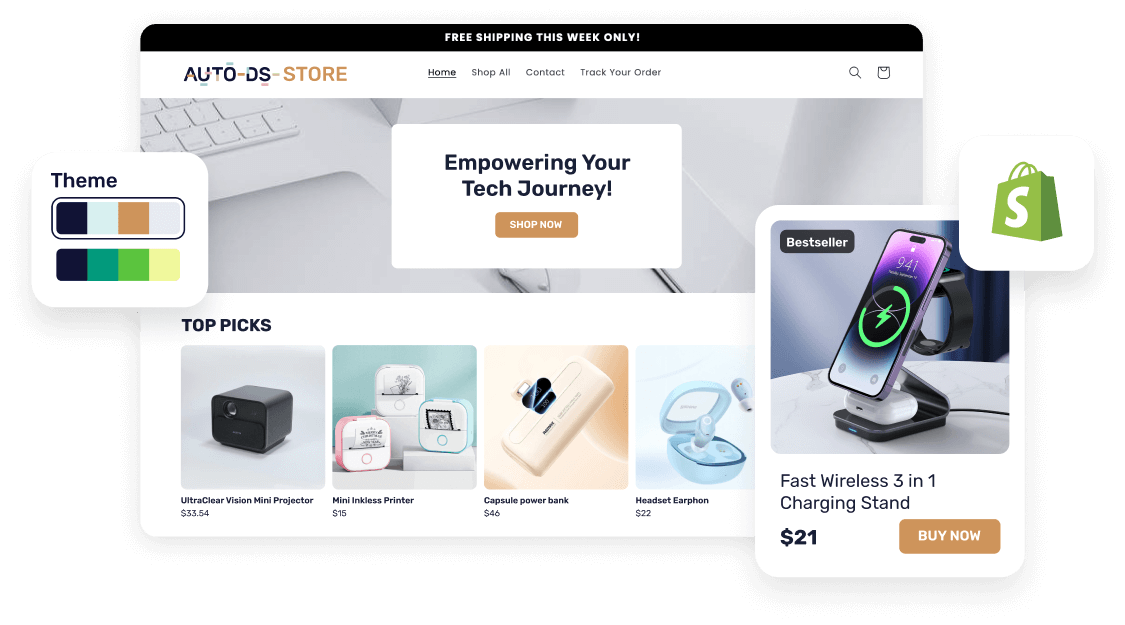
Others combine POD services with automation features to cover not just production and shipping, but also the entire workflow. For example, AutoDS helps sellers automate product importing, price and stock monitoring, order fulfillment, and tracking updates from one dashboard. This can be useful if you want to manage print-on-demand products alongside other dropshipping items without handling every task manually.
In this comprehensive guide, I’ll take you on a journey through the best print on demand sites that empower entrepreneurs to turn their creative visions into tangible products. From apparel to accessories, home decor, and more, these companies offer a wide array of customizable items ready to be adorned with your unique designs.
POD companies manage key aspects like product sourcing, printing, packaging, and shipping, eliminating inventory hassles.
Consider individual business goals, product categories, ease of use, and compatibility with existing ecommerce platforms when selecting a print on demand partner.
Choosing a Reliable POD Partner Involves quick shipping times, product quality, transparent pricing, favorable return policies, customization options, and platform integrations.
What Is A Print On Demand Company?
Print-on-demand (POD) is a modern e-commerce model where items are produced only after they’re ordered, eliminating the need for inventory storage. Entrepreneurs upload their designs to a POD platform, which then handles the printing, packaging, and shipping directly to customers. This approach allows us to offer custom-designed products without the upfront costs or logistical challenges of traditional manufacturing. Print-on-demand sites manage fulfillment and delivery services, freeing us to concentrate on creativity and business development.
In essence, print on demand works as a form of dropshipping, simplifying the entire process for entrepreneurs. We must create cool designs, set up our products, and sell them online. The nice part is that the print on demand company handles the tricky parts, like processing orders. This way, we can focus more on being creative.
In 2022, the print on demand market was worth about $5.4 billion, and it’s expected to reach $39 billion by 2031. That’s a really fast growth rate of 26.2% every year. So, this is definitely a great moment to dive into the POD world. In fact, print on demand lets us start an online store right from our homes. And for those of us who already have a business, adding print on demand can help us grow by offering new and unique products to attract more customers.
What To Look For In A Print On Demand Company
When we’re on the hunt for a reliable print on demand company, we should always keep a few crucial points in mind:
- Quick Shipping Times: Look for a company with fast shipping times. It’s crucial for customer satisfaction and keeps them coming back. Short shipping times also contribute to positive reviews, enhancing our business reputation.
- Product Quality: Opt for a provider that ensures top-notch quality. The better the quality of the products, the more satisfied our customers will be. Happy customers are more likely to become repeat customers and even brand ambassadors.
- Pricing: Understand the pricing structure of the company. Consider the base costs and additional fees and how they align with our budget. A transparent and reasonable pricing model contributes to better financial planning.
- Return Policies: Check the return policies. A good print on demand company should have fine and fair return policies, ensuring our customers and our protection in case of any issues.
- Product Variety and Customization: Assess the range of products they offer. Having a diverse catalog allows us to cater to different tastes and preferences. Customization options and various printing choices add versatility to our product offerings.
- Platform Integrations: Consider the ease of integrating their services with other platforms. Smooth integration improves our workflow, making managing our print on demand business easier. It’s crucial to look for companies that seamlessly integrate with popular e-commerce platforms, ensuring a hassle-free operation.
15 Best Print On Demand Sites
Without further ado, let’s explore the world of POD with a curated list of the 15 best print on demand sites. Here, we’ll introduce you to the top players in the POD game and delve into their critical unique features, pricing structures, shipping details, integration capabilities, product catalog offerings, and even some cons.
Whether you’re a seasoned entrepreneur or a budding creative looking to kickstart your online venture, this guide is a one-stop destination for navigating the landscape of print on demand. Let’s dive in and uncover the perfect platform for your journey!
Print On Demand Sites — Comparison Table
| Platform | Product Range | Production Time | Shipping (US domestic) | Pricing Tiers | Trustpilot |
|---|---|---|---|---|---|
| AutoDS (POD feature) | Continuously updated catalog (apparel, accessories, decor) bundled inside the AutoDS platform | Varies by product | Varies by product | POD is a feature inside AutoDS plans, starting at $26.90/mo ($1 trial available) | 4.8/5 Trustpilot (26,400+ reviews, platform-wide) |
| Printify | 1,300+ products | Varies by provider (2–7 business days) | 5–12 business days | Free tier available ($0); then starts at $39/mo. | 4.6/5 Trustpilot (7,400+ reviews) |
| Printful | ~370 products | 2–5 business days | 3–8 business days after production | No monthly fee — pay per order | 4.3/5 Trustpilot (7,700+ reviews) |
| Gelato | ~300 products | Varies by local hub | Often same-day-to-3-day (local production in 32 countries) | Free to join; Gelato+ at $29.99/month | 4.3/5 Trustpilot (3100+ reviews) |
| Merch by Amazon | Core apparel + accessories (t-shirts, hoodies, phone cases, PopSockets) | Amazon-managed | Prime-eligible (as fast as 2 days) | Free to join (invite-only); Amazon takes production cost + ~15% referral fee | N/A (royalty marketplace, not a storefront tool) |
| JetPrint | 400+ products | Standard 13–18 working days; Express 3–7 working days | Global, tiered by region | Free — pay per order | 3.0/5 Trustpilot (17 reviews) |
| CustomCat | Hundreds of products | ~2–6 business days (Economy) | 2–6 business days domestic | Pro Subscription $30/mo | 2.5/5 Trustpilot (14 reviews) |
| SPOD | ~200 products | 48 hours for 95% of orders | Order-value-based (e.g. t-shirt $3.57 first item / $1.50 each additional) | No monthly fee — pay per order | 2.6/5 Trustpilot as "Spreadconnect" (14 reviews) |
| Sellfy | ~120+ products (thinner catalog; expanding over time) | 97.66% ship within 5 business days (apparel 2–7 days, non-apparel 2–5 days) | 5–11 business days typical US; up to 20 business days possible depending on destination | Plans are revenue-capped, starts at $19/mo (caps at $10K/yr revenue) | 4.1/5 Trustpilot (70+ reviews) |
| Teelaunch | 200+ products (300+ per some sources); differentiated in jewelry, metal decor, drinkware | 2–5 business days off-season, 9–12 days during holidays; orders can sit up to 24 hrs before entering production queue | 3–8 business days US after production (5–13 days total domestic); 2–4 weeks international | Free — pay per order | 2.6/5 Trustpilot (100+ reviews) |
| Apliiq | 750+ products, apparel-only (tees, hoodies, jackets, hats); premium blanks (Gildan, Bella+Canvas, Next Level) | Standard on-demand: ~1 week (up to 7 days); warehoused/bulk stock: 24–48 hrs (often same-day) | USPS to 150+ countries; weight-based rates; free US shipping on samples and bulk orders over $100 | Free to join, no minimums — pay per product. | 3.2/5 Trustpilot, but only 1 review (not a meaningful sample) |
| Print Aura | Hundreds of garment styles + accessories (mugs, bags, phone cases) | Standard 3–5 business days; rush option ~48 hrs (+$2) | 3–5 business days | Free — pay per order, no setup costs | 1.4/5 Trustpilot (50+ reviews) |
| Gooten | ~140–150 products | ~2–5 business days | Varies by partner/region | No monthly fee — pay per order | 3.3/5 Trustpilot (220+ reviews) |
| T-Pop | Smaller in-house catalog: apparel, tote bags, mugs, posters, pet accessories (eco/organic focus) | Dispatches within 48–72 hrs on average | 3–7 days within EU; longer and costlier outside Europe | Free plan; Plus starts at €19.99/mo (Europe-based) | 4.7/5 Trustpilot (430+ reviews) |
| Displate | Metal posters only (single category) | N/A (marketplace model) | 3–4 business days | Free to open a shop (curated/approval-based) | ~4.6/5 Trustpilot (18,000+ reviews) |
1. AutoDS All-In-One Dropshipping Solution + POD
AutoDS’s new Print On Demand (POD) feature is ideal for taking any online business to a new level. It empowers you to create and sell custom-designed merchandise effortlessly. The platform is tailored to help entrepreneurs gain a unique competitive edge and stand out in the crowded e-commerce landscape. Also, it’s really simple to get started:
- Craft eye-catching designs that resonate with your target audience.
- Easily configure your chosen products within the AutoDS platform.
- Benefit from a seamless integration process with major e-commerce platforms such as eBay, Shopify, Wix, and Etsy.
- Use the user-friendly editor to revisit and redesign your customized products effortlessly.
- Whether you’re a seller on eBay, Shopify, Wix, Etsy, or other major platforms, AutoDS’ POD feature caters to all, ensuring a consistent experience.

Key Features:
- Diverse Product Categories: Explore an extensive range of customizable products, meticulously categorized for easy navigation, including accessories, decorations, and printed apparel.
- Editing & Redesigning Tools: Easily revisit and redesign your customized products through the intuitive editor, ensuring flexibility and creativity in your offerings.
- Dynamic Product Range: Stay ahead with a continually updated and wide-ranging POD product selection. From apparel and accessories to decorations and footwear, AutoDS’ monthly updates keep your offerings fresh.
- Platform Flexibility: AutoDS’s POD solution integrates with major platforms, including eBay, Shopify, Wix, Etsy, offering a consistent and streamlined experience for all sellers.
- Built-in automation for dropshipping: Manage key backend tasks like product importing, price and stock monitoring, order processing, and tracking updates from one dashboard, helping you streamline your POD workflow and scale with less manual work.
Pricing & Shipping:
AutoDS offers a risk-free exploration with a trial for just $1, giving you a comprehensive understanding of the benefits of the POD service. After that, plans start at $26.90/month (billed monthly).
Cons:
AutoDS’s Print On Demand feature isn’t a standalone POD specialist competing head-to-head with Printify or Printful. It’s a POD catalog built into a broader dropshipping automation platform. It makes sense if you’re looking for an all-in-one platform, not if you’re looking for a variety of POD suppliers.
Rating:

AutoDS holds a 4.8 out of 5 rating on Trustpilot across more than 26,000 reviews.
From trendy apparel to unique accessories, AutoDS’s catalog provides a lot of choices to suit different audiences’ preferences.
2. Printify

Printify is the largest print-on-demand catalog on the market, with over 1,300 customizable products spanning apparel, accessories, home goods, and drinkware. That breadth comes from a marketplace model rather than owned factories: Printify connects you to 90+ independent print providers around the world, and you (or its routing tool) pick which one fulfills each order.
Key Features:
- Robust Scaling: With a big network of partners and automatic routing functionality, Printify simplifies handling peak holiday seasons.
- Huge Selection: Access over 900 products, including top-quality brands, providing a diverse range for your business.
- Profitability: Printify offers some of the lowest prices in the industry, ensuring higher profits for your business.
Pricing & Shipping
Printify is 100% free to use, with no subscription fees. Also, it operates on a risk-free model, where you pay for fulfillment only when you make a sale, providing a cost-effective approach for your business. Shipping costs vary based on the product, destination, and chosen shipping method.
The Premium plan runs $39/month on monthly billing (or $24.99/month billed annually), and unlocks up to 20% off most products, which tends to pay for itself once you’re doing 15 to 25 orders a month.
Cons:
The tradeoff for that scale is consistency. Because production and shipping both depend on which of the 90+ providers handles a given order, times vary. Most US orders land within 5 to 12 business days, but quality and speed on any single SKU depend entirely on the provider behind it.
Rating:

Printify holds a 4.6 out of 5 rating on Trustpilot from 7,391 reviews, and the recurring theme in the lower-starred reviews is exactly this: strong catalog and pricing, but you need to test and vet providers before scaling a design, since two sellers running the same product through different providers can get noticeably different results.
For sellers who want the widest possible product selection at the lowest cost of entry and are willing to spend a little time sample-testing providers, Printify remains the default starting point.
3. Printful

Printful is a reliable print on demand site with global reach designed to help you build and elevate your business. The platform offers top-notch design tools and a dedicated customer service team to streamline business operations.
It takes the opposite approach to Printify: a smaller, in-house-produced catalog of roughly 370 products in exchange for far more consistent quality control. Because Printful owns its production facilities rather than routing through third-party partners, print quality, packaging, and turnaround are more predictable across orders, a meaningful advantage for sellers who care about brand consistency more than raw catalog size.
Key Features:
- Quality control: This ensures high standards in every product. Printful checks items three times for quality – before, during, and after printing.
- Order fulfillment: Printful handles everything from order to delivery. They pack, print, and send the product, so sellers don’t have to worry about these steps.
- Printing tech: It’s the advanced technology Printful uses to make your designs look great on their products, turning your ideas into reality.
In Printful’s diverse catalog, you’ll find sections ranging from eco-friendly options to stylish men’s and women’s clothing, trendy kids’ and youth apparel, hats, accessories, and items for home and living. This extensive range ensures you can offer a variety of products to suit your customers’ preferences while maintaining Printful’s high-quality standards.
Pricing & Shipping:
There’s no monthly subscription fee on the base plan, as you pay per order. Growing brands can opt for a membership tier with added perks for $24.99, or an Enterprise plan for custom pricing.
Production typically runs 2 to 5 business days, and domestic US shipping adds another 3 to 8 business days on top of that, so most orders arrive within 7 to 10 days total. International shipping can stretch to 7–20 business days.
Cons:
The most common complaints are about price. Printful tends to run higher than Printify or Gelato on comparable SKUs, with shipping costs creeping up on international orders. It’s the platform to choose when your margins can absorb a few extra dollars per unit in exchange for not having to manage provider quality yourself.
Reviews:

Printful sits at 4.3 out of 5 on Trustpilot across 7,618 reviews, with reviewers consistently praising print quality and fulfillment reliability.
4. Gelato

Gelato is another big POD company. Its whole pitch is geography: instead of shipping every order from one or two hubs, it routes production across 130+ local partners in 32 countries, so a large share of orders are printed and shipped from a facility near the customer rather than crossing a border. That significantly reduces both shipping time and cost for international sellers, which is Gelato’s clearest edge over Printify and Printful.
The catalog is smaller as a result (with around 300 products concentrated in apparel, wall art, home decor, and stationery), and it’s genuinely strong in the wall art and photo product categories specifically, though less so if you’re building an apparel-only store with dozens of SKUs.
Key Features:
- Global Production Network: Gelato boasts 130+ production partners in 32 countries, offering localized fulfillment for over 10 million orders.
- Easy-to-Use Interface: Integrate your online store with Gelato effortlessly, kickstarting your print on demand venture in seconds.
- Risk-Free Operation: Gelato’s fee-free model eliminates minimum orders and excess stock concerns.
- 24/7 Customer Support: Gelato’s customer success team provides continuous support, aiding businesses in scaling their operations efficiently.
Pricing & Shipping
Since it operates in 32 countries, it lets users enjoy the benefits of shorter shipping distances and lower emissions for faster, more sustainable delivery. Also, Gelato adopts a straightforward payment model, allowing businesses to pay for products and shipping after the sale.
Pricing starts with a free plan and no upfront fees. Gelato+ runs roughly $20 to $30 a month, depending on the billing cycle, and includes shipping discounts and premium mockup tools.
Cons:
The main gripes are a comparatively narrow catalog and support that can be slow on more technical edge cases.
Reviews:

Gelato currently holds a Trustpilot score of 4.3 out of 5, with reviewers consistently citing fast shipping and reliable quality.
5. Merch by Amazon

Merch by Amazon works differently from every other platform on this list: you upload a design, Amazon prints and ships it under Prime, and you earn a royalty rather than setting your own product cost and margin directly. In other words, while other platforms let you set your own retail price, pay a base cost, and keep the difference, Merch by Amazon controls the pricing and production cost, and just pays you a fixed cut per sale (a royalty) instead of you calculating your own margin.
Key Features:
- User-Friendly Process: Simply upload your artwork, suggest a list price, and choose a product type and color to create a product page on Amazon.
- No Inventory Risk: Amazon prints your product after each sale, eliminating concerns about unsold stock and utilizing world-class print technology.
- Prime Shipping: All products are eligible for Prime Shipping, ensuring your customers receive orders promptly.
- Monthly Royalties: Earn royalties for every product sold, with analysis tools available to track the success and revenue growth of your designs.
- Sample Orders: Before publishing a product, you can order a sample to ensure your design aligns with selected product attributes.
Pricing & Shipping:
As of June 2026, Amazon moved from a flat royalty to a three-tier structure (Creator, Plus, and Premium) based on how much of your sales traffic comes from outside Amazon itself. A standard $19.99 t-shirt now earns around $2.44 at the base Creator tier, climbing to roughly $5.27 at the Premium tier for sellers who drive meaningful external traffic to their listings, so how you market matters as much as what you design.
When it comes to shipping, the upside is Amazon’s built-in customer base and Prime-eligible shipping, which is typically the fastest delivery on any platform here, often 2 days.
Cons:
Merch by Amazon’s tradeoff is control: you don’t run a storefront, set flexible pricing, or manage your own branding, and the program is invite-only with approval taking anywhere from two to eight weeks
Reviews:
Merch by Amazon isn’t available for customer ratings on Trustpilot or G2.
6. JetPrint

JetPrint empowers creators with a hassle-free approach to print on demand, offering a vast selection of over 400 customizable products. From shoes to jewelry, shirts to rugs, JetPrint handles the fulfillment process. With no minimum order quantity, it provides good freedom to shape a brand.
Key Features:
- Free Mockup Generator: Use versatile design tools for free, creating unique products effortlessly.
- Automatic Orders: Streamline order management with optional automation, reducing time costs.
- High Profits: Benefit from high-quality products and competitive prices, maximizing your profits.
- Global Shipping: Deliver standard and fast shipping services globally, reaching customers’ doorsteps.
- Live Preview: Quickly adjust product design positions and generate ideas with ease.
Pricing & Shipping
Standard Delivery takes about 13-18 working days, while Express Delivery ensures 3-7 working days.
JetPrint boasts an extensive catalog of print on demand products, including shoes, watches, jewelry, shirts, and more. It integrates with Shopify, facilitating seamless product publishing on e-commerce stores. This platform allows customers to personalize purchases by uploading text and images.
Cons:
- Standard Delivery may take 13-18 working days, which could be considered relatively long.
- While offering swift delivery, Express Delivery might incur additional costs for customers.
- Some specific details, such as exact product types and design tools, could benefit from more explicit explanations.
Reviews:

JetPrint holds a 3.0 out of 5 on Trustpilot (17 reviews), a score confirmed by its Shopify App Store rating: also 3.0 out of 5, from a larger pool of 95 reviews. Both platforms show recurring complaints about production errors and slow support responses.
7. CustomCat

CustomCat has been in print fulfillment for more than 20 years and ships roughly 40,000 items a day out of its Detroit production facility. It’s one of the few platforms on this list that owns its printing in-house rather than routing through third-party partners, closer in structure to Printful than to Printify.
The catalog runs to a few hundred products (apparel, hats, drinkware, home goods like rugs and blankets), and its signature technique is DIGISOFT, a proprietary ink process that CustomCat positions as more durable through repeated washes than standard DTG, alongside embroidery for hats and heavier garments.
Key Features:
- Diverse Product Range: Choose from hundreds of unique products, allowing you to cater to many customer preferences.
- Volume Discounts: It has unbeatable pricing for high-volume sellers, maximizing profit margins.
- Fast, Reliable Fulfillment: CustomCat prioritizes speed, ensuring your customers receive their orders promptly and reliably.
Pricing & Shipping
Production speed is CustomCat’s clearest selling point: orders are imported from your store every two hours, and the company advertises a roughly 3-business-day average turnaround in the US, genuinely fast for an in-house model. Shipping is split into three tiers: Economy, Ground, 2nd Day.
Pricing splits into a free tier, where you pay standard per-item costs (a basic t-shirt starts around $5.50, shipping around $3.99), and CustomCat Pro at $30/month on monthly billing, which unlocks a 20–40% discount across the catalog.
Cons:
The trade-off is integration breadth: CustomCat connects natively to only Shopify, WooCommerce, BigCommerce, and Etsy, compared to Printful’s 20+ supported platforms. So, if you’re selling on a marketplace outside those four, you’re working through its API or manual CSV bulk uploads rather than a native connection.
Reviews:

Its live Trustpilot page currently shows a “Poor” 2.5 out of 5 from just 14 reviews, one reviewer specifically describing an unresolved shipping mislabeling dispute. That said, the profile isn’t claimed by the brand, so it isn’t official. A more reliable score is on the Shopify App Store, with a 4.4 out of 5 from 100+ customer reviews.
8. SPOD

Next on the list is SPOD. It provides the essential features to create, build, and expand your print on demand offerings. SPOD offers fast processing and shipping, ensuring swift customer delivery. Backed by Spreadshirt’s 20 years of industry experience, SPOD combines fair prices, 200+ quality products, global reach, and local fulfillment. SPOD adopts a circular approach to production, ensuring nothing goes to waste. For example, any returned items are either donated to charity or upcycled into fabric insulation.
Key Features:
- Under 48-Hour Production: SPOD delivers 95% of orders in under 48 hours, minimizing wait times for your customers.
- Fair Prices and Quality Products: Your brand’s integrity is safe with SPOD’s commitment to maintaining quality without compromising pricing.
- Powered by Spreadshirt: Benefit from Spreadshirt’s expertise, which contributes 20 years of industry knowledge to printing and fulfillment.
- Samples: SPOD lets you experience your product firsthand by ordering samples at a discounted rate.
Pricing & Shipping
Shipping runs on an order-value-based model rather than flat per-item pricing. For example, a US Standard t-shirt costs $3.57 for the first item and $1.50 for each additional one in the same order, a hoodie is $5.99 first item / $2.00 each additional, and a mug is $6.50 first item / $2.00 each additional. That structure specifically rewards multi-item orders: a customer buying three shirts pays meaningfully less per unit than they would under Printful’s or Printify’s flat per-item shipping.
Production is SPOD’s headline number: 95% of orders ship within 48 hours, the fastest advertised turnaround of any platform in this comparison, backed by a claimed sub-0.8% return rate per 100,000 items shipped.
Cons:
The tradeoffs are integration breadth and, for some sellers, consistency. Branding options are limited too, as packing slips and custom inserts aren’t available, which repeat users specifically flag as a gap.
Reviews:

SPOD is listed on Trustpilot under its “Spreadconnect” branding, where it holds a 2.6 out of 5, rated “Poor,” from 14 reviews — a small sample, but a genuinely split one: roughly 21% five-star against 50% one-star, with almost nothing in between.
9. Sellfy

Sellfy isn’t a dedicated POD specialist. It started in 2013 as a platform for selling digital downloads (ebooks, music, software), and print-on-demand was added later as one feature alongside digital products, subscriptions, and physical goods.
The POD catalog reflects that origin: it runs to roughly 120+ products (apparel for men, women, and kids, hats, bags, and home goods like canvas prints and notebooks), noticeably thinner than dedicated POD platforms, though Sellfy says it’s expanding the range over time. Everything is printed via direct-to-garment, with embroidery available as an add-on for clothing and hats, and orders are routed to whichever of Sellfy’s 11 fulfillment centers worldwide is closest to the customer.
Key Features:
- Website Embed: Easily integrate essential eCommerce features like a “buy now” button and shopping cart into your existing website with a simple copy-paste action.
- Print on Demand: Automatic printing and fulfillment of incoming orders ensure a streamlined process for creators.
- Built-in marketing tools: Discount codes, email campaigns, and upsell prompts are included natively, so creators can run promotions without installing extra plugins or connecting a separate email tool.
Pricing & Shipping:
On speed, Sellfy publishes real numbers rather than vague estimates: 97.66% of orders are printed and shipped within 5 business days, and more than half ship within 3 business days or fewer. Add shipping on top of that, and total delivery typically lands at 5–11 business days in the US.
Pricing is where Sellfy differs most sharply from the rest of this list: rather than a flat monthly fee, every plan caps how much you can earn per year. Starter costs $19/month and caps annual revenue at $10,000; Business raises that ceiling to $50,000/year and adds marketing tools like abandoned-cart emails and affiliate management; Premium allows up to $200,000/year with priority support.
Hit the cap on your current tier, and you’re forced to upgrade regardless of whether you actually need the added features. It’s worth doing the math on before committing, since $10,000 a year is only around 28 t-shirts a month at a typical $30 retail price, a threshold a moderately successful store can cross within its first few months.
Cons:
While a great e-commerce platform, Sellfy might not be the ideal choice for those solely focused on print on demand, as it offers a broader range of e-commerce services beyond POD.
Reviews:

It holds a solid 4.1 out of 5 on Trustpilot, with reviewers consistently praising ease of setup rather than any specific POD strength. The platform’s built-in marketing tools and digital-product handling get more attention than its merch catalog.
10. Teelaunch

Teelaunch has been running since 2012–2013 and was acquired by Printful’s parent company (Idea Commerce Group) in 2018, though it operates as a separate product with its own catalog and fulfillment network rather than sharing Printful’s infrastructure directly. Its catalog runs to 200+ products, and its real differentiator is category depth in categories like jewelry (necklaces, bracelets, earrings), laser-etched cutting boards and metal signs, beer steins and wine glasses, pet bowls and bandanas, and tech accessories like laptop sleeves and wireless chargers.
Key Features:
- Fresh Product Offerings: Teelaunch makes sure you have different styles of the same thing and different types of products. This way, your brand always has new and exciting things for customers to buy.
- Worldwide Production Network: Teelaunch knows people want their stuff quickly, especially since Amazon set the standard. So, they work with factories all around the world. A shorter distance means faster shipping, and that makes customers happy.
- Integrations: Shopify, Etsy, WooCommerce, BigCommerce, and TikTok.
Pricing & Shipping:
There’s no monthly fee: you pay per order, with pricing generally competitive with Printify and cheaper than Printful on standard apparel.
Teelaunch batches orders every 4 hours but doesn’t send them to production immediately. It can take up to 24 hours before an order actually enters the queue, and average production runs 2–5 business days in the off-season, stretching to 9–12 days during the December holiday rush. Add standard US shipping (3–8 business days) on top of that, and total delivery typically lands at 5–13 business days domestically, while international orders can run 2–4 weeks.
There’s a deliberate 24-hour order hold built in specifically to let buyers catch mistakes before production starts, which cuts into speed but reduces misprint disputes.
Cons:
Detailed shipping information and pricing are available only through the Teelaunch app with a user account. Users need to explore the platform for specific shipping details. Another big con is print quality consistency on standard apparel. Recurring reports of pre-treatment overspray leaving stains after washing, off-center or crooked prints, and cracking after just 3–4 washes.
Reviews:

Teelaunch is rated 2.6 out of 5 on Trustpilot from 111 reviews, “Poor.”
11. Apliiq

Apliiq is a Los Angeles-based POD company built specifically for apparel brands, offering 750+ products, almost entirely garments and garment components (tees, hoodies, sweatshirts, hats, jackets, joggers) built on name-brand blanks like Gildan, Bella + Canvas, and Next Level, rather than the mugs-to-phone-cases spread of general POD platforms.
Key Features:
- Private Labeling: Woven labels, neck-print relabeling, and sew-on patches let sellers replace manufacturer tags entirely so the finished product reads as their own brand rather than a visibly outsourced one.
- Dual Fulfillment Model: Sellers can choose standard on-demand production or pre-stock bestsellers in Apliiq’s warehouse for faster turnaround.
- Hands-On Quality Support: Apliiq offers video calls with an in-house production artist before sellers commit to a design, reviewing print placement and fabric choice in advance.
Pricing & Shipping
Free to join and no minimums. Sellers pay per product ordered, though premium blanks and branding services cost more than budget platforms like Printify or SPOD. Standard on-demand orders take about a week to produce; warehoused or bulk-stocked items ship in 24–48 hours, often the same day. Apliiq ships via USPS to 150-plus countries on weight-based rates, with free US shipping on samples and on bulk orders over $100.
Cons:
A recurring set of complaints centers on shipping delays and inconsistent communication once something goes wrong — which matters more for Apliiq specifically, since its whole positioning is a premium, branded unboxing experience that a late or poorly explained order undercuts more than it would on a budget platform.
Review:

3.2 out of 5, but from only 1 review, not a meaningful sample either way.
12. Print Aura

Print Aura is a US-based, white-label POD provider offering hundreds of garment styles across multiple brands, plus accessories like mugs, bags, and phone cases, printed using Direct-to-Garment technology at 12″x16″ standard or up to 14″x18″ oversized placement.
Key Features:
- No Minimum Order: Print Aura has a flexible approach, allowing you to order as few as one item or larger quantities with no setup costs. Everything is printed on demand, catering to both individual creatives and businesses.
- Large Daily Capacity: Print Aura’s printing capacity accommodates various order sizes, from one to hundreds, ensuring consistent, high-quality printing for all.
- High-Quality Printing: Utilizing Direct to Garment printing technology, Printaura ensures full-color prints with standard garment prints at 12″x16″ or oversized printing up to 14″x18″.
- Design Tool: The Design Tool empowers you to create high-quality mock-ups, allowing you to visualize your designs on any offered product.
On the other hand, Printaura integrates easily with popular platforms like Shopify, WooCommerce, Etsy, Storenvy, and Opencart, enabling you to set up your online t-shirt store effortlessly. Printaura’s catalog is extensive in clothing-related and decoration items, but not so much in other types of merchandising.
Pricing & Shipping
No monthly fee. Sellers pay per order with no setup costs. Standard order processing runs 3–5 business days; the $2 rush option brings that down to about 48 hours.
Cons:
Print Aura’s review record includes a genuinely serious pattern of complaints. Multiple reviewers describe billing disputes and slow or refused refunds, including one account of a $2,000 charge with no matching order. Support has no phone line, and several sellers report interface bugs where synced products display incorrectly as sold out.
Reviews:

1.4 out of 5, rated “Bad,” from 52 reviews, one of the lowest scores in this comparison. That said, Print Aura’s own Shopify App Store listing scores meaningfully higher at 3.1 out of 5 from 58 reviews.
13. Gooten

Gooten is a US-based POD company, founded in 2015, that routes orders through a network of 30+ manufacturing partners rather than owning its own factories. The catalog covers roughly 140–150 customizable products across apparel, home goods, and accessories, and the company reports having shipped more than 4 million items with a 95% on-time fulfillment rate.
Key Features:
- Solution Consultants: Gooten goes beyond cookie-cutter B2B solutions, offering tailored solutions through consultants to help businesses scale effectively. The VIM loyalty program provides additional rewards as your business grows.
- Integrations: Gooten seamlessly integrates with leading e-commerce platforms through its advanced API. Connect your store within minutes, whether you exclusively offer print on demand or a broader on-demand manufacturing experience.
- Extensive Catalog: Gooten offers a diverse range of products, including over 60 exclusive items, 260+ customizable products, and a broad selection across 250+ product lines.
Moreover, Gooten offers an average production time of 1.98 days with a 99% print accuracy rate.
Pricing & Shipping
No monthly fee. Sellers pay per order, with base costs typically running 10–20% below Printful on comparable products. Production takes roughly 2–5 business days, and shipping times depend on which partner in the network fulfills a given order, so they vary by product and destination rather than following a single fixed timeline.
Cons:
Because Gooten doesn’t manufacture in-house, quality and shipping experience vary by which partner handles a given order — several reviewers report damaged shipments (particularly wall art and posters arriving bent) and difficulty getting a clear resolution from support.
Reviews:

Gooten currently holds a 3.2 out of 5 score from 221 reviews.
14. T-Pop

T-Pop (also written TPOP) is a French POD company based in southern France that manufactures everything in-house rather than routing through outside partners, with a deliberate focus on eco-responsible apparel and accessories: organic cotton apparel, tote bags, mugs, posters, and pet accessories. Because production stays entirely in-house, the catalog is noticeably smaller than global networks like Printify or Printful.
Key Features:
- All-in-One Platform: Tpop integrates store setup, product management, logistics, and shipping – all in just two minutes. The user-friendly interface adds to the ease of the overall experience.
- Environmental Commitment: Tpop is committed to eco-responsibility, covering products, printing, transport, and servers. The platform offers eco-responsible and ethical products, zero plastic packaging (100% recycled and recyclable), and a range of branding options aligning with values focused on environmental sustainability.
- Compatibility with Major Platforms: Tpop supports integration with platforms such as Etsy, WooCommerce, and Shopify, making it convenient for those who already have a store on these platforms.
- Fast Order Processing: With a vast stock, Tpop ensures that print-on-demand orders are dispatched within an average of 48 hours, providing quick turnaround times for customer satisfaction.
- Constantly Evolving Catalog: Tpop’s product catalog evolves continually, focusing on ethically produced and responsible products that adhere to high design standards.
Pricing & Shipping
A free plan covers the core service with no upfront fees. Then, a Plus tier runs roughly €19.99/month for expanded store features, and a Business tier runs roughly €249.99/month for volume discounts, priority support, and returns management.
Orders are dispatched within 48–72 hours on average, with delivery inside the EU typically taking 3–7 days; shipping outside Europe takes longer and costs more.
Cons:
The catalog is limited to what T-Pop manufactures itself, so sellers can’t request products outside its selection the way they could on a marketplace model. Tracking through La Poste is limited until a package is close to delivery, and a handful of reviewers report occasional off-center prints and app syncing issues.
Reviews:

4.7 out of 5, rated “Excellent,” from 436 reviews — one of the strongest scores in this entire comparison.
15. Displate

Displate is a curated marketplace based in Warsaw, Poland, exclusively for metal-poster wall art — a single product category rather than a broad catalog — with official licensing deals covering major IP holders like Disney, Marvel, and Warner Bros. Sellers apply and get approved before opening a shop rather than being auto-admitted.
Key Features:
- Artist Collaboration: Artists joining Displate enjoy a commission of 50% on the total sale value by sharing links to their artworks on social media, creating a collaborative and rewarding environment.
- Marketplace for Art: Displate provides a free marketplace for artists to sell their designs as one-of-a-kind metal prints, fostering a creative and supportive community.
- Easy Magnet Mounting System: Displate offers an aesthetic alternative for mounting with an easy magnet system, eliminating the need for nails, tapes, or tools.
- Global Reach: Displate delivers to 46 countries, showcasing its global presence, and boasts artists from 87 countries and over 2.4 million social media fans.
Pricing & Shipping:
Free to open a shop, but access is by application only. The underlying model is a 50% artist royalty on sales rather than the margin-on-base-cost structure used everywhere else in this comparison. Delivery runs 3–4 business days, and Displate offers a 100-day return policy (among the longest of any platform here), though return shipping costs fall on the customer.
Cons:
The mounting system’s adhesive struggles on heavily textured walls or wallpaper, a recurring complaint in reviews. The artist application process also means new creators may wait days to weeks for portfolio review before they can publish anything, unlike open marketplaces with instant onboarding.
Reviews:

Around 4.6 out of 5, with regional Trustpilot pages showing 18,000+ reviews. Keep in mind that it’s worth considering only if you’re specifically targeting the metal-print or gaming-wall-art niche. For anyone selling apparel or general merch, it’s not a relevant comparison.
Top Print On Demand Marketplaces & Selling Channels
When it comes to print-on-demand marketplaces and Selling Channels, there are many choices out there. Deciding on the right one is a big deal and can really affect how well your business does. So, it’s like choosing the perfect tool for the job. Let’s take a closer look at the different options available and think about what might work best for your unique business goals.
Online Marketplaces
- eBay: A well-established online marketplace that allows sellers to set up shop and list products. While competition is high, eBay provides a massive customer base and the potential for free organic traffic.
- Amazon: As one of the largest e-commerce platforms globally, Amazon offers a vast customer reach. Sellers can leverage its established infrastructure to list and sell print-on-demand products.
- Facebook Marketplace: A social commerce platform where sellers can connect with local buyers. It provides an opportunity to tap into a broad audience through a trusted social network.
- Facebook Shops: Integrating with Facebook, this feature enables businesses to create a customized online store directly on the social media platform. It offers a seamless shopping experience for users.
Customizable Websites
- Shopify: A robust e-commerce platform that allows businesses to create a fully customizable online store. Shopify is user-friendly and supports various marketing tools to enhance brand visibility.
- Wix: A versatile website builder that enables users to design and customize their online stores. Wix is known for its intuitive drag-and-drop interface, making it accessible for users with varying technical expertise.
- WooCommerce: A WordPress plugin that transforms websites into fully functional online stores. WooCommerce provides flexibility in design and functionality, ideal for those already using the WordPress platform.
💡 Pro Tip: When choosing the best POD site for your business, think about how many people visit that platform (your potential customers), how easy it is to set up your online store), and what kind of tools the platform gives you to make your shop look cool. It’s about finding the perfect match for your business to thrive.
Frequently Asked Questions
Is Print On Demand Profitable?
Absolutely, print on demand can be quite profitable. It allows you to sell custom products without the need for upfront costs or holding inventory. You only produce items when they’re ordered, reducing risks. Success depends on factors like product selection, marketing, and finding the right selling channels. With the right strategy, many businesses find POD a lucrative and low-risk way to offer personalized products to a wide audience.
Which Website Is Best For Print On Demand?
For a comprehensive solution, consider AutoDS, a platform known for its ease of use and extensive product range. There are also other options like AutoDS All-In-One Dropshipping Solution + POD, Printify, Printful, Gelato, and Merch by Amazon, to name a few!
Is Print On Demand The Same As Dropshipping?
While both print on demand (POD) and dropshipping involve fulfilling orders without holding inventory, they have differences. POD focuses on customizing and printing unique products, such as apparel and accessories, upon order. Dropshipping, in a broader sense, can include various products, and the supplier handles both manufacturing and shipping without customization.
Conclusion
Now that you’re fully equipped with insights into the top print on demand sites, your journey into the world of custom merchandising is set to be a creative and lucrative adventure. Choosing the right site is key, whether you opt for the diverse product offerings of AutoDS or a niche-based platform.
Remember, success in print on demand depends on more than just the platform; consider shipping times, product quality, pricing, and return policies. So, embark on this POD journey, tailor your store, market creatively, and keep your offerings fresh. With the right strategies, your business will flourish. Your journey to becoming a print on demand pro is just starting! For more useful information about online success, check out these articles: