


A dropshipping API is a set of endpoints that let your store software talk directly to a supplier’s or marketplace’s systems, pulling product data, pushing orders, and syncing prices, stock, and tracking numbers automatically, rather than having a person do it by hand.
In practice, this is what lets a tool like AutoDS sit between your sales channels (eBay, Shopify, TikTok Shop, Amazon, and others) and your suppliers, keeping everything in sync without you touching a keyboard. Below, we break down how these APIs actually work, what request limits and authentication look like across the major providers, and where a dropshipping API costs more than a manual, non-API workflow.
A dropshipping API is a connection method, not an eBay-specific feature.
The core benefits apply across every platform: product imports, automatic price optimization, tracking updates, price & stock monitoring, customer service management, and AI-assisted tasks.
Rate limits and authentication vary by provider, not by which channel you sell on.
Non-API tools require your browser and extension to stay running; API-based connections keep working even when your computer is off, since requests happen server-side.
What Is A Dropshipping API?
First of all, we need to clarify that a dropshipping application programming interface (API) is a method of linking your sales channel — eBay, Shopify, TikTok Shop, Etsy, Amazon, WooCommerce, and others — with third-party platforms. Consequently, we can automate our processes and purchases programmatically, regardless of the channel we’re selling on. For example, we can connect eBay, Shopify, or Amazon to AutoDS.
So, when we connect a sales channel to AutoDS, we can automate all of our dropshipping processes. As a matter of fact, it can help us with account settings, stock monitoring, order fulfillment, order tracking, customer service, and much more, regardless of which platform that channel runs on.
Basically, to get a little technical, an API provides server endpoints where we can send requests to retrieve or send data. In essence, a platform’s API lets us programmatically perform any action that a user would perform directly on that platform’s website or dashboard.
Why This Matters For Sellers
Every dropshipping API, regardless of provider, is solving the same core problem: keeping a store’s product data, pricing, and order status accurate against a supplier’s live inventory, without requiring a human to refresh a page. The differences between providers show up in three places: how you authenticate, how many requests you’re allowed to make, and what you pay for the privilege.
| Provider | Acces Model | Authentication | Pricing |
|---|---|---|---|
| CJdropshipping API | Official REST API (JSON over HTTPS), documented developer portal, API v2.0 current | OAuth-style access token + refresh token, cached for 24 hours per account | CJ doesn't charge for API/platform access. Cost instead comes from product price, shipping, and optional paid add-ons (private inventory, custom packaging, etc.) |
| AliExpress Open Platform API | Official REST-style API, but access requires developer registration and manual approval (historically 1–2 business days) | App Key + Secret Key issued after approval; no published OpenAPI spec | Free to use once approved — there's no subscription fee for the API itself, but access is gated behind having an active AliExpress seller/affiliate account and passing the approval review |
| Spocket API | API access exists but is aimed at platform integrations rather than open self-serve developer docs | Managed through Spocket account/app integration | Starter $39.99/mo, Pro $59.99/mo, Empire $99.99/mo, Unicorn $299.99/mo, each with a 14-day free trial. |
| AutoDS | Automation layer sitting on top of 25+ supplier sources (AliExpress, CJdropshipping, Amazon, Walmart, and more) plus direct marketplace connections | Managed through your AutoDS account login; no separate developer key needed for standard use | It starts with a one-dollar trial, and after that it depends on which plan best fits your needs. |
The Benefits Of Dropshipping API
Amazingly, the dropshipping API assists dropshippers with their overall selling activity. Thus, instead of doing all the work ourselves, the dropshipping API helps us grow our business.
So, from configuring account settings to importing products on eBay, order fulfillment, and more, the dropshipping API has us covered. In fact, it automates the entire dropshipping process. As such, we can have support in every step of our daily business activities. All in all, it creates a seamless experience when selling on eBay. Plus, it provides an efficient solution to manage an eBay dropshipping store.
With that said, let’s take a look at all the ways we can benefit from a dropshipping API:
- Product imports
- Automatic price optimization
- Tracking numbers & updates
- Price & stock monitoring
- Customer service management
- AI-Assisted Tasks
Product Imports

Undoubtedly, we spend hours manually copying & pasting product details to import products to our store. Alternatively, we can use a dropshipping API like the AutoDS product importer and import products quickly. With an efficient system, AutoDS helps dropshippers succeed with quick and easy product imports. Whether it’s a single or multiple products, this dropshipping API enables us to speed up the process.
Interestingly, we can use item IDs or URLs to import products one by one. Or, grab full product pages in bulk using the AutoDS Helper item grabber extension. As such, this not only saves us time and effort but also helps us build a more extensive product catalog.
Automatic Price Optimization

Moreover, it’s difficult to manually track the performance of each product in our product catalog. As a result, we miss the opportunity to optimize our prices based on how well a product is selling. So, that’s where the AutoDS dropshipping API comes in with its automatic price optimization tool.
To demonstrate, when a product is selling well, then AutoDS will increase the price of that item to maximize our profits. On the other hand, if a product is not selling well, AutoDS will lower the price to encourage sales. So, we don’t have to manually check our product performance each hour since this API tool does it all for us.
Tracking Numbers & Updates

Surely, as we receive more orders, it becomes harder to track them and keep our customers updated. However, with automated tracking updates from the AutoDS dropshipping API, we can avoid the struggle.
Once the tracking information is available from our supplier, AutoDS takes it and updates our customer. Consequently, we can let the API handle the work while we focus on scaling our dropshipping business, no matter which channel it runs on.
Price & Stock Monitoring

Importantly, without any assistance, dropshippers can have a hard time tracking product stock levels and prices. So, a vital benefit of a tool like AutoDS price and stock monitoring is that it does this for us.
This tool keeps track of stock levels, ensuring our supplier has the product we listed in stock. Additionally, it also tracks price fluctuations. So, we can ensure that our listings are in stock and priced right.
Otherwise, if our supplier changes the price, we can lose revenue. And, if an item is out of stock while we have it in our store, we can turn customers away since they won’t get what they want. All in all, this tool drives customer satisfaction through the roof, enabling us to create a loyal customer base.
Customer Service Management
Last but not least, offering excellent customer service is vital for standing out from the competition. So, to properly manage our customer service system, we need support from a dropshipping API.
Notably, the best way to stay on top of customer support is through the AutoDS Customer Support Management System. This dropshipping API synchronizes with your channel’s messaging system — eBay Messages, Shopify’s inbox, and others — and consolidates all messages into a single screen in AutoDS. Plus, with this API tool, we can reply to customers and cases and create chat snippets.
Ultimately, the support and assistance we get from a dropshipping API are unmatched. It not only alleviates our work but also optimizes it. As a result, we can easily start scaling our dropshipping business.
AI-Assisted Tasks
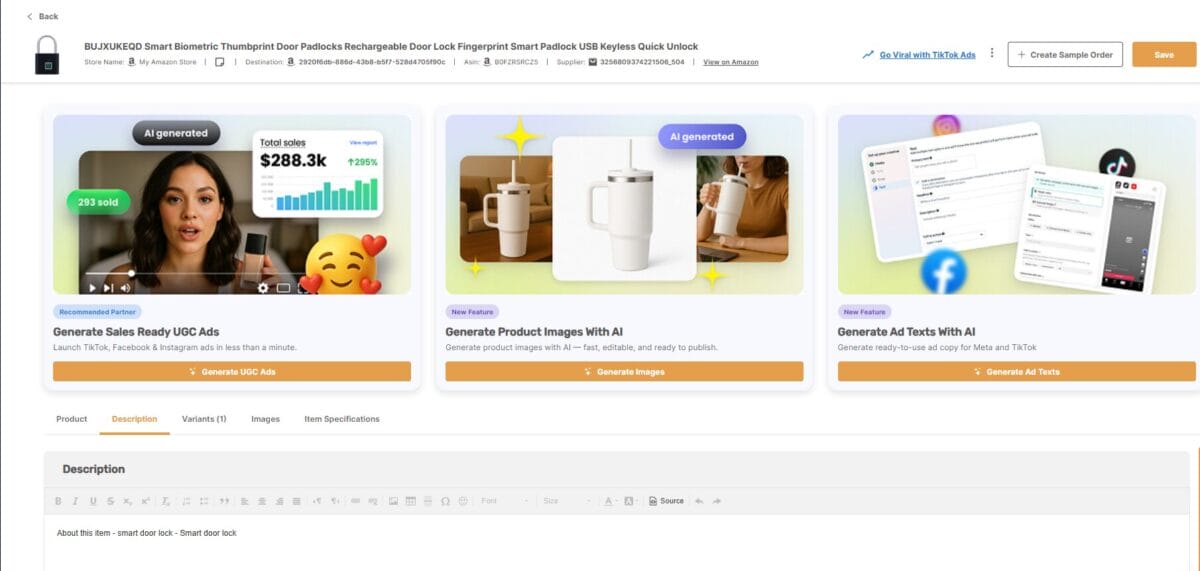
The same API connection that handles imports and pricing now also carries AI-generated product titles/descriptions and, on some platforms, AI-assembled store setup, shifting some of the creative and research work, not just the repetitive work, onto automation.
In recent years, AI has grown by leaps and bounds, working its way into nearly every corner of business, and e-commerce is no exception. Using these AI features to optimize product descriptions directly affects how customers perceive the product, freeing up time for sellers to focus on higher-priority tasks rather than rewriting listing copy by hand.
Dropshipping API vs. Non-API: What Actually Changes
The practical difference comes down to four things: tracking updates, customer messaging, product imports, and pricing changes. Without an API connection, tracking numbers usually update in the automation tool but not on the marketplace itself, so you’d have to update the marketplace by hand. Automated customer messages and support similarly depend on an API connection to the marketplace’s messaging system. Product imports and live price/stock updates on your actual listings require the same thing; without it, you’re back to manual edits.
The other practical distinction: non-API (browser-extension-based) tools generally require the extension and a connected browser session to be running for automation to work. An API-based connection keeps working even when your computer is off, since the requests are handled on the server.
The Final Verdict: Is Dropshipping API Worth It?
All things considered, we can conclude that using a dropshipping API helps us optimize and scale our store, regardless of which platform we sell on. With unrestricted dropshipping automation that covers the entire process from A to Z, we can run our business easily.
Moreover, with a Non-API, we can’t use many of the amazing automation tools. Plus, we can see the lack of functionality in Non-API. In fact, it requires our extension to run constantly. Alternatively, with a dropshipping API, our store will remain automated even when our computer is off.
So, the final verdict is YES! The Dropshipping API is 100% worth it. We can sit back and relax while the API does the work for us. However, those who wish to dropship with a Non-API solution can still do so.
At the end of the day, we have a great solution no matter which option we choose. But we should take the dropshipping API seriously, as it helps us run a more optimized business.
Frequently Asked Questions
What authentication method do dropshipping APIs use?
Most modern dropshipping APIs (CJdropshipping, AliExpress Open Platform) use token-based authentication, an access token obtained after registering an app, often paired with a refresh token so you don’t have to re-authenticate on every call. Tools like AutoDS that operate on top of these APIs typically handle this token management for you at the account level, so you’re not manually juggling keys.
Are there rate limits I should plan around?
Yes, and they vary a lot by provider. CJdropshipping’s non-authenticated endpoints are capped at around 30 requests per second platform-wide, with a per-IP account cap, while authenticated business endpoints run at lower default rates and scale up for higher-tier seller accounts. AliExpress assigns a flow-rate ceiling per approved app rather than publishing a universal number. If you’re building anything custom, always check the provider’s current developer documentation rather than relying on older published figures, since these limits get adjusted periodically.
What data format do these APIs return?
The major providers return JSON over HTTPS, which is the current standard for REST-style dropshipping APIs. Some legacy or wholesale-style integrations still use EDI (batch file exchange) rather than real-time REST calls, which matters if you’re integrating with a supplier that hasn’t modernized its systems.
Do I need to be an approved developer to get API access?
For official supplier APIs like AliExpress’s, yes, you register, submit your intended use case, and wait for approval before you get a key. For automation platforms like AutoDS, no separate developer approval is required; API access is included with your account and plan.
Which selling platforms support dropshipping API connections?
Most major platforms do — eBay, Shopify, Amazon, TikTok Shop, Etsy, and WooCommerce all support third-party API connections through their own developer platforms. AutoDS is built on top of these connections across all of them, automating account settings, stock monitoring, order fulfillment, tracking, and customer service, no matter which channel you’re selling on.
Conclusion
A dropshipping API is, at its core, the plumbing that lets your store and your suppliers stay in sync without manual work.
Which provider’s API you’re relying on, directly or through a tool like AutoDS, changes what you can automate, how fast you can move, and what it costs.
If you’re evaluating options, the questions worth asking aren’t just “does it have an API,” but specifically: what’s the authentication model, what are the rate limits at your sales volume, and what’s the actual monthly cost at the product count you need.