


Dropshipping in Canada can be a great way to build an e-commerce business without holding inventory or managing our own warehouse. With access to strong online marketplaces, reliable payment infrastructure, and suppliers that can ship locally or internationally, Canada offers plenty of opportunities for both new and experienced dropshippers.
In this guide, we’ll cover how to start dropshipping in Canada step by step, from finding winning products and Canada-friendly suppliers to choosing the best-selling channels and understanding taxes, GST/HST, and customs.
We’ll also share practical ways to scale faster with automation and market data tools. For instance, AutoDS can help us research trending products, connect with suppliers, monitor prices and stock levels, automate order fulfillment, and manage our store from a single platform.
Dropshipping is legal in Canada, but staying compliant means following business registration, tax, customs, product safety, and consumer protection rules that apply to our setup. Canadian sales taxes vary by province. GST/HST generally uses a CAD $30,000 small-supplier threshold, while PST, RST, and QST can have separate rates and registration requirements. Fast, Canada-friendly suppliers matter. Options like AutoDS, Walmart Canada, Costway Canada, Costco Canada, and Wayfair Canada can help reduce shipping times and improve the customer experience. Product research and supplier selection are fundamental. Winning products should solve a problem, show clear demand, offer healthy margins, and be easy to source and ship reliably. Automation makes scaling much easier. Tools like AutoDS can streamline product research, importing, price and stock monitoring, order fulfillment, and other repetitive tasks as the business grows.
What Is ‘Canada Dropshipping’?
Before we proceed further, let’s first understand what dropshipping is and how it works in Canada.
Dropshipping is an e-commerce business model that doesn’t require a physical inventory of the product. Instead, dropshipping utilizes an order fulfillment framework that relies on third-party suppliers to store products and ship orders for us. Therefore, dropshipping carries lower risks than standard e-commerce and requires minimal working capital.
The dropshipping process includes these three basic steps:
- Step 1: Customer purchases a product
- Step 2: Seller forwards order details to the supplier
- Step 3: Supplier delivers the item
Let’s use an example where a Canada-based customer buys a water bottle from a dropshipping store to see how the process works in practice.
Upon checking out, the shopper pays for the water bottle at the price displayed in our store, say, $29. Then, the dropshipper forwards the order information to the supplier.
When the details reach the supplier, we pay the wholesale price of the water bottle, say $25. Then, the supplier prepares and ships the order directly to the buyer in Canada. The difference between what we paid the supplier and what the customer paid us is our profit.
Now, anyone can dropship in Canada, even when we don’t live there. As long as we have the right tools, we can source products from anywhere in the world and deliver them to Canada.
Is Dropshipping Legal In Canada?
Yes, dropshipping is legal in Canada. There’s no law that prohibits the business model itself, whether we’re based in Canada or selling to Canadian customers from abroad. It is a widely used e-commerce model and is treated the same as other forms of online retail under the law.
That said, a dropshipping store is still an e-commerce business, so we need to follow the same general rules as other online retailers. Depending on how and where we operate, this can include business registration, GST/HST and provincial sales taxes, customs and import duties, product safety requirements, and consumer-protection laws. These obligations can vary based on our business structure, location, and our customers’ locations.
On top of legal requirements, it’s also important to consider the compliance rules of the selling channels we use. Platforms like Shopify, Amazon, Etsy, or eBay each have their own policies regarding product listings, fulfillment standards, prohibited items, and customer service expectations. Even if our business is legally compliant, failing to follow a platform’s rules can still result in account restrictions or suspension.
We’ll break down each of these obligations below.
Tax & Business Obligations For Canada Dropshipping
As we mentioned above, dropshipping itself is legal in Canada, but staying compliant is what makes our business operate legally in practice. That means following the registration, tax, customs, product safety, and consumer protection rules that apply to our specific setup.
The exact requirements depend on factors such as where our business is based, where our customers are located, and where our suppliers ship from. Let’s break down the main obligations we need to know.
Product And Consumer Protection Rules
The first step to keep our dropshipping business legal is complying with product and consumer protection rules. Under the Canada Consumer Product Safety Act, businesses cannot import, advertise, or sell prohibited products, non-compliant regulated products, or products known to pose a danger to health or safety. Examples of products that are prohibited or subject to specific safety requirements in Canada include:
- Baby walkers
- Infant self-feeding devices
- Lawn darts with elongated tips
- Balloon-blowing kits
- Relight candles
- Toys that exceed permitted lead or sound limits
- Regulated children’s products such as cribs, strollers, children’s sleepwear, and children’s jewelry
This isn’t an exhaustive list, so we should always check the applicable Canadian requirements before sourcing products from overseas. Categories such as toys and children’s products deserve particular attention, while cosmetics are regulated separately under the Food and Drugs Act and Cosmetic Regulations.
Returns are also subject to consumer protection rules. Canada doesn’t have a general nationwide “cooling-off” period that lets customers return any online purchase simply because they changed their mind. However, provincial and territorial laws may give buyers cancellation or refund rights in certain situations, such as when required information isn’t provided, an order arrives significantly later than agreed, or a product is defective. Any return or refund policy we publish must also be followed, so we should check the rules that apply in the provinces where we sell.
Business Registration Requirements
Whether we need to register our dropshipping business in Canada depends on factors such as our main office location, the provinces or territories we operate in, our business name, and the business structure we choose. Registration requirements can vary across provinces and territories, so there isn’t a single process that applies to every Canadian seller.
According to the Government of Canada’s official website, the main business structures available in Canada are:
- Sole proprietorship: One person owns and operates the business. It’s generally the simplest structure, but the business and owner are not separate legal entities, so the owner is personally responsible for its risks and debts.
- Partnership: Two or more people or entities operate a business together and share its profits or losses.
- Corporation: The business becomes a separate legal entity from its owners, with different tax, reporting, and liability requirements.
There’s also the Cooperative structure, a business owned and controlled by an association of members, but it’s not relevant for most dropshipping businesses and falls under separate federal legislation.
For many people starting a small dropshipping business on their own, a sole proprietorship may be the simplest structure to set up. However, that doesn’t automatically make it the right choice for everyone, so we should consider the tax, liability, and administrative implications of each structure before deciding.
We may also need a Business Number (BN) from the Canada Revenue Agency (CRA). A BN is separate from registering our business with a province or territory and is used to identify our business when dealing with CRA program accounts, such as GST/HST, payroll, and import/export accounts. Not every business needs one immediately, as it depends on which CRA programs we need to register for.
Sales Tax: GST, HST, PST, And QST
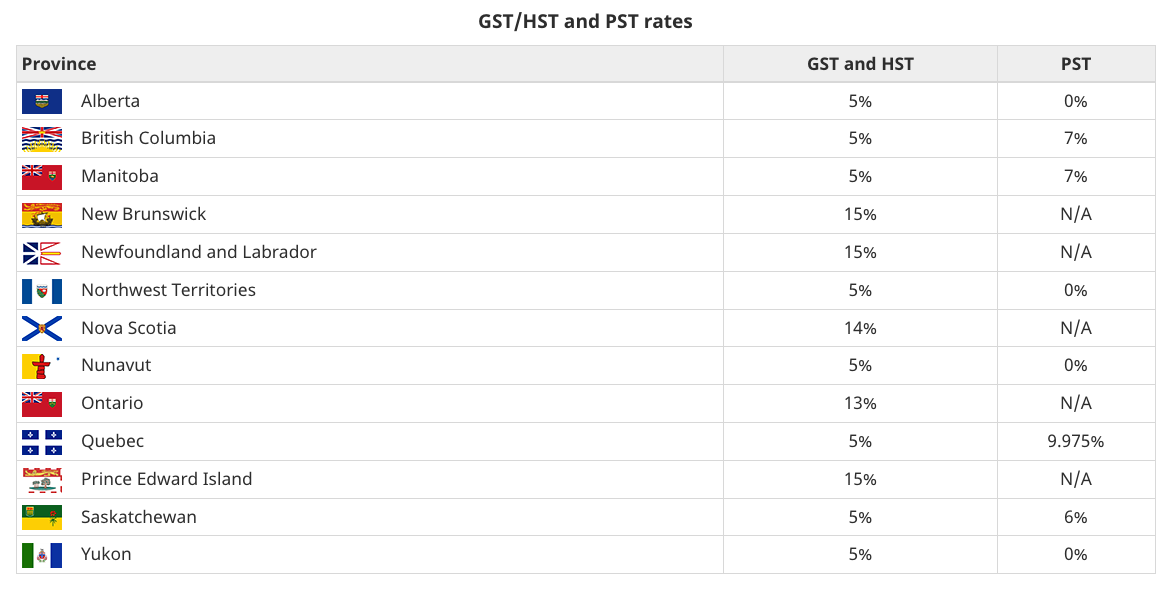
Sales tax is where Canadian dropshipping gets a little more complicated, because the amount and type of tax can vary by province. This means Canada doesn’t have a single sales tax system that applies the same way across the entire country. Instead, there are different categories.
The GST (Goods and Services Tax) is the federal sales tax, while the HST (Harmonized Sales Tax) combines the federal GST with a provincial portion in provinces that use the harmonized system. Other provinces apply the 5% GST alongside their own provincial tax, such as:
- PST (Provincial Sales Tax) in British Columbia and Saskatchewan
- RST (Retail Sales Tax) in Manitoba
- QST (Quebec Sales Tax) in Quebec.
Once we understand this structure, let’s go a bit deeper and zoom in on each one of these categories.
For most businesses, the key federal GST/HST threshold is CAD $30,000 in taxable supplies. According to the Canada Revenue Agency (CRA), if we exceed $30,000 in a single calendar quarter, or over the previous four consecutive calendar quarters under its small-supplier rules, we generally need to register for GST/HST and begin collecting it.
Once registered, the GST/HST rate we charge generally depends on the delivery location (where the customer receives the product). For example, if our business is based in British Columbia but we ship an order to a customer in Ontario, the sale is generally treated as taking place in Ontario for GST/HST purposes, so we would charge Ontario’s HST rate.
Current official GST/HST rates include:
- 5% GST in Alberta, British Columbia, Manitoba, Quebec, Saskatchewan, Northwest Territories, Nunavut, and Yukon.
- 13% HST in Ontario.
- 14% HST in Nova Scotia.
- 15% HST in New Brunswick, Newfoundland and Labrador, and Prince Edward Island.
Now, here’s where it gets tricky. Some provinces also charge a separate provincial sales tax. For example, 7% PST in British Columbia, 7% RST in Manitoba, 6% PST in Saskatchewan, and 9.975% QST in Quebec. On top of that, don’t assume the federal $30,000 threshold automatically applies to every provincial sales tax, as provincial registration rules can work differently.
For example, in Manitoba, small businesses with annual taxable sales under $30,000 generally do not need to register for RST. However, there are important exceptions, including businesses that use out-of-province suppliers that don’t collect Manitoba RST, which is important for dropshippers to know. Saskatchewan has a similar dynamic: non-resident/out-of-province vendors selling into the province generally need to register for PST regardless of sales volume, with no minimum threshold at all.
And then we have Quebec, where Revenu Québec generally administers both GST/HST and QST. The province uses the same $30,000 small-supplier threshold, but QST remains a separate provincial tax with its own rules.
So, bottom line? We should always check the CRA to understand which taxes apply, when registration is required, and what rate applies based on our customers’ locations.
💰 Financial Tip: Tax structures can be complicated. It’s important to consider hiring an accountant who understands local regulations and helps keep the operation compliant.
Selling To Canada From Abroad
Now, what happens if we’re selling to Canadians, without actually being in Canada? Of course, everyone can dropship to Canada, even people abroad. That said, this also comes with tax obligations we need to be aware of.
Selling to Canadian customers doesn’t automatically mean we need to register or incorporate a business in Canada. However, if our activities are considered to be carrying on business in Canada, we may have registration obligations, fall under the regular GST/HST rules, and need to register once we exceed the CRA’s small-supplier threshold.
But there’s also a separate rule for some non-resident e-commerce sellers that aren’t necessarily carrying on business in Canada. If we sell qualifying goods that are supplied in Canada (for example, products held in a Canadian fulfillment warehouse), we may need to register for GST/HST once our applicable revenue exceeds CAD $30,000 over a 12-month period. If a registered distribution platform facilitates those sales, the platform may instead be responsible for collecting the GST/HST.
So, if we’re dropshipping into Canada from abroad, we shouldn’t assume the same rules apply to every setup. Where our business operates, where our supplier holds and ships the products, and whether we sell directly or through a marketplace can all affect our registration and GST/HST responsibilities.
Customs, Duties, And Imported Orders
If our supplier ships products from outside Canada, customers may have to pay import taxes or customs duties when the order enters the country. The exact amount depends on factors such as the shipment value, country of origin, and whether it arrives by mail or courier.
As a general reference, shipments imported by mail are usually duty- and tax-free up to CAD $20 according to the Canada Border Services Agency. Courier shipments from the US or Mexico can qualify for higher thresholds, with some shipments up to CAD $150 entering duty-free, although taxes may still apply.
For dropshippers, the key is to know where our supplier ships from and who is responsible for import charges. We should always make this clear in our shipping policy so customers aren’t surprised by additional costs when their order arrives.
How To Start Dropshipping In Canada
Once the legal setup is all done, we can roll up our sleeves and work on our dropshipping business in Canada. Let’s go through everything step by step.
Step 1: Conduct Product Research
Products are the cornerstone of our business. What are we selling? Why are we selling that? How do we sell it? At this point, all these questions can feel a little overwhelming, but good product research helps us answer them.
Through product research, we identify products that allow us to stand out from the competition. In other words, items with characteristics that make them winning products are in greater demand than others for various reasons. Essentially, a winning product usually has some of the following advantages:
- High Demand: Winning products are often in high demand, attracting many customers looking to purchase them.
- Solves a Problem: These products typically address specific problems or pain points for consumers, making them valuable and necessary.
- Unique or Innovative: Winning products usually have a distinct “wow” factor that captures attention and sets them apart from competitors.
- Makes Life Easier: They often simplify tasks or improve users’ quality of life, providing convenience or efficiency.
- Affordable and Accessible: Successful products are generally priced affordably, allowing for a good profit margin while still being attractive to consumers.
- Easy to Ship: They should be lightweight and compact, minimizing shipping costs and logistical challenges.
- Not Commonly Available in Retail Stores: Winning products are often difficult to find in traditional retail outlets, making them more appealing to online shoppers.
Of course, the idea is not to burn the midnight oil searching for a treasure that meets all those qualities at once, but if it fulfills any of them, it will likely be a product that sells better and generates more customer traffic.
So, how do we find a winning product? Initially, we can always turn to free technological tools like Google Trends. This easily accessible software provides valuable information about a specific item and its demand by simply typing its name. Additionally, we can access other types of data, such as related articles, times of the year when demand rises and falls, trending categories, and much more.
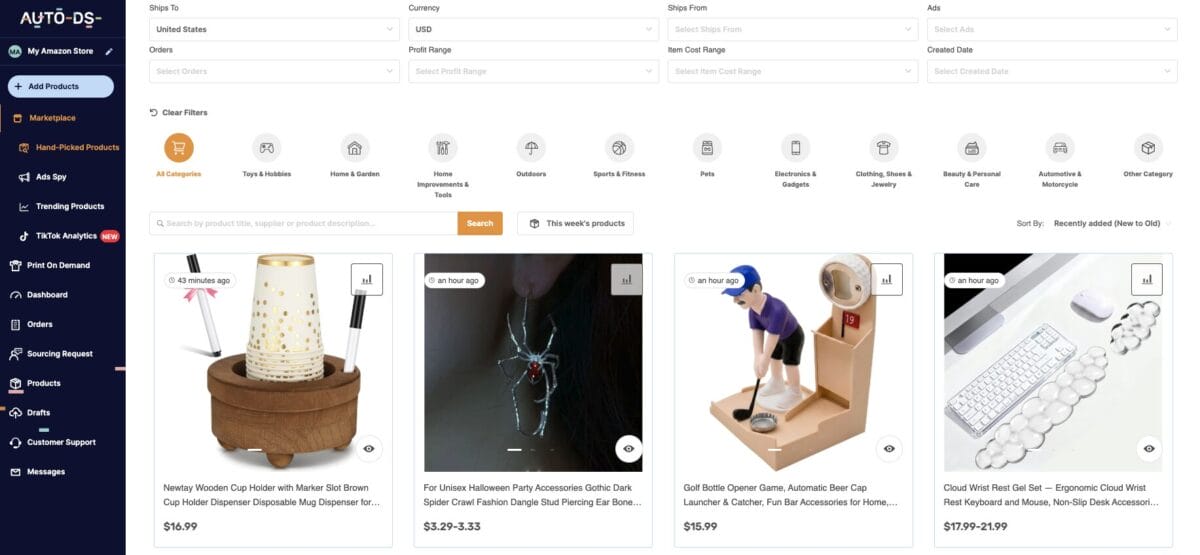
On the other hand, professional supplier sites usually have a page of selected items we can browse for ideas. Amazon, AliExpress, CJDropshipping, and Walmart allow us to access these sections. If we want to fine-tune our search, we can turn to AutoDS’s Hand-Picked Products Hub, a constantly updated, curated list by AutoDS’s product team featuring highly relevant items.
Of course, the products we choose will largely depend on the type of business we are targeting and the niche we decide to delve into, but by considering these tips, we will be much closer to our goal.
Step 2: Work With Canadian Dropshipping Suppliers
If products are as important as we discussed above, imagine how relevant a good supplier is (where the product comes from). The whole point is to partner with vendors and manufacturers that align with our business vision and policies. As we’ve established before, dropshipping is the chain that forms between the buyer, the dropshipper, and the supplier, so much of our success depends on finding the right one.
The supplier is ultimately responsible for ensuring that the products purchased from us arrive on time and in good condition at our customers’ doors. When we venture into this business, we can turn to a wide variety of reliable Canadian suppliers.
The good old-fashioned method is simple: search for suppliers manually through Google, marketplaces, directories, and supplier websites. Then, compare them one by one, checking where their products ship from, delivery times to Canada, return policies, reviews, product quality, and pricing. Whenever possible, prioritize suppliers with Canadian warehouses or domestic fulfillment capabilities, as this can help reduce delivery times and simplify the customer experience.
Good news: we’ve already done part of the research. After this step-by-step section, we’ll go through some of the best Canadian suppliers.
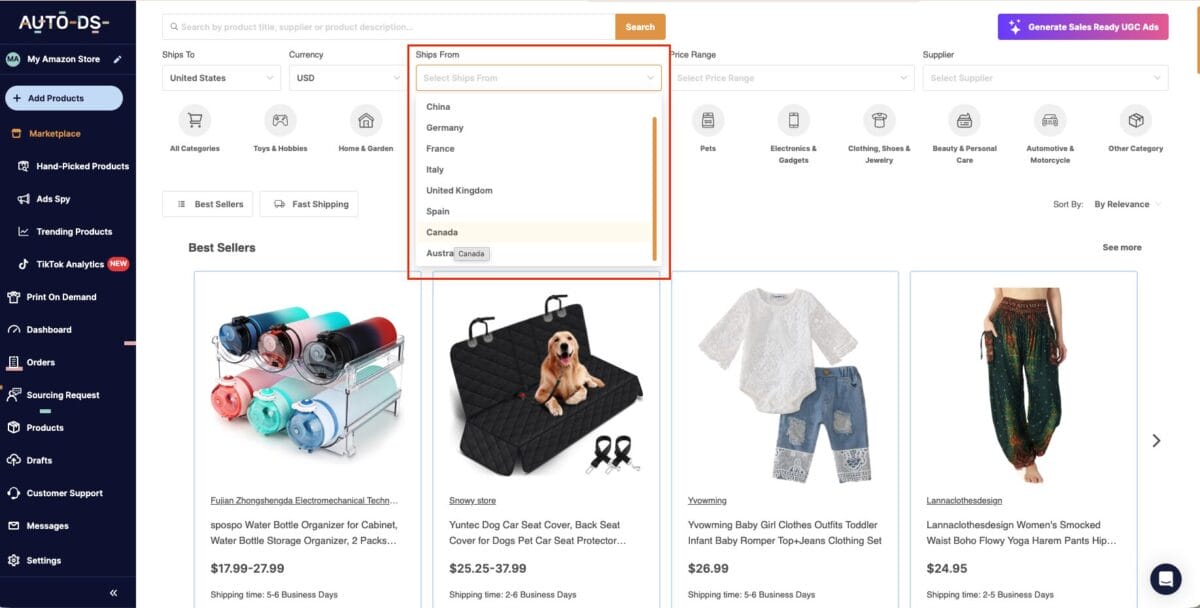
Now, the second option is much quicker and simpler. The AutoDS Marketplace lets us filter products by supplier region to quickly narrow the search to products that can be sourced and delivered efficiently within Canada, then import them directly to our store.
Step 3: Choose A Dropshipping Selling Channel
Having chosen the ideal suppliers and products for our store, it’s time to focus on the selling channel, the platform through which we will connect our store with our target audience. These virtual storefronts, which can be significant marketplaces or customizable e-commerce platforms, have different characteristics depending on how we prefer to set up our store. These are some of the best ones:
eBay Canada

eBay Canada is one of the largest e-commerce marketplaces, attracting millions of customers daily. The platform’s free organic traffic can significantly boost our sales as more visitors visit our page daily.
Key Features:
- Free organic traffic that enhances visibility.
- No store subscriptions are required, making it accessible.
- High selling fees, which can reduce profit margins.
Shopify Canada

Shopify Canada is a leading e-commerce platform favored for online dropshipping stores. It allows us to customize our store’s appearance fully and has no selling limits, allowing for greater flexibility.
Key Features:
- No selling limits, enabling us to list as many products as we want.
- Full customization of our dropshipping store’s design.
- Minimal organic traffic necessitates a proactive marketing approach.
Wix Canada

Wix Canada is a great choice if we want to build a visually appealing and personalized dropshipping store. It offers numerous benefits for dropshippers, including a wide selection of templates for brand customization. Additionally, Wix provides a business email with our store’s domain name and supports various payment methods, such as PayPal and credit cards.
Key Features:
- Variety of page templates for easy customization.
- Option to purchase a personalized email linked to our store.
- Multiple payment processing options enhance customer convenience.
Amazon Canada

The reputation and credibility of Amazon need no introduction. With millions of customers visiting daily, the platform provides an excellent opportunity for dropshippers to tap into a vast market. Amazon’s infrastructure supports sellers with fulfillment centers across major cities, ensuring efficient shipping and delivery.
Key Features:
- Access to a large customer base, enhancing visibility and sales potential.
- Amazon’s reputation fosters consumer confidence, encouraging purchases.
- Simplifies logistics by allowing sellers to store products in Amazon’s warehouses.
Etsy Canada

Etsy Canada is a unique e-commerce platform focused on handmade, vintage, and craft supply items. It caters to a niche market of consumers looking for distinctive products. Etsy allows us to create a personalized storefront that reflects our brand identity.
Key Features:
- Ideal for sellers of handmade or unique products.
- Provides options to create a personalized shopping experience.
- Encourages interaction with customers through reviews and messages.
Step 4: Create Business Policies
The next step in establishing our dropshipping business is to set up our business policies. If we put ourselves in the customer’s shoes, this is one of the first things they notice before making a purchase. Customers are probably wondering:
- How does the store handle shipping?
- What are the delivery times?
- How do I return a product?
- How can I pay?
Our policies should answer all these questions in a clear, transparent, honest way. Also, it’s important to make them easy to find in our store. If they can’t figure it out in seconds, then we’re not being helpful.
The setup of these policies will vary slightly depending on the selling channel we use for our dropshipping business.
Step 5: Import Products
We’re almost ready to start selling. First, we still need to import products to our dropshipping store in Canada. Like many other tasks involved in dropshipping, importing can be done manually or automatically.
If we choose the manual method, we may risk wasting significant time downloading, copying, and uploading all the necessary information for each item we want to publish. On the other hand, if we opt for automation, we can gain more free time and avoid common human errors.
Regarding this latter method, AutoDS offers a very intuitive and practical way to import products, allowing us to add items individually or in bulk through a series of simple steps: all we need to do is copy the URL of the product(s) we are interested in publishing, then go to the AutoDS marketplace and click on “Add Products” in the upper left corner. A box will appear where we can paste the links to add our products automatically.

After importing, we can use the AI Product Title and Description Generator to optimize each listing, making sure they are high-converting, speak in our own tone, and are clear.
The AutoDS $1 trial is an easy way to test these automation features and see how they fit into our workflow.
Step 6: Start Marketing

Marketing is the thread connecting our brand with our target audience. We could have the best-selling products, a suitable supplier, and a beautiful store, but it won’t do us any good if no one knows it is happening.
This is where developing marketing strategies aligned with our short- and long-term goals, depending on the type of product we intend to sell, comes into play. First, it’s almost unnecessary to mention, but we should highlight the importance of understanding social media, the different communities within it, and how to leverage them.
Today, most of the population spends a significant part of their day consuming content on TikTok, Instagram, or Facebook. Each platform has its own dynamics, which help us segment audiences. It’s not the same to create a post for TikTok as it is for Facebook. While the first one targets younger segments with short-form videos, Facebook reaches a wider audience with a greater variety of formats.
At this point, it’s also a good idea to invest in advertising on social media and Google to achieve greater visibility and generate increased traffic. Another smart initiative is to invest in influencer marketing by partnering with a celebrity in a specific niche we are targeting. This way, people who visit our store will do so more organically.
Finally, collecting data on our customers’ behavior on the page can help us improve our strategies. For example, we can run email marketing campaigns announcing promotions and discounts while making our customers feel extraordinary to create a deeper connection with them.
Step 7: Fulfill Orders

By now, we have probably received our first few orders. Time to fulfill them!
Let’s focus on the fundamentals: to keep customers happy, we must fulfill our orders accurately. Delays, bad product quality, or typos in shipping information can lead to frustration, which is why proper order fulfillment is critical.
Naturally, managing numerous orders at once can quickly become overwhelming, making it challenging to track each one from the moment it’s placed until it’s delivered.
This is where automation comes into play, offering a significant advantage with features like the Fulfilled by AutoDS option. This tool streamlines the entire process, allowing us to monitor orders from the moment customers make the purchase until their packages arrive at their doorstep.
Step 8: Deliver Outstanding Customer Service
As mentioned above, order fulfillment is one of the most important tasks for keeping our customers happy. But it doesn’t stop there! We should always strive to provide exceptional customer service.
Whether it’s to resolve a question or address a complaint, good support can significantly affect a person’s decision to continue purchasing from us.
Let’s consider this: How would we feel if a product we bought arrived damaged, and when we reached out to the store for assistance, no one responded, or we received poor service? On the other hand, if we find someone on the other end of the line who is willing to help us and solve the problem, trust and credibility in the brand will likely be strengthened.
Step 9: Managing Returns & Refunds
This is closely related to the previous point and what we discussed earlier regarding policies. First and foremost, we must be clear about our store’s rules. How long does it take to ship? How long do returns take? Until what date after purchase can a product be exchanged? Being clear and concise with our customers will help us maintain better relationships with them and prevent situations from worsening in the event of conflict.
After this, if a buyer returns an item, we need to request a refund from our supplier and then issue the refund to the buyer. Selling channels like AliExpress offer programs like the Buyer Protection Program, which aim to reasonably protect both the customer and the seller.
Keep in mind that our store policy doesn’t override provincial consumer protection laws, which may require refunds or cancellations in specific situations.
Step 10: Scale The Business
Once we have done everything we need, we can start scaling our Canada dropshipping success to achieve better profits. We can suggest similar items or use customer movements on our page to offer exclusive discounts. However, the ability to automate truly helps us scale any dropshipping business.
The fact that we can run a business with just a computer and internet access from anywhere in the world opens up many opportunities. Since dropshipping is already a low-risk business with minimal initial investment, automating not only makes our processes more efficient but also frees up time that we can use to focus on the priority aspects of our business.
Software like AutoDS serves as a comprehensive tool that handles various parts of a dropshipper’s workflow, such as:
- Creating an online store with AI
- Order fulfillment
- Price and stock monitoring
- Finding suppliers
- Product sourcing
- Print on demand
It’s a bit like Mario eating a mushroom and suddenly becoming bigger and stronger. That’s basically what automation can do for our business.
Best Dropshipping Suppliers For Canada
A major part of dropshipping in Canada comes down to finding local, Canadian suppliers. This leads to three major benefits. First, fast local shipping. Second, local currency and pricing. And third, catalogs that are already designed for the Canadian market.
While there are plenty of options available, here are eight of the best Canadian dropshipping suppliers. They stand out for their local presence, broad catalogs, or ability to get products to Canadian customers quickly. Keep in mind that delivery times can vary by product, seller, and destination.
AutoDS’s Marketplace
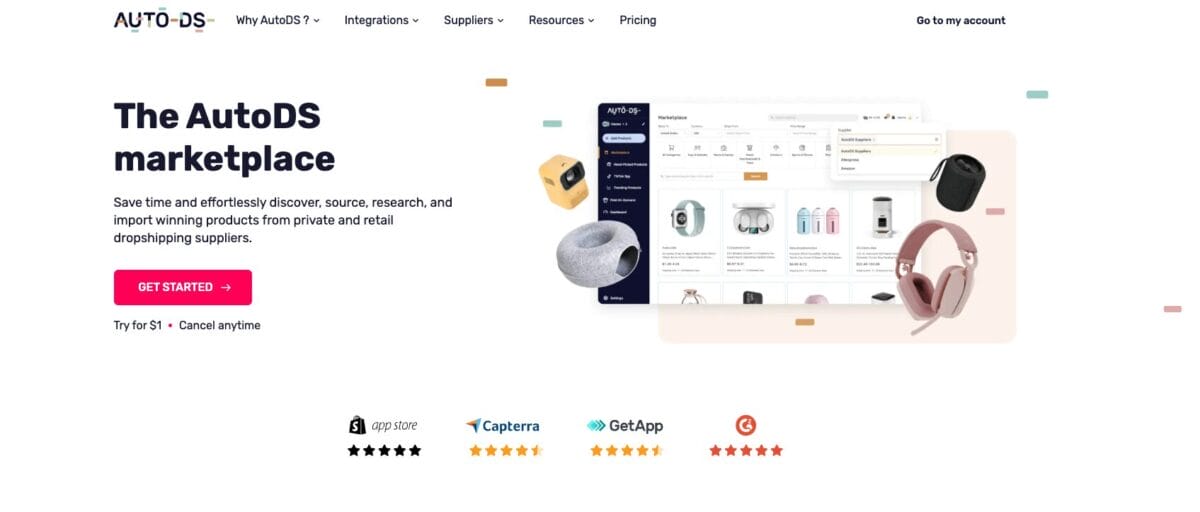
AutoDS is a strong option for Canadian dropshippers because it combines access to its warehouse and private supplier network with automation tools for sourcing and fulfillment. Its marketplace includes products from private suppliers, while regional fulfillment options can help shorten delivery times and simplify logistics.
On top of that, AutoDS connects with multiple global suppliers that ship to Canada, providing greater product variety, more shipping options, and pricing flexibility. The best part? We can manage all of them from the same dashboard, both private vendors and global manufacturers.
Finally, it also supports branded shipments with a store logo, which can be useful if we want to build a more recognizable customer experience as we scale.
🚚 Typical shipping time: Varies by product and supplier, with regional fulfillment options available for faster shipping to Canada.
eBay Canada
eBay Canada gives dropshippers access to a huge product selection across virtually every niche, with sellers located both in Canada and internationally. One of its biggest advantages is its seller-feedback system, which makes it easier to compare suppliers before sourcing from them. Canadian domestic sellers and warehouses can also provide faster delivery than sourcing the same products internationally.
🚚 Typical shipping time: Varies by seller and product; Canadian sellers can offer faster domestic shipping.
Costway Canada
Costway Canada is a strong option for dropshippers looking for competitive prices, domestic fulfillment, and a supplier that explicitly supports dropshipping. It operates through a Canadian warehouse and offers more than 8,000 self-branded products across multiple categories, giving sellers plenty of options while avoiding some of the branding overlap found on larger marketplaces. It also offers dropship certification, daily CSV files with product information and stock data, free shipping, and a 90-day return window.
🚚 Typical shipping time: Around 3–10 days, with product handling generally completed within 24 hours, depending on the destination and carrier.
Walmart Canada
Walmart Canada is particularly useful if we want a large catalog of competitively priced everyday products, including home supplies, outdoor products, personal care, and other popular dropshipping categories. Thousands of products qualify for next-day delivery, giving dropshippers the chance to compete on shipping speed without limiting their product range.
🚚 Typical shipping time: Next-day delivery is available on thousands of eligible products.
Home Depot Canada
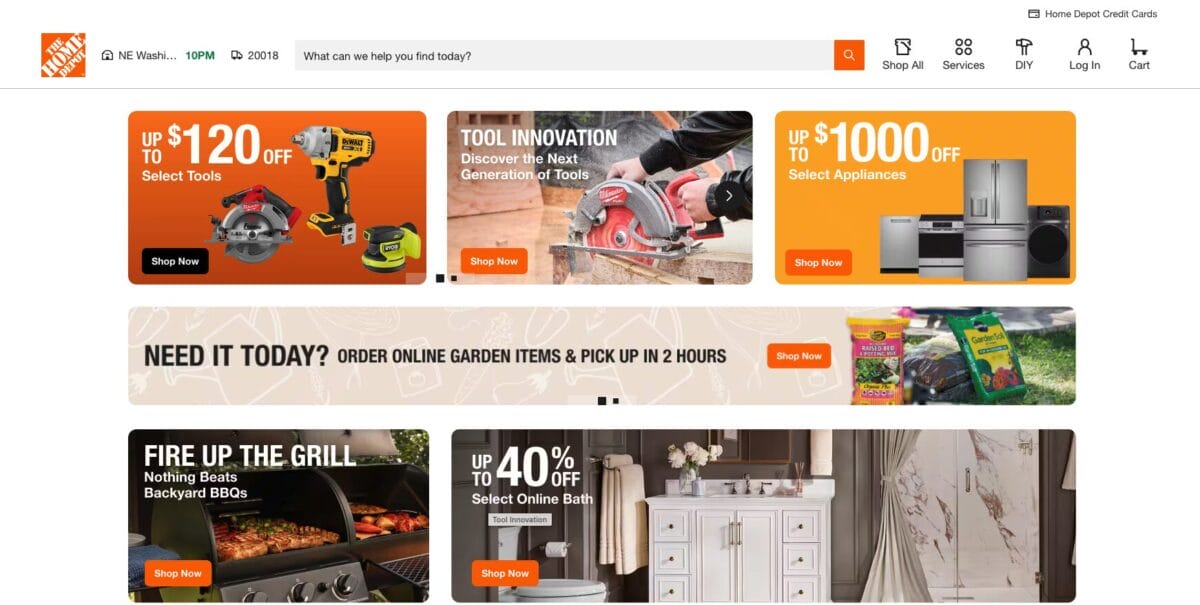
For stores focused on home improvement, DIY, tools, or home supplies, Home Depot Canada is one of the strongest niche options. Its catalog includes millions of products and well-known brands, while its large Canadian footprint helps support fast domestic fulfillment. More than one million products are eligible for its two-day shipping service.
🚚 Typical shipping time: Around 2 days for more than one million eligible products, with same-day or next-morning Express Delivery available for eligible items.
Etsy Canada
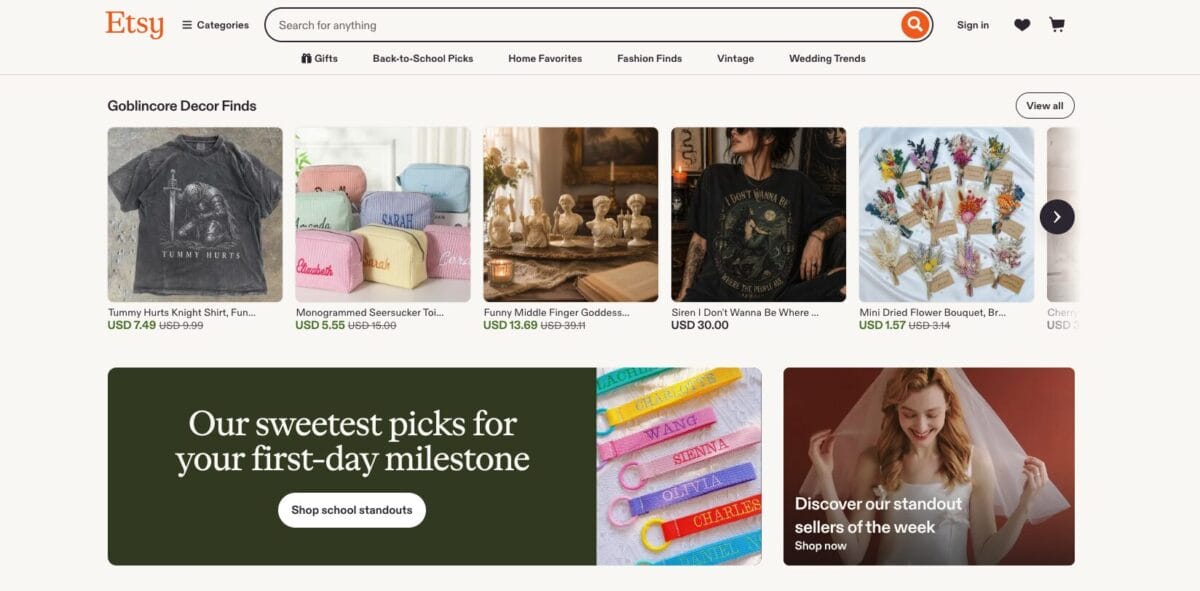
Etsy Canada is a different kind of supplier option because it focuses heavily on handmade, crafted, personalized, and distinctive products. That makes it especially useful for dropshippers looking to move away from generic products and build a more differentiated store. Categories range from home goods and apparel to furniture, jewelry, toys, and bags, and unique or customized products can often support higher margins.
🚚 Typical shipping time: Varies significantly by individual seller and product.
Costco Canada
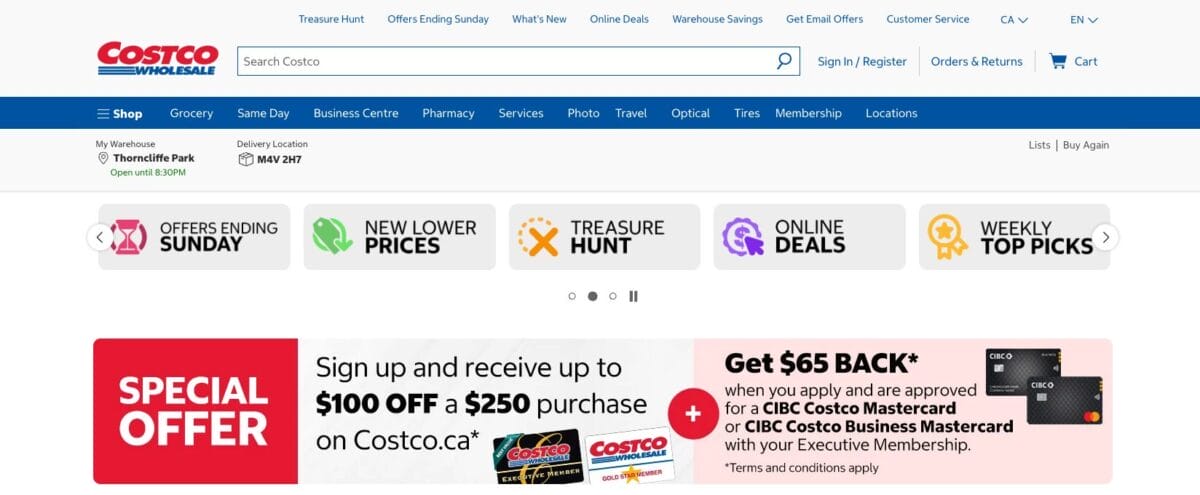
Costco Canada combines wholesale-style pricing, Canadian warehouses, and a broad product catalog, making it particularly attractive for household essentials and products that customers purchase repeatedly. Its membership-based business model helps keep product prices competitive, while its Canadian fulfillment network supports relatively quick delivery.
🚚 Typical shipping time: Varies by product, but mostly between 3-5 business days.
Wayfair Canada
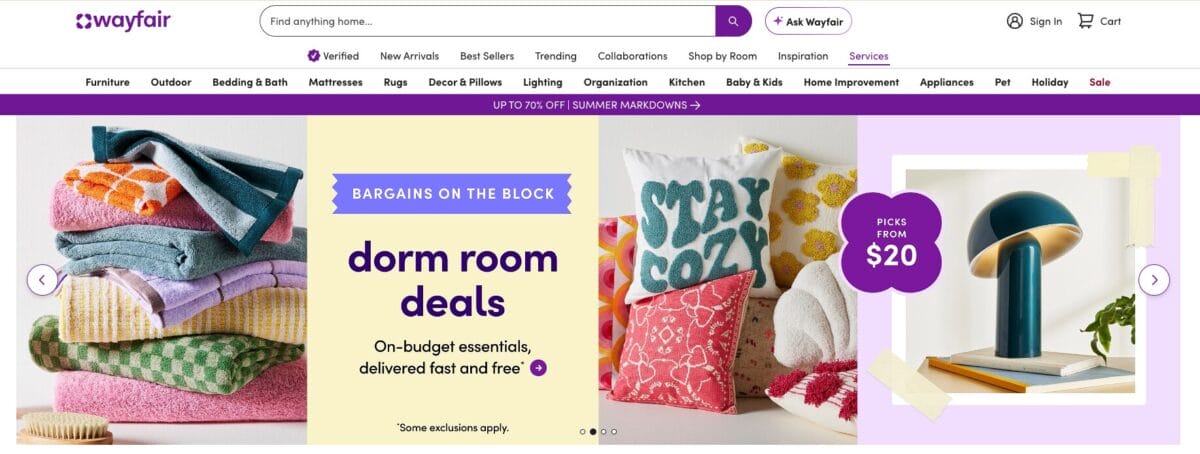
Wayfair Canada is a particularly strong supplier for dropshippers targeting the home, furniture, appliance, and décor niches. Its catalog includes millions of home-related products from thousands of suppliers, giving us plenty of room to build either a broad home store or a more focused niche. It also offers fast shipping on many products.
🚚 Typical shipping time: 2-day shipping is available on thousands of eligible products.
Frequently Asked Questions
Is dropshipping legal in Canada?
Yes. Dropshipping is legal in Canada, but dropshipping stores still need to comply with normal e-commerce rules, including taxes, business registration, customs, product safety, and consumer protection.
Is it worth starting a dropshipping business in Canada in 2026?
How can I find reliable dropshipping suppliers in Canada?
To find reliable dropshipping suppliers in Canada, we can use platforms like AutoDS or explore established marketplaces such as eBay and Costway, which offer a range of local supplier options and tools for monitoring product availability and pricing.
What are the best Canadian or fast-shipping-to-Canada suppliers?
The best Canadian suppliers include AutoDS, eBay Canada, Walmart Canada, Home Depot Canada, Etsy Canada, Costco Canada, Wayfair Canada, and Costway Canada. Many offer Canadian warehouses or fast domestic delivery options, depending on the product.
How does AutoDS handle returns and refunds in Canada?
AutoDS handles returns and refunds with the Fulfilled by AutoDS system. Once the customer requests a refund through the selling channel, the Return status is automatically updated on their AutoDS dashboard. With the one-click return option, the system processes the return label and updates it in the Returns Dashboard. Without Fulfilled by AutoDS, returns need to be managed manually.
Build and Scale Your Dropshipping Business in Canada
At this point, we have everything we need to start dropshipping in Canada with a solid foundation. We know what to look for in a product, how to choose suppliers that can reliably serve Canadian customers, which platforms we can sell on, and what to keep in mind when it comes to shipping, taxes, and customs. From here, it’s really about putting those pieces together, testing what works, and improving our store as we go.
We also don’t have to manage every part of that process manually. AutoDS can help with product research, importing products, price and stock monitoring, order fulfillment, and other repetitive tasks that become harder to manage as we grow. The AutoDS $1 trial is an easy way to start building our Canadian dropshipping business with more of the day-to-day work automated from the beginning.
To keep learning, here are a few more helpful guides: