


Yes, dropshipping is still worth it in 2026, but only if you treat it like a real business.
Dropshipping is worth it when you choose the right products, price them correctly, and automate operations. On the other hand, it fails when you rely on saturated products, manual workflows, or outdated tactics from 2018 YouTube tutorials.
I’ve seen stores struggle to make their first sale, and others hit consistent 4–5 figures/month. The difference is in the systems, speed, and decision-making.
That’s exactly where tools like AutoDS come in. AutoDS connects suppliers to your store, automates inventory and pricing updates, and fulfills orders automatically, so you’re not stuck doing everything manually.
If you’re asking whether it’s “too late,” the short answer is no. But if you’re asking whether it’s easy… also no.
Dropshipping still works in 2026, but success depends on execution. It’s no longer about starting, but about doing it right.
Income varies by experience. Beginners earn little at first, while experienced sellers can scale consistent profits.
Saturation isn’t the real problem; poor execution is. Strong products and good marketing still win.
Consistency and systems drive results. Testing, reliable suppliers, and smooth operations make the difference.
Automation helps you scale. Tools like AutoDS reduce manual work and keep your business running efficiently.
Is Dropshipping Worth It?
Yes, dropshipping is still worth it in 2026. Let me be honest with you for a second. The model itself didn’t stop working; what changed is the level of execution required to make it work.
A few years ago, you could upload a random trending product, run some ads, and hope for the best. Today, that same approach will burn your budget fast.
What I see now is a clear split between two types of sellers:
On one side, there are people treating dropshipping like a structured business. They test products consistently, use automation to move faster, and make data-driven decisions. These are the ones building stores that actually generate steady income.
On the other side, there are people still chasing “winning products” without a system. They rely on guesswork, do everything manually, and quit after a few failed tests. That’s usually where dropshipping starts to feel “not worth it.”
So the real answer isn’t just yes or no. It’s this: Dropshipping is worth it if you build systems. It doesn’t work if you rely on luck.
Who Dropshipping Works For
Dropshipping works best if you’re willing to think long-term and operate efficiently.
You don’t need to be an expert, but you do need to:
- ✅ Be comfortable testing products consistently, not just once in a while
- ✅ Use tools and automation to save time and reduce errors
- ✅ Learn basic marketing, especially short-form content (TikTok is still a huge driver)
- ✅ Make decisions based on performance, not emotions
Who Dropshipping Doesn’t Work For
Dropshipping usually doesn’t work if you’re expecting it to feel easy or passive from day one.
If you:
- ❌ Expect quick money without learning how the model works
- ❌ Avoid tools and try to manage everything manually
- ❌ Stop after a few products don’t perform
- ❌ Or rely only on “viral” items without a strategy
…then yeah, it’s probably going to feel frustrating and unprofitable.
🆕 Beginner Tip: Start simple. Complexity comes later. You don’t need a perfect brand, logo, or funnel to begin. A clean store, a decent product, and a clear offer are more than enough to validate an idea.
How Dropshipping Works Today (2026 Reality Check)
Dropshipping in 2026 still follows the same basic logic (sell first, fulfill later), but the way you run the business has changed quite a bit. If anything, it’s become more structured, faster, and a lot less forgiving of slow or manual workflows.
First, competition is higher, and there’s no point sugarcoating it. E-commerce keeps growing every year, so naturally, more people are entering the space. But what I’ve noticed is that the real shift isn’t just more competitors, it’s better competitors.
You’re now competing with sellers who understand content, who study trends on TikTok, and who know how to position products in a way that actually converts. Stores look cleaner, ads feel more native, and overall execution is sharper. So, you can’t rely on being early anymore; you need to be better and faster.
Second, dropshipping automation and AI have quietly become the backbone of the model.
Without them, everything slows down. Listing products takes longer, updating prices becomes messy, and fulfilling orders manually turns into a full-time job. That friction adds up quickly, especially when you’re trying to test multiple products at once.
With tools like AutoDS, a lot of that operational weight disappears. Your store stays synced with suppliers, pricing adjusts automatically, and orders can be processed without you touching each one.
At the same time, AI has changed how sellers approach execution. Writing product descriptions, coming up with ad angles, even spotting trends: it all happens faster now.
What This Means in Practice
Instead of hoping one product takes off, sellers are testing continuously, learning from the data, and scaling what performs. That only works if your operations can keep up, which is why automation plays such a central role.
So when people ask if dropshipping has changed, the answer is yes, but not in the way they think. The opportunity is still there. If anything, it’s bigger. It just rewards a different kind of approach now: one that’s faster, more structured, and a lot more intentional.
✅ Pros of Dropshipping
- Low upfront investment. You don’t need to buy inventory in advance. That means you can start testing products without putting thousands of dollars at risk.
- Fast product testing. You can launch and validate multiple products quickly. This flexibility is key in a market where trends move fast and timing matters.
- Scalable with the right systems. When you combine dropshipping with automation, growth becomes much more manageable. Tools like AutoDS handle inventory syncing, pricing updates, and order fulfillment, so you’re not stuck doing repetitive tasks while trying to scale.
- No inventory management. You don’t deal with storage, packing, or shipping logistics. Suppliers handle fulfillment, which keeps your operation lean.
- Location freedom. As long as you have a laptop and an internet connection, you can run your store from anywhere. The business isn’t tied to a physical space.
- Access to global suppliers. You’re not limited to one region or catalog. You can quickly adapt to trends and switch products without being locked into stock.
💡 Pro Tip: A lot of beginners obsess over profit margins first, but that’s backwards. If a product already sells consistently, you can optimize margins later. If it doesn’t sell, even a 70% margin won’t save it.
❌ Cons of Dropshipping
- Lower profit margins. Since you’re not buying in bulk, margins are typically tighter. Most stores operate in the 10%–30% range, depending on pricing strategy and niche.
- High competition. Popular products can get saturated quickly. If you’re slow to test or differentiate, you’ll end up competing on price or ad spend.
- Limited control over shipping. You rely on suppliers for delivery times and product quality. If something goes wrong, your customer sees your brand—not the supplier.
- Ongoing product testing is required. There’s no “set it and forget it.” You need to continuously test, replace, and optimize products to stay profitable.
- Customer support can be demanding. Delays, returns, or product issues still land on you. Even with automation, you’re responsible for the customer experience.
How Much Can You Make With Dropshipping?
Let’s get straight to it: dropshipping profitability varies a lot, but there are realistic ranges you can expect depending on your level.
This isn’t one of those business models where everyone makes the same amount. Your results depend heavily on how fast you learn, how consistently you test, and how efficiently you run your store.
If we break it down by experience level, here’s what realistic income ranges for dropshipping typically look like today:
- Beginner stage: Most people make anywhere from $0 to $1,000/month while learning. This phase is less about profit and more about understanding what works.
- Intermediate stage: Once you start finding products that convert, reaching $1,000 to $10,000/month in revenue becomes realistic.
- Advanced sellers: Experienced dropshippers running optimized systems and strong marketing can generate $10,000 to $100,000+/month in revenue, sometimes more.
In terms of profit, most stores operate with margins between 10% and 30%. So a store making $10,000/month in sales might keep $1,000 to $3,000 after costs.
What Actually Affects Profitability
The gap between someone making $500/month and someone making $20K/month usually comes down to a few key factors.
First, product selection still matters, but not in the “find one winning product and you’re set” kind of way. It’s about consistently testing and identifying what has demand.
Second, the speed of execution is huge. The faster you can launch products, adjust pricing, and react to trends, the more opportunities you capture. Here, automation becomes a real advantage. For example, AutoDS automates inventory and price updates, which helps you avoid pricing mistakes and stay competitive without constant manual work.
Third, marketing skills play a big role. Whether you’re using TikTok organic content or paid ads, your ability to position a product and communicate its value directly impacts conversions.
And finally, there’s consistency. This is the part that people underestimate the most. The sellers who grow are the ones who keep testing, optimizing, and scaling week after week.
Your earnings depend on how well your system performs over time.
💡 Pro Tip: Pricing is a positioning tool, not just a margin lever. Slightly higher prices can increase perceived value and improve conversion, especially if your branding and creatives support it. Cheapest doesn’t always win.
Is Dropshipping Saturated in 2026?
Short answer: No. Dropshipping isn’t saturated. What’s saturated is bad execution.
This is one of those questions that comes up every year, and honestly, I get it. When you see the same products over and over again, it feels like everything has already been done. But what’s actually saturated isn’t the model but the lazy way of doing it.
When people say dropshipping is saturated, they’re usually referring to one thing: too many sellers offering the exact same product in the exact same way. And that’s not really market saturation… it is idea saturation.
Because the reality is, demand doesn’t disappear. Products don’t stop selling just because more people list them. What happens is that only the best-positioned offers survive.
Where Beginners Go Wrong
Most beginners fail because they enter the market with an outdated approach.
The most common mistake I see is copying instead of interpreting. People find a product that’s already trending and try to replicate it exactly: same creatives, same messaging, same everything.
Another issue is moving too slowly. Trends in 2026 don’t last forever, especially on platforms like TikTok. If it takes you days to list a product, update pricing, or fulfill orders, you’re already behind.
That’s why having systems in place makes a difference. With the AutoDS $1 trial, for example, you can import products quickly, keep your store synced with suppliers, and automate fulfillment. That kind of setup removes the friction that usually holds beginners back.
And finally, there’s consistency. A lot of people test one or two products, don’t see results, and assume the market is saturated. Meanwhile, experienced sellers are testing dozens of products and learning from each one.
When Dropshipping Is Worth It (Use Cases)
Dropshipping isn’t a one-size-fits-all model, and that’s actually what makes it powerful. It works especially well in certain situations, depending on where you’re starting from and what your goals look like.
Let’s break down the scenarios where it genuinely makes sense.
🐣 Beginners Starting Online
If you’re just getting into e-commerce, dropshipping is still one of the easiest ways to start. Not because it’s “easy,” but because it removes the biggest barrier: inventory risk.
You don’t need to:
- Buy stock upfront
- Rent storage space
- Or guess what will sell before you have data
Instead, you can launch a store, list products, and learn by doing. That learning curve is where most of the value is.
Dropshipping is one of the few business models where you can build skills and test ideas at the same time. You’re learning how pricing, marketing, and customer behavior actually work in real time.
💡 Testing Product Ideas
This is probably one of the most underrated use cases.
Even experienced sellers use dropshipping as a testing ground. Instead of investing in bulk inventory for a product that might work, you can validate demand first:
- List the product
- Drive traffic (organic or paid)
- See if it converts
If it works, you scale it. If it doesn’t, you move on without losing much.
That flexibility is a huge advantage, especially in fast-moving niches where trends change quickly.
In practice, this means you can test multiple ideas in a short period of time. And with something like AutoDS handling product imports, pricing, and fulfillment, you’re able to test faster without creating operational chaos.
🧑💼 Side Hustle vs Full-Time Business
Dropshipping can work as both, but how you approach it should be different.
As a side hustle, it’s a great entry point. You can start small, test products in your free time, and gradually build something without quitting your main income source. Automation becomes especially important here because you don’t have hours every day to manage orders or update listings manually.
As a full-time business, the expectations shift. You’re optimizing, scaling, and building systems. At that level, dropshipping starts to look less like a “side project” and more like a structured e-commerce operation.
The key difference is commitment. A side hustle grows when you have time. A full-time store grows when you have systems.
When Dropshipping Is NOT Worth It
Dropshipping can be a solid business model, but there are very clear situations where it’s simply not the right fit. And being honest about this upfront saves a lot of frustration later.
🌈 Unrealistic Expectations
If you’re coming into dropshipping expecting fast, effortless money, it’s probably not going to work out the way you imagine.
This model is often marketed as “low effort” or “passive,” but in reality, it requires:
- Testing products
- Learning basic marketing
- Adjusting based on results
Most stores don’t become profitable overnight. There’s usually a phase where you’re experimenting, making mistakes, and figuring out what actually converts. If you’re not willing to go through that phase, dropshipping will feel disappointing very quickly.
😴 Lack of Consistency
This is one of the biggest reasons people fail. Dropshipping rewards volume and repetition. The more products you test, the more data you collect, and the better your decisions become. But that only works if you stay consistent.
What I often see is:
- Someone tests one or two products
- They don’t see results immediately
- They stop
Meanwhile, experienced sellers are testing continuously, refining their approach, and improving over time.
Consistency means showing up regularly and treating it like a process, not a one-time attempt.
🙅 No Willingness to Learn
Even though dropshipping is beginner-friendly, it’s still a business, and every business requires some level of learning.
You don’t need to know everything from day one, but you do need to be open to:
- Understanding how pricing works
- Learning what makes a product appealing
- Improving how you present and market your offers
The landscape evolves quickly. Platforms change, trends shift, and customer expectations increase. If you’re not willing to adapt, it becomes very hard to stay competitive.
What Determines Success in Dropshipping



In dropshipping, success may seem arbitrary, but it’s not. Two stores can sell similar products and get completely different results. One struggles to make sales, while the other scales consistently. The difference usually comes down to how well you execute four core areas, and more importantly, how they work together.
Product Selection
Everything starts with the product, but not in the “find one winning item, and you’re set” kind of way.
In 2026, product selection is really about identifying demand and testing quickly. A good product is one that people can understand instantly, ideally something that solves a small, clear problem or creates a strong visual reaction (especially important for platforms like TikTok).
The real advantage is testing consistently and learning fast. The more products you test, the higher your chances of finding something that actually converts.
Marketing Execution
Having a good product is not enough if you don’t know how to communicate its value. In 2026, marketing is less about “selling” and more about showing.
The difference often comes down to how you present the product. The same item can feel either boring or irresistible depending on the angle, the visuals, and the way it’s introduced to the audience.
That’s exactly the reason why marketing is a core skill for dropshipping nowadays. It’s what turns a product into something people actually want to buy.
📣 Marketing Tip: Look for “repeatable creatives,” not one-hit viral videos. A product that relies on one viral clip is risky. What you want is a product that can be sold through multiple angles, formats, and creators. That’s what makes scaling predictable.
Supplier Choice
Suppliers don’t get as much attention as products or marketing, but they can quietly make or break your business.
At the end of the day, your customer experience depends on them. Shipping times, product quality, and packaging; these are all things you don’t fully control, but your customers will associate them with your brand.
Choosing the right dropshipping supplier means finding a balance between reliability and speed. If deliveries take too long or the product quality is inconsistent, refunds and complaints start to pile up. And that quickly eats into your margins and your reputation.
Operations and Automation
If your dropshipping backend is messy, everything else becomes harder. Listing products takes longer, orders pile up, pricing gets outdated, and mistakes start to happen. So, most successful sellers rely on automation. Not because they want a “hands-off” business, but because they need to remove the repetitive tasks that slow them down.
With tools like AutoDS, inventory and pricing are automatically synced, and orders can be fulfilled without manual input. That kind of setup lets you focus on testing products and improving marketing rather than constantly fixing operational issues.
And over time, that efficiency compounds. You test more, you learn faster, and you scale more smoothly.
How to Increase Your Chances of Success
If I had to focus on the things that actually move the needle towards dropshipping success in 2026, it would come down to this:
- ⭐ Focus on validated products. Don’t rely on gut feeling or random picks. Before committing to a product, look for signs of real demand: existing sales, engagement on social media, or similar products already performing well. The goal isn’t to reinvent the wheel, but to enter proven demand with a better angle.
- ⭐ Improve customer experience. Even if you don’t control manufacturing or shipping directly, you do control how the experience feels. Clear communication, realistic delivery expectations, and quick responses to issues can turn a basic store into a trustworthy one. In a competitive market, stores that feel reliable tend to convert better and get fewer refunds.
- ⭐ Build better listings and creatives. Your product page and content are doing most of the selling for you. If they’re generic, unclear, or copied, your conversion rate will reflect that. Strong listings explain the product quickly, highlight its value, and make it easy to imagine using it. On the content side, especially with short-form video, the first few seconds matter the most. If you can grab attention early and show the product in a relatable way, you’re already ahead of a large portion of competitors.
- ⭐ Use automation tools. One of the biggest advantages you can give yourself is speed. The faster you can test products, update pricing, and fulfill orders, the more opportunities you can capture. Tools like AutoDS handle inventory syncing, price monitoring, and order fulfillment, reducing manual work and minimizing errors.
How AutoDS Helps Make Dropshipping Worth It
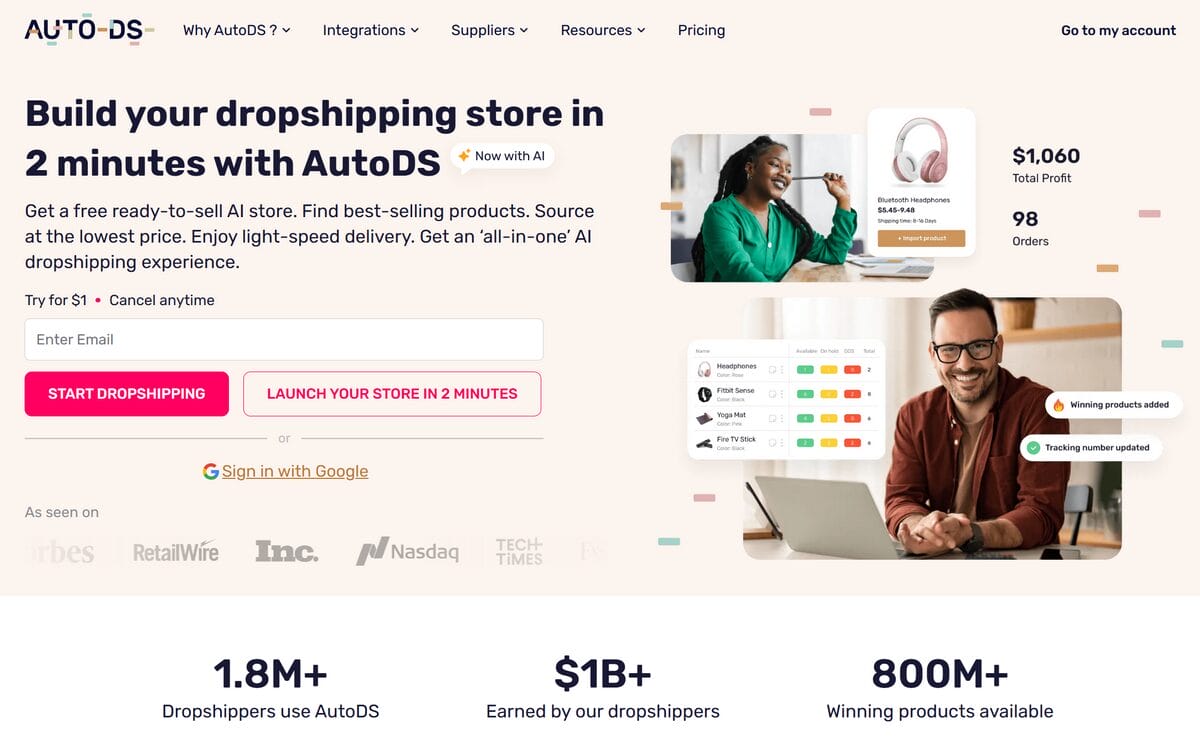
By now, one thing is pretty clear: in 2026, dropshipping is worth it when you treat it like a system. The challenge is that without the right setup, the day-to-day operations can get messy fast. That’s exactly where a tool like AutoDS starts to make a real difference.
It doesn’t “guarantee success” (nothing does), but it removes a lot of the friction that usually slows people down or causes avoidable mistakes.
Reducing Manual Work
One of the highest hidden costs in dropshipping is time. Not just the time you spend launching your store, but the hours that go into repetitive tasks: listing products, updating prices, tracking stock, and placing orders.
When you’re doing all of that manually, it limits how much you can actually grow. You spend more time managing the business than improving it.
AutoDS reduces workload by centralizing your operations in a single place. Instead of jumping between tabs and tools, you can manage products, orders, and suppliers from a single dashboard. That shift alone frees up time to focus on what actually drives results, like testing and marketing.
Product Research Support
Finding products is still one of the most important parts of dropshipping (but also one of the most time-consuming if you’re doing it blindly).
AutoDS streamlines product research by giving you access to product data, trending items, and research tools that help you spot potential winners. Instead of guessing what might work, you’re starting from insights and patterns.
And when you combine that with consistent testing, your chances of finding profitable products increase significantly.
Automation and Scaling Workflows
As your store grows, operations become more complex. More orders, more products, more moving parts.
This is where automation becomes essential. AutoDS automates key parts of the workflow, like syncing inventory and prices with your suppliers and fulfilling orders automatically. That means your store stays updated in real time, and you don’t have to manually process each sale.
The result is a business that can handle more volume without requiring more manual effort. In other words, it becomes scalable.
Minimizing Operational Errors
Manual processes delay you and create room for mistakes.
Things like:
- Selling out-of-stock products
- Pricing inconsistencies
- Delayed order fulfillment
These small errors can quickly turn into refunds, complaints, and lost trust.
AutoDS helps reduce these risks by keeping your store aligned with your suppliers. Inventory updates and price changes happen automatically, reducing surprises and increasing consistency. The best part is that AutoDS offers a $1 trial so you can test these benefits for yourself.
Dropshipping vs Other Business Models
When you’re deciding if dropshipping is worth it in 2026, the real question is how it compares to other ways of making money online. Because the truth is, dropshipping sits in a very specific spot: low risk, high flexibility, but more hands-on than people expect.
Let’s look at how it stacks up in real terms.
💎 Dropshipping vs Private Label
Private label is what a lot of dropshippers aim for long term. Instead of selling existing products, you create your own branded version: your packaging, your identity, sometimes even slight product customization.
That control is powerful. It usually leads to better margins and a stronger brand presence. But it also comes with a much higher barrier to entry. You need to invest upfront in inventory, wait for production, and take on the risk of not knowing whether the product will actually sell.
Dropshipping works differently. It allows you to test products without committing to inventory, which makes it much more forgiving at the beginning. You can validate demand first, and only then decide if it’s worth turning that product into a brand.
That’s why, in practice, these two models often complement each other. Dropshipping is about speed and validation. Private label is about control and long-term growth.
👥 Dropshipping vs Affiliate Marketing
Affiliate marketing is often positioned as the “simplest” way to make money online, and in some ways, that’s true. You promote someone else’s product, and when a sale happens, you earn a commission.
There’s no store to manage, no customer support, and no fulfillment to worry about. It’s clean and straightforward.
But that simplicity comes with a limitation: you don’t own anything in the process. You don’t control the pricing, the offer, or the customer relationship. Once the sale is made, the connection ends there.
Dropshipping, on the other hand, gives you ownership. You control the store, the experience, and the way the product is presented. That means you can build something that grows over time, instead of relying on one-off commissions.
So while affiliate marketing is easier to start, dropshipping gives you more room to build and scale.
🛍️ Dropshipping vs Wholesale
Wholesale is closer to traditional retail. You buy products in bulk at a lower price and sell them with a markup. Because you’re purchasing inventory upfront, your margins are usually stronger, and you have more control over stock and shipping.
But that control comes with responsibility. You need capital to buy inventory, space to store it, and systems to manage logistics. And if a product doesn’t sell, you’re left holding that stock.
Dropshipping removes that risk. You don’t need to invest heavily upfront, and you can switch products quickly if something isn’t working. That flexibility is a huge advantage, especially when you’re still figuring things out.
At the same time, wholesale tends to be more stable once you’re established. Many sellers actually move into it after validating products through dropshipping.
Frequently Asked Questions
Is dropshipping worth it in 2026?
Yes, dropshipping is still worth it in 2026—but only if you approach it strategically. The model itself is still profitable, but competition is higher, and execution matters more. Sellers who treat it like a real business, use automation, and test products consistently are still seeing solid results.
Can you still make money with dropshipping?
You can absolutely still make money with dropshipping. Many sellers generate anywhere from a few hundred to several thousand dollars per month. The difference comes down to how well you select products, market them, and manage operations. It’s not fully passive income, but it is scalable if done correctly.
How much do beginner dropshippers make?
Most beginners earn between $0 and $1,000 per month at the start. This phase is usually focused on learning and testing rather than profit. As you gain experience and find products that convert, income can grow steadily over time.
Is dropshipping too saturated to start?
No, dropshipping is not too saturated. What’s saturated is the approach of copying the same products and marketing angles as everyone else. There is still plenty of demand, but success depends on how you position your products and how quickly you adapt to trends.
How long does it take to become profitable?
It typically takes a few weeks to a few months for dropshipping to become profitable. Some sellers see early wins, but for most, profitability comes after consistent testing and optimization. The more efficiently you operate and learn from your results, the faster you improve.
Is dropshipping a good side hustle?
Yes, dropshipping works well as a side hustle because it doesn’t require a large upfront investment or full-time commitment at the beginning. With the right setup and some automation, you can manage it alongside a job while gradually scaling.
What are the biggest risks of dropshipping?
The main risks include low profit margins, supplier-related issues like shipping delays or product quality, and high competition. These risks don’t make the model unviable, but they do require careful management and realistic expectations.
Do I need a lot of money to start dropshipping?
No, you don’t need a large budget to start. Many people begin with a relatively small investment for their store and marketing. However, having some budget for testing products and running ads can significantly speed up your results. You can learn how much it costs to start a dropshipping business in 2026 here.
Start Your Dropshipping Journey with AutoDS
So, is dropshipping worth it in 2026? Yes, if you approach it with the right mindset and systems. A lot of people are still building profitable stores, testing products, and scaling them every day. But the difference now is that success comes from execution, consistency, and efficiency.
If you’re willing to:
- Treat it like a real business
- Test products instead of guessing
- And build systems that allow you to move fast
…then dropshipping is still one of the most practical ways to start in e-commerce.
Using a platform like AutoDS can completely change the experience. It automates product imports, pricing, inventory, and order fulfillment, so you can focus on what actually drives growth.
If you’re serious about making this work, don’t just “try” dropshipping; build it properly from day one. 👉 Start your AutoDS journey for just $1 and see how much smoother dropshipping can actually be when everything is connected and automated.
And don’t just stay with this info! AutoDS has hundreds of expert articles to guide you through this process:
- Is Dropshipping Worth It?
- How Dropshipping Works In 2026
- How Profitable Dropshipping Is?
- Is Dropshipping Saturated In 2026?
- When Dropshipping Is Worth It
- When Dropshipping Is NOT Worth It
- What Determines Success In Dropshipping
- How To Increase Your Chances Of Success
- How AutoDS Helps Dropshippers
- Dropshipping VS Other Business Models
- FAQ
- Conclusion