


I’m going to walk you through 10 real ways to earn on Shopify, what each one actually costs to start, and roughly what you can expect to make. No fluff, no “just be passionate” nonsense — just the stuff I wish someone had told me when I started.
To make money on Shopify, set up and manage your store using its user-friendly interface and comprehensive tools.
Customize your store, add products, set up payment and shipping, market your store, and manage your orders efficiently.
Explore profitable strategies like dropshipping, print on demand (POD), and selling digital products and downloads.
Utilize automation tools like AutoDS to streamline inventory management, order fulfillment, and product customization.
Implement marketing strategies such as email marketing, paid advertising, discount codes, product bundles, and analyzing customer feedback.
What Is Shopify And How Does It Work?
Shopify is an all-in-one commerce platform. It gives you a storefront, a checkout, payment processing, inventory tools, and marketing features under one roof — no need to duct-tape together five different services like you would with a custom-built site.
You’re choosing between two broad paths when you sell online: marketplaces (Amazon, eBay, Etsy), where you borrow someone else’s traffic, or your own e-commerce site, where Shopify shines. On your own site, shoppers see your brand and only your products, no competitor’s “similar item” popping up two inches from your buy button.
🆕 Beginner’s tip: If you’re brand new, don’t overthink your first Shopify plan. Start on Basic, get your first few sales under your belt, and upgrade once you actually hit the limits, not before.
How Much Does Shopify Cost in 2026?
Here’s the current Shopify pricing breakdown:
| Plan | Monthly Price | Annual Price | Best For |
|---|---|---|---|
| Basic | $39/mo | $29/mo | Solo sellers just starting out |
| Grow | $105/mo | $79/mo | Small teams scaling past their first few thousand in sales |
| Advanced | $399/mo | $299/mo | Stores needing advanced reporting and lower transaction fees |
| Plus | From $2,300/mo | - | High-volume brands needing custom checkout and B2B tools |
Every plan now includes agentic commerce features (selling directly inside AI chat tools like ChatGPT and Gemini) at no extra cost — something that used to be a Plus-only perk. For a $39/month store, that’s genuinely one of the better free upgrades Shopify has rolled out in years.
10 Proven Ways to Make Money on Shopify

I’ve ranked these roughly by how beginner-friendly they are, not by earning potential. Because honestly, the “best” method is the one you’ll actually stick with long enough to see results.
1️⃣ Start a Dropshipping Store
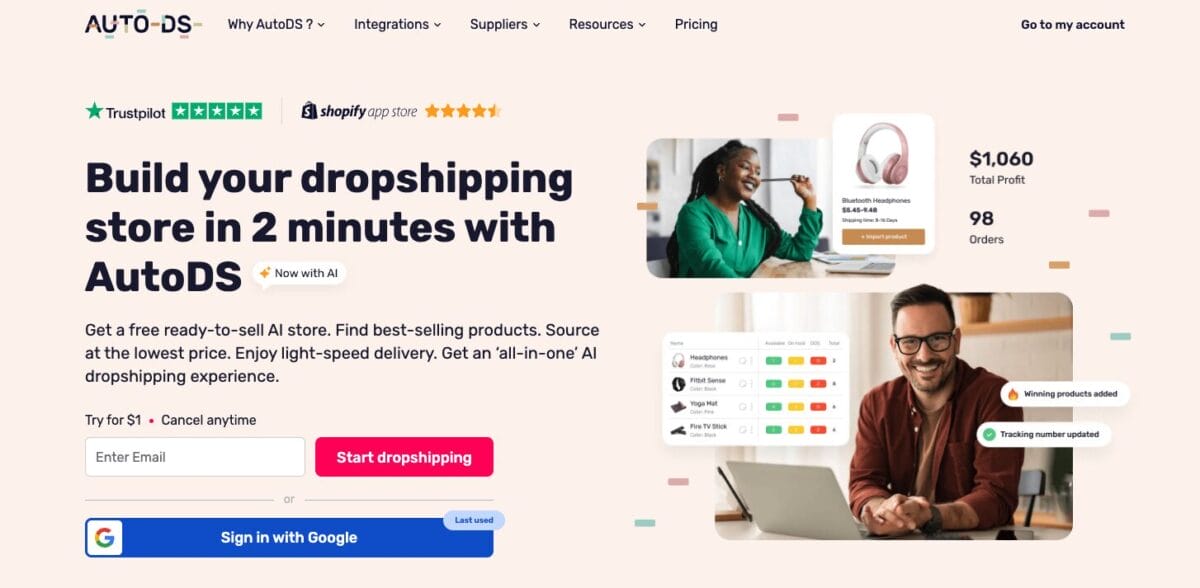
This is still, in my opinion, the most practical way to start selling on Shopify with minimal cash on hand. You partner with a supplier who holds inventory and ships orders; you handle the storefront, marketing, and customer experience.
The appeal is simple: no warehouse, no upfront inventory risk, and you can test a dozen product ideas before you find one that clicks. I’ve talked to sellers who made their first sale within two weeks of launching, and others who took three months of testing before anything stuck — that variance is normal, not a red flag.
Getting started: Pick a niche, import products (manually or with a tool like AutoDS’s product importer), and set up automated order fulfillment so you’re not copy-pasting tracking numbers all day.
💡 Pro tip: Save yourself the setup headache with AI-built Shopify stores that generate a ready-to-sell store in under two minutes, complete with products and theme.
For a full walkthrough, check out my breakdown of dropshipping on Shopify.
2️⃣ Launch a Print-On-Demand (POD) Brand
Print on demand lets you slap your own designs on blank products (t-shirts, mugs, phone cases, tote bags) without ever touching inventory. A supplier prints and ships each item only after it sells.
What I like about POD is the margin story: customers pay a premium for something that feels personal or on-trend, and you’re not competing purely on price the way you sometimes do with generic dropshipped items. It’s also genuinely fun! You can chase a meme, a niche fandom, or a seasonal trend and have a product live the same day.
AutoDS’s own Mario’s POD success story is a good example of how far a focused POD niche can go when you stick with it.
What it costs: Design tools like Canva are free to start; per-item costs vary by product but usually run $6-$18 before your markup.
3️⃣ Sell Digital Products and Downloads
Ebooks, templates, courses, presets, printables, stock photos — digital products have zero shipping costs and infinite inventory, which is a dream if you hate logistics as much as I do.
The catch is that success here leans heavily on your marketing and SEO game, since there’s no physical “wow” factor to lean on. Build an email list early, because digital product buyers tend to be repeat customers if you nail the first purchase.
📢 Marketing tip: Bundle 2-3 related digital products together at a discount. It bumps your average order value without costing you a single extra dollar in fulfillment.
4️⃣ Do Affiliate Marketing Through Your Shopify Store or Blog
This one surprises people, but you don’t need your own inventory at all to profit from Shopify traffic. Run a content-driven Shopify store or blog, recommend products (yours or others’), and earn a commission per sale.
The affiliate marketing industry is projected to surpass $20 billion globally in 2026, and it’s still one of the most accessible ways to monetize an audience without carrying stock. Realistically, average affiliate earners bring in around $8,000 a month once they’re established — though that number includes a wide range from beginners making very little to top performers making six figures.
How to combine it with Shopify: Use your store’s blog to publish buying guides and reviews, link out to affiliate offers, and cross-sell your own products in the same content.
5️⃣ Sell Services and Book Appointments
Coaching calls, design consultations, photography sessions, tutoring — Shopify handles booking-based services just as well as physical products when you add a booking app. If you already have a skill people pay for offline, Shopify gives you a professional storefront to sell it online.
This is a low-cost way to generate revenue while you build out a product-based side of your store, since your only real overhead is your time.
6️⃣ Launch a Subscription Box
Recurring revenue is the dream for a reason, and the subscription box market is valued at roughly $49.7 billion globally in 2026, still growing at nearly 20% a year. Beauty, pet products, snacks, and hobby niches all do well here.
I’ll be straight with you though: churn is the silent killer of subscription businesses. Industry data shows the average box faces 10-15% monthly churn, and 44% of cancellations happen in the first 90 days. If you go this route, obsess over your first-box experience — that’s where most subscribers decide whether to stay.
📦 Supplier’s tip: Negotiate volume-based pricing with your supplier before you launch a subscription box. Recurring orders give you real leverage that one-off dropshipping orders don’t.
7️⃣ Resell Products (Retail Arbitrage and Secondhand)
Buy discounted or secondhand items, list them at a markup, sell through Shopify. It’s not glamorous, but it works — especially in fashion, where the global secondhand market is projected to hit $393 billion by 2030, growing twice as fast as new apparel retail.
Clearance sales, liquidation pallets, and thrift finds can all become Shopify inventory if you’re willing to put in the sourcing legwork. This method takes more manual hustle than dropshipping since you’re physically handling and often photographing each item.
8️⃣ Sell Wholesale or Private Label Products
Buying products in bulk from a manufacturer and branding them as your own (private label) gives you more control over quality and margins than dropshipping, at the cost of upfront capital and inventory risk.
This is a natural “level up” move once you’ve validated a product through dropshipping and know it sells. I’ve seen sellers use dropshipping specifically as free market research before committing to a private label order.
🔍 Research tip: Before you commit to a bulk order, run the exact product through a dropshipping test for 4-6 weeks. If it doesn’t sell as a dropshipped item, it’s not going to magically sell better once you’ve paid for 500 units upfront.
9️⃣ Sell Handmade or Custom-Made Goods
Jewelry, art, custom furniture, personalized gifts: if you make things by hand, Shopify gives you a proper storefront instead of relying solely on marketplace fees eating your margin. Custom and personalized products also tend to justify higher prices, since customers are paying for something no one else has.
🔟 Flip Shopify Stores
This one’s less talked about, but it’s real: buy an underperforming or dormant Shopify store, improve its SEO, design, or product mix, grow its revenue for a few months, then sell it for a multiple of its monthly profit. Store marketplaces and Shopify’s own ecosystem make this more accessible than it sounds, though it does require some existing e-commerce know-how to pull off well.
💰 Financial tip: When evaluating a store to flip, focus on stores with clean traffic sources and organic search rankings, not stores propped up entirely by paid ads that’ll disappear the moment you stop spending.
Frequently Asked Questions
How long does it take to make money on Shopify?
Most sellers make their first sale within 30 to 60 days of launching, assuming they’re actively marketing the store. Reaching consistent, meaningful profit — enough to call it a real income stream — typically takes 6 to 12 months of steady optimization, testing, and reinvestment. Methods like dropshipping and affiliate marketing tend to show early traction faster than inventory-heavy models like wholesale, which need more upfront capital and time to break even.
How much money can you make on Shopify?
Earnings vary enormously by method, niche, and effort. Dropshippers and POD sellers commonly report anywhere from a few hundred to several thousand dollars a month within their first year, while affiliate marketers average around $8,000 a month once established, with the top performers earning significantly more. Subscription boxes and private label brands can scale higher but require more capital and patience upfront. There’s no universal number, but the platform itself doesn’t cap your potential — your niche, product, and marketing do.
Is Shopify worth it in 2026?
Yes, for most people starting an online business. Shopify’s pricing has stayed competitive, it now includes AI shopping channel integration on every plan, and its app ecosystem covers nearly every business model on this list, from dropshipping to subscriptions to services. The main reason it might not be worth it is if you’re running a multi-vendor marketplace or need full control over your source code — otherwise, it remains one of the most complete platforms available.
How do I make quick money on Shopify?
Automation is your fastest lever. Tools like AutoDS handle inventory syncing, order fulfillment, and price monitoring automatically, which frees you up to focus purely on marketing and product selection — the two things that actually move the needle on quick sales. Running a flash sale, launching a trending POD design, or promoting an existing digital product to an email list are also faster paths than starting a brand-new store from zero.
Which Shopify money-making method is best for beginners?
Dropshipping and print-on-demand are the most beginner-friendly because they require no upfront inventory investment. You can test multiple products and niches without risking much capital, which matters a lot when you’re still learning what resonates with an audience.
Conclusion
If there’s one thing I want you to take from this, it’s that Shopify isn’t a one-trick platform anymore. Dropshipping might still be the front door most people walk through, but affiliate marketing, subscription boxes, reselling, and even store flipping are all legitimate ways to build income on it in 2026.
Pick the method that matches your budget, your time, and honestly, your patience level, because the sellers who stick around long enough to optimize almost always beat the ones chasing the “perfect” niche on day one.
Whichever path you choose, you can get started today by setting up your store and letting AutoDS automate the busywork so you can spend your energy on the parts of the business that actually make you money.
If you’re ready to keep building out your knowledge, here are a few more guides worth your time: