


If you ever look at your numbers and wonder if you’re actually making money from your business, then PnL is the term you’re looking for. PnL means Profit and Loss and, in simple terms, shows how much money you earned, how much you spent, and whether you ended up with a profit or a loss over a specific period.
You’ll typically see the term PnL used in two main contexts: trading and investing (not exactly my area of expertise) and business or e-commerce, where it reflects revenue, costs, and overall profitability. That second one is what I’ll focus on here.
In this guide, I’ll break down everything online sellers and dropshippers need to know about PnL: what it means, how to read a P&L statement, which numbers actually matter, and how it connects to your store’s real profitability.
I’ll also show you tools and best practices for tracking expenses and profitability, including how AutoDS centralizes key metrics such as revenue, product costs, and profit.
PnL stands for Profit and Loss and shows whether your business made or lost money over a specific period.
A P&L statement breaks profitability into layers, from revenue and COGS to gross profit, operating expenses, and net profit.
PnL and cash flow are not the same: a store can be profitable on paper while still being short on cash because money doesn’t always move at the same time.
For dropshippers, profitability depends on more than sales. Product costs, shipping, fees, ads, pricing, and supplier changes all affect the final number.
AutoDS can help you monitor the factors that affect profitability, including revenue, product costs, supplier price changes, pricing rules, and product-level profit data from one platform.
PnL Meaning in Trading vs. PnL in E-commerce
First things first: PnL (also known as P&L) is not some mysterious finance code you were supposed to learn somewhere along the way. It simply means Profit and Loss, although its meaning can change slightly depending on the context. That’s why a quick Google search can send you from e-commerce accounting advice straight into crypto trading.
In trading and investing, PnL refers to the profit or loss generated by a position or portfolio. If an asset increases in value after you buy it, you have a profit. If it drops, you have a loss.
In e-commerce, PnL is not that different, really. It just has a broader role. Instead of looking at a trade, it looks at the financial performance of your business over a specific period.
For an online seller, that means comparing the money coming in from sales with the money going out through expenses and fees, such as:
- Product costs
- Shipping and fulfillment
- Marketplace or payment processing fees
- Advertising
- Software subscriptions
- Refunds and returns
- Other operating expenses
Here’s a practical example: if your store generates $10,000 in revenue during a month, but costs $8,000 to run, your PnL shows a $2,000 profit. If expenses exceed revenue, that number turns into a loss.
The goal is simple: keep a positive PnL. That usually goes hand in hand with a positive dropshipping profit margin, meaning your store is keeping part of its revenue as profit after costs. For sellers, that information is gold because sales alone don’t tell you how healthy your business is. A store can generate plenty of revenue and still lose money with product costs, ads, fees, refunds, and subscriptions.
Throughout this guide, I’ll use PnL in the e-commerce sense to understand whether your store is actually making money after costs are accounted for.
What Is a P&L Statement?
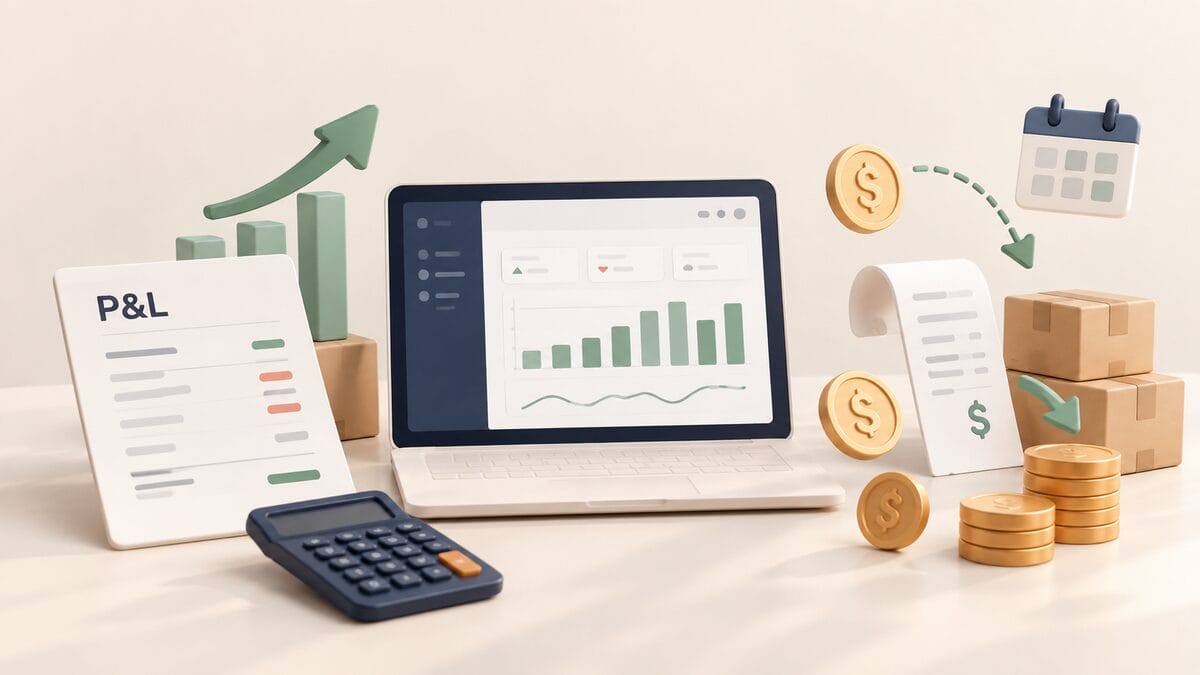
Now, let’s get a little more technical. When it comes to understanding your business finances, the P&L statement is one of the first things worth getting familiar with. This is a financial report that shows your business’s revenue, expenses, and resulting profit or loss over a specific period. You may also hear it called an “income statement”.
Think of it as an organized version of all those numbers floating around your store. Instead of looking at sales, supplier costs, ad spend, and fees separately, a P&L statement brings them together so you can see whether your dropshipping business was profitable.
At its simplest, the logic looks like this:
Revenue – Expenses = Profit or Loss
As you can see, it’s nothing complicated.
A typical P&L statement includes:
- Revenue: The total income generated from sales.
- Cost of goods sold (COGS): What you paid for the products you sold, including supplier costs and other direct expenses.
- Gross profit: Revenue minus COGS.
- Operating expenses: Costs such as advertising, software subscriptions, marketplace fees, and other expenses involved in running the business.
- Net profit or loss: What remains after all expenses are deducted.
P&L statements usually cover a specific period, such as a month, quarter, or year. That makes them especially useful for comparing performance over time. For example, you might discover that revenue went up from one month to another, but your profit actually dropped because ad spend or product costs increased.
And that’s the important part: a P&L statement tells you much more than how much you sold. It helps you understand how efficiently your store turns those sales into actual profit.
💰 Financial Tip: As your store grows, consider hiring an accountant or bookkeeper to keep your records organized, your P&L accurate, and your tax reporting in order.
How to Read a P&L Statement
At first glance, a P&L statement can look like a crossword of financial jargon. But once you know the order, it’s actually pretty straightforward: you start with revenue, subtract different layers of costs, and see what’s left.
Here’s how the standard structure works:
1. Revenue
Formula:
Revenue = Total Sales Income
Revenue is all the money your store generates from sales before expenses are deducted. It tells you how much your business is bringing in, but not yet how much you’re actually keeping.
2. Cost of Goods Sold (COGS)
Formula:
COGS = Direct Costs of Products Sold
COGS covers the direct cost of the products you sell. For a dropshipper, that usually means what you pay your supplier for the items customers order, plus other direct product-related costs, when applicable.
3. Gross Profit
Formula:
Gross Profit = Revenue − COGS
Gross profit shows how much money remains after covering the direct cost of your products. It’s a quick way to see whether your pricing leaves enough room to cover the rest of your business expenses.
4. Operating Expenses
Formula:
Operating Expenses = Total Day-to-Day Business Costs
These are the costs of running your store that aren’t directly tied to producing or sourcing each product. Think advertising, software subscriptions, apps, platform fees, and other overhead.
5. Operating Profit
Formula:
Operating Profit = Gross Profit − Operating Expenses
Operating profit tells you how profitable the core business is after both product costs and everyday operating expenses are accounted for.
6. Net Profit
Formula:
Net Profit = Total Revenue − Total Expenses
Net profit is the number most sellers ultimately care about: what’s actually left after all costs are taken into account. If it’s positive, you made a profit. If it’s negative, your expenses were higher than your revenue.
The full flow looks like this: Revenue → COGS → Gross Profit → Operating Expenses → Operating Profit → Net Profit. Each step gives you a slightly clearer picture of where your money is going. And if profits start shrinking somewhere along the way, your P&L helps you spot exactly where the problem begins.
PnL vs. Cash Flow: What’s the Difference?
Here’s where things can get a little confusing: being profitable doesn’t necessarily mean having cash available. Your PnL and your cash flow both tell you something about your store’s financial health, but they answer different questions.
- PnL indicates whether the business made or lost money during this period.
- Cash flow shows how much money actually moved in and out of the business during the selected period.
In other words, a P&L shows the revenue and expenses tied to your business during a given period, while cash flow tracks when that money actually enters or leaves your account. The issue? Those two moments don’t always happen at the same time.
Let’s say your dropshipping store makes a $1,000 sale today. After product costs, ads, fees, and other expenses, you expect to keep $200 in profit. Great news: your store may have generated a profitable sale. But that doesn’t mean the cash is already available in your account.
Here’s the catch: your payment processor might not deposit that $1,000 into your account for another few days, while your supplier needs to be paid right now to fulfill the order. Suddenly, your business is profitable on paper, but you still need enough cash on hand to pay your suppliers.
That timing gap becomes even more important as order volume grows. You could have thousands of dollars in profitable sales waiting to be paid out while simultaneously needing thousands of dollars to fulfill those orders.
That’s why you should keep an eye on both PnL and cash flow. PnL tells you whether your business model is actually profitable, while cash flow tells you whether you have enough money available to keep that business running in the meantime.
💰 Financial Tip: Build cash flow into your pricing strategy. Don’t set prices based on product cost alone. Factor in supplier costs, shipping, transaction fees, ad spend, refunds, and your target margin so every sale leaves enough breathing room to cover expenses while you wait for payouts.
Gross PnL vs. Net PnL
Another distinction worth knowing is gross PnL and net PnL. In accounting, you’ll more commonly see these referred to as gross profit and net profit. They both measure profit, but they stop at different points in the calculation.
Every time you see a “gross” figure, it basically reflects a number before all the other deductions are taken out. It’s an earlier, less-filtered figure. Instead, a net number is what remains after most or all relevant costs have been deducted.
Therefore, Gross PnL shows how much profit is left after subtracting the direct cost of the products you sold. For dropshippers, that usually means supplier costs and any other direct product-related expenses.
Formula:
Gross PnL = Revenue − COGS
So, if you generate $10,000 in sales and spend $6,000 on products, your gross PnL is $4,000. Simple as that.
That number is useful because it shows the direct profitability of your product strategy, but it’s not the whole story. You still haven’t accounted for everything else it costs you to run the store.
That’s where Net PnL comes in. It goes one step further and subtracts all remaining business expenses that haven’t already been included in COGS, such as:
- Advertising
- Marketplace and payment processing fees
- Shipping and fulfillment costs
- Software and tools
- Refunds and returns
- Other operating expenses
Formula:
Net PnL = Revenue – All expenses
Using the previous example, if your gross PnL is $4,000 but you spend another $3,000 on ads, fees, subscriptions, and other costs, your net PnL is $1,000.
That’s why net PnL gives you a much more realistic picture of profitability. Gross PnL tells you whether your products leave enough margin to work with, while net PnL tells you whether the business as a whole is actually making money.
💡 Pro Tip: In your product research phase, focus on high-margin products. The more room you have between your product cost and selling price, the easier it is to absorb ads, fees, refunds, and other expenses without destroying your net profit.
How AutoDS Helps You Track Profitability
Knowing your theories and concepts about PnL is one thing, but keeping track of all the moving pieces behind it is another, especially when supplier prices, fees, sales, and inventory can change while you’re busy doing literally anything else.
Luckily, in 2026, you have a wide variety of platforms and tools to help you. That’s where AutoDS comes in: it doesn’t replace accounting software or a formal P&L statement, but it can help you monitor many of the day-to-day numbers from your dropshipping business, including:
- Product research with profitability in mind. AutoDS’s product research tools show useful data like product cost, shipping cost, selling price, and potential profit. This makes it easier to compare opportunities and focus on products with stronger profit potential before adding them to your store.
- Price and stock monitoring. A profitable product can become a lot less profitable and affect your PnL if your supplier suddenly raises its price. AutoDS scans supplier prices and stock levels every 60 minutes and automatically updates your listings to keep them aligned with supplier changes and protect your margins.
- Automatic price optimization. It adjusts product prices based on sales performance. You can automatically raise prices for high-demand sellers to increase profit, or lower them for slower-moving products to stay competitive.
- Pricing rules based on profit goals. AutoDS also lets you create pricing rules that factor in things like target profit, fees, shipping costs, and minimum profit. This helps you maintain your target margins.
- Metrics dashboard. The AutoDS dashboard centralizes metrics like revenue, product costs, orders, and platform-calculated profit, giving you a quick operational view of store performance.
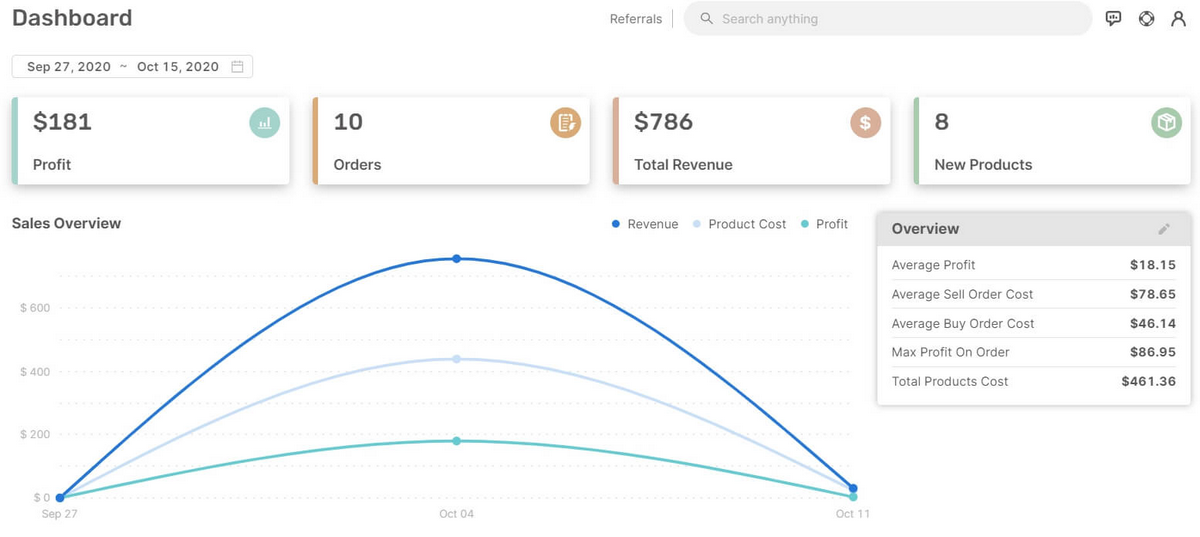
This way, AutoDS can help you manage many of the operational factors that influence your PnL, from product costs and pricing to sales performance and stock changes.
If you want to try these features out, you can get started with the AutoDS $1 trial. During the trial, you get access to the full feature set of your selected plan and can cancel at any time.
Just keep in mind that it’s still a dropshipping automation platform, not a replacement for bookkeeping or accounting software. For a complete financial picture, you’ll want to use these insights alongside your P&L statement and broader business records.
Frequently Asked Questions
What does PnL mean?
PnL stands for Profit and Loss. It shows whether a business, investment, or trade made money or lost money over a specific period.
Is PnL the same as a P&L statement or income statement?
No, PnL is not exactly the same as the P&L statement or income statement. PnL can refer broadly to profit and loss, while a P&L statement is the financial report used to organize that information. A P&L statement and an income statement are essentially the same type of report.
What’s the difference between P&L and cash flow?
A P&L measures profitability, while cash flow tracks the actual money entering and leaving your business. Because payments and expenses don’t always happen at the same time, a store can be profitable on paper but still have limited cash available.
What is the difference between gross PnL and net PnL?
Gross PnL is what remains after subtracting the cost of goods sold (COGS) from revenue. Net PnL goes further by accounting for all expenses, such as advertising, fees, shipping, software, and other operating costs.
What does “today’s PnL” mean?
Today’s PnL simply means the profit or loss generated during the current day. It’s especially common terminology in trading dashboards, but the same idea can be applied to a business tracking its daily performance.
Is it mandatory for a small business to prepare a P&L statement?
Not necessarily. Requirements depend on your country, business structure, tax obligations, and reporting rules. That said, even when a formal P&L isn’t legally required, keeping one is useful for understanding profitability, preparing taxes, applying for financing, and making better business decisions.
How do I calculate my profit or loss?
At the simplest level, you can calculate your profit and loss (PnL) with the following formula: Profit or Loss = Revenue − Expenses. If the result is positive, you made a profit. If it’s negative, you made a loss. For a more accurate picture, make sure you include all relevant costs, not just what you paid for the product.
What’s the difference between a P&L statement and a balance sheet?
A P&L statement shows financial performance over a period of time by tracking revenue, expenses, and profit or loss. A balance sheet shows your financial position at a specific point in time, including what the business owns (assets), what it owes (liabilities), and the owner’s equity.
How often should a dropshipper review their P&L?
As a dropshipper, you should review your P&L around once a month, with quarterly and yearly reviews helping you spot broader trends. If your store is growing quickly, running lots of ads, or experiencing frequent cost changes, checking profitability more often can help you catch problems earlier.
Can AutoDS help me track my store’s profit and loss?
Yes, AutoDS can help you monitor profitability metrics and many operational factors that affect your P&L, but it isn’t a replacement for accounting software or a formal P&L statement, as it isn’t a dedicated P&L tool. As a dropshipping platform, it tracks metrics such as revenue, profit, orders, and product performance, while tools for pricing, supplier price monitoring, and expected versus actual product profit help you manage some of the factors that affect profitability.
Know And Improve Your PnL With AutoDS
At the end of the day, PnL is simply a way to answer one very important question: is your business actually making money? Understanding revenue, COGS, gross profit, expenses, and cash flow, and how they relate to actual profitability, gives you a much clearer picture of what’s really happening behind your numbers and spreadsheets.
Once you know how to read a P&L statement, it becomes much easier to spot where profit is growing, where costs are stacking up, and what needs your attention.
Tools like AutoDS can help with the day-to-day side of that picture by centralizing key store metrics, monitoring supplier prices and stock, supporting pricing rules, and showing profitability data during your product research phase.
Just remember: it doesn’t replace proper accounting tools, but it can be a smart addition to your financial tech stack to stay on top of the operational factors that influence your PnL in the first place.
Want to learn a bit more about finances in dropshipping? Here are a few other reads you might find useful: