A private label business can give you something traditional dropshipping can’t: more control over the product you sell and the brand you build around it. But before your logo ever reaches a package, you need a supplier that can actually make the whole thing work.
And that’s where things get tricky. Private label dropshipping suppliers can differ significantly in what they offer, from product selection and customization to minimum order quantities (MOQs) and pricing. The perfect match for a skincare brand, for example, may be completely wrong for someone launching custom apparel.
So, let me save you some digging. In this guide, I’ll compare the best private label dropshipping suppliers by niche and look at what each brings to the table. Plus, I’ll unpack how private label differs from regular and white-label dropshipping, when it makes sense to take that leap, and the steps to launch your own business.
Private label dropshipping lets you sell personalized products without touching inventory, combining the brand-building benefits of private labeling with the low-risk model of dropshipping.
The right private label dropshipping supplier depends on what you’re building, since niches, MOQs, customization options, costs, and fulfillment models can vary considerably.
MOQs aren’t universal in private label with several platforms supporting individual fulfillment, while deeper customization often requires a larger commitment.
Supplier research should go beyond catalog prices to include samples, packaging, shipping, certifications where relevant, and total landed costs.
AutoDS can simplify the operation around your private label dropshipping business by connecting supplier access with research, importing, monitoring, and fulfillment automation.
What Is Private Label Dropshipping?
Picture this: you hand off the manufacturing and the shipping, but you keep the brand. That’s private label dropshipping: a supplier makes (or sources) the product, and once you’ve stamped it with your own identity, they ship it straight to your customer’s door. You never touch a box, yet everything about the experience feels distinctly yours.
Here’s how it works in practice: you track down a supplier who fits your niche, pick or tweak a product, layer on your branding, and list it in your store. From there, your partner takes the wheel on fulfillment while your name stays on the label. Not bad, right? You get to pour your energy into the storefront and the customer experience, and your garage never has to double as a warehouse.
Private Label vs. White Label Dropshipping
Private label and white label dropshipping may sound similar, but the key difference is how much you can customize the product itself. With private label, you work with a supplier to create or modify a product around your specifications, then sell it under your own brand.
White label dropshipping takes a different route. The merchandise already exists and is typically available to multiple sellers. So, while you can add your branding, you have little room to change what’s actually inside the box.
Think of it this way: private label lets you shape the product; white label lets you brand an existing one. That extra creative freedom can be worth the effort if you want to build a brand around something shoppers won’t encounter in a dozen other stores.
Private Label vs. Dropshipping
Traditional dropshipping keeps things simple: you sell items that already exist, and a third party fulfills each order for you. There’s usually no need to develop your own version or commit to large amounts of inventory upfront. The trade-off? Other stores can often sell the exact same thing.
Private label takes you further into brand-building territory. Instead of choosing an existing item and listing it as-is, you can adapt what you sell to your specifications, from its features or formulation to packaging and branding. That gives you more room to differentiate, but it can also mean higher upfront costs, minimum order quantities (MOQs), samples, and longer lead times.
Private label dropshipping sits somewhere between those two worlds. You get the customization and branding opportunities of private labeling while outsourcing fulfillment like a dropshipper. Depending on the arrangement, your partner may manufacture, store, package, and ship orders directly to customers under your brand.
So, what do you gain? A more distinctive offer without taking fulfillment entirely into your own hands.
Comparison Table: Dropshipping vs. White Label vs. Private Label
Now that I’ve walked through each model on its own, let’s see how the three models stack up side by side:
| Aspects | Traditional Dropshipping | White Label Dropshipping | Private Label Dropshipping |
|---|---|---|---|
| What you sell | Existing products also available to other sellers | Existing products sold under your brand | Products created or adapted for your brand |
| Customization | Little to none | Mostly branding and packaging | Product, branding, and packaging options |
| Brand differentiation | Low | Medium | High |
| Upfront investment | Low | Low to moderate | Typically higher |
| Best for | Testing products with minimal commitment | Building a brand around existing goods | Creating a more distinctive branded offer |
| MOQs | Often none | Varies by provider | More common |
Private Label Dropshipping: Pros & Cons
Private label gives you more room to build something of your own. But, as you’ve probably guessed by now, that extra freedom comes with a few strings attached.
Before committing, here’s what to put on each side of the scale:
Pros:
- Stronger brand differentiation: You’re not limited to selling the exact same item as dozens of other stores. Depending on your supplier, you can customize the product, packaging, formulation, or other details that make your offer harder to replicate.
- More pricing power: When shoppers can’t easily find an identical product elsewhere, you’re less likely to compete on price alone. A distinctive offer and stronger branding give you more room to set prices around perceived value.
- Higher margin potential: Private label gives you more control over production costs and pricing, creating more room to improve profitability as your brand grows. Net profit margins for private label businesses can range from 13–33%, compared with around 15–25% for traditional dropshipping. That wider upside reflects one of private label’s biggest advantages: a differentiated product gives you more ways to protect your margins than competing on price alone.
- More room to build customer loyalty: A memorable brand gives customers something to come back to. Instead of remembering a generic item they could buy elsewhere, they can associate the experience (and hopefully their next purchase) with your store.
Cons:
- Fewer suitable suppliers: Finding someone who can simply fulfill an order is one thing; finding a partner that offers the customization, branding, and shipping setup you need is another. Your pool of options gets smaller as your requirements become more specific.
- Minimum order quantities (MOQs): Some manufacturers require you to commit to a certain number of units before they’ll customize or produce an item. That can make testing demand more expensive than with traditional dropshipping.
- Higher upfront costs: Samples, custom packaging, product development, deposits, and initial production runs can all require money before your first customer buys. How much depends heavily on the provider and level of customization.
Should You Start With Private Label, or Validate First?
Going private label can be an exciting next step: you’ve found something worth selling, and now you get to make it more distinctly yours. But if you’re starting with a brand-new product idea, there’s a smart way to build toward that point: validate demand first.
Traditional or white label dropshipping can work as your testing ground. You can launch the product with little to no inventory commitment upfront, see how real customers respond, and gather sales data before investing in customization. Once demand is there, private label becomes a much more informed move.
A simple progression could look like this. Say you want to build a brand around insulated water bottles:
- Test the idea: Start by dropshipping an existing insulated bottle and put it in front of real customers. At this stage, you’re trying to answer one question: will people actually buy it?
- Validate demand: Sales start coming in, reviews reveal what customers like, and maybe a pattern emerges: they love the design but wish the bottle were larger or easier to carry. Now you have more than a hunch; you have actual customer signals to work with.
- Make it yours: Take those insights to a private label supplier. You could introduce a larger size, change the lid or handle, choose your own finish, and add branded packaging. The product that proved itself in step one is now becoming yours distinctly.
Why bother with this order of operations? Because private label suppliers often ask for samples, MOQs, and other costs before you’ve sold a single unit. Validating first means that money is backing a product that’s already shown it can sell.
None of this is set in stone, by the way. If you’ve already got an audience, solid market data, or the capital to launch your concept outright, skipping straight to private label can make perfect sense. The goal isn’t to slow you down but to give your brand the strongest possible launchpad.
Private Label Dropshipping: Best Practices
Once you’re ready to move into private label, the details start to matter. You’re putting your name on the product, after all. Here are a few practices I’d follow before sending it out to customers:
- Vet the supplier, not just the catalog: A great-looking product means little if fulfillment is unreliable. Check reviews, business history, communication, shipping capabilities, and how the supplier handles quality issues. And don’t rely on star ratings alone: pay attention to recurring complaints about delays, inconsistent quality, or poor support.
- Get the full picture before doing the math: Ask for specifications, customization options, MOQs, sample costs, production lead times, shipping estimates, packaging details, and any relevant certifications or testing documents. Those details affect both what you can promise customers and whether your margins actually work.
- Always order a sample: Photos and spec sheets can only tell you so much. Test the item yourself, inspect the packaging, and experience the order as your customer would. If you wouldn’t be happy opening that package, your logo probably shouldn’t go on it yet.
- Know exactly who you’re building for: “People who like skincare” or “fitness enthusiasts” isn’t much of a target market. Get more specific about the customer, the problem your offer solves, what alternatives they already buy, and why they’d choose yours. The clearer that picture gets, the easier your branding and positioning decisions become.
- Start focused, then expand: You don’t need a 30-product catalog to look like a real brand. A smaller selection gives you room to learn what customers respond to, refine the experience, and invest more deliberately in the products that show potential.
- Keep checking quality after launch: One good sample doesn’t guarantee every future batch will match it. Monitor reviews, returns, complaints, and supplier performance as orders grow. Private label quality control is an ongoing job, not a box you check before launch.
Best Private Label Dropshipping Suppliers by Niche
Now we’re getting to the good part. You know how private label dropshipping works and the key factors to consider when choosing a supplier. So, it’s time to see who can actually help you bring your brand to life.
One thing to keep in mind: the best option depends heavily on what you want to sell. So, instead of throwing every provider into one giant list, I’ve grouped them by niche.
Here are some of the best private label dropshipping suppliers to consider:
General & POD
AutoDS
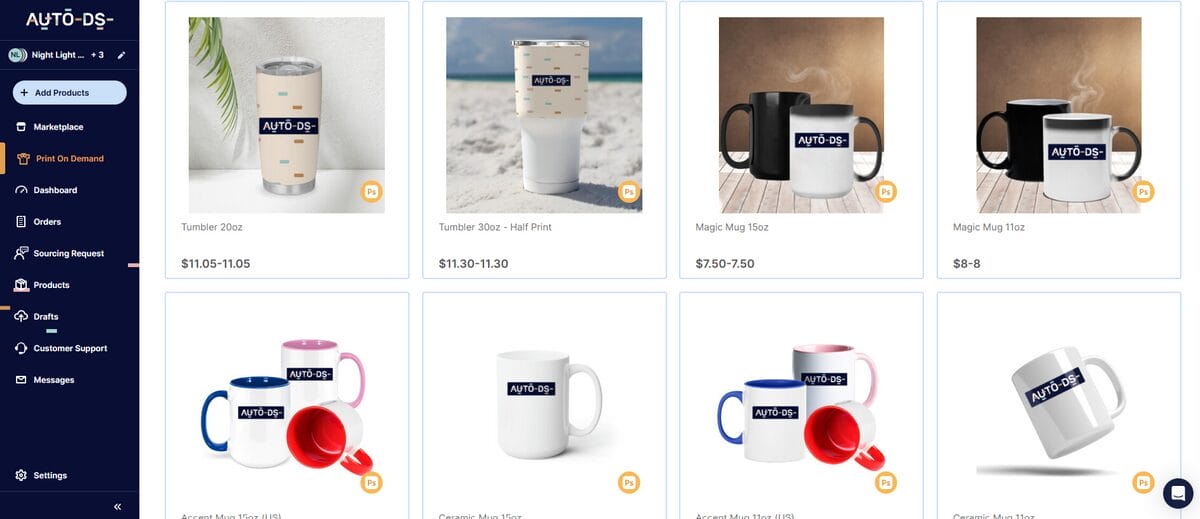
AutoDS is a dropshipping automation platform that gives you several ways to start building a private label business without taking manufacturing into your own hands. Through its Print on Demand (POD) offering, you can customize apparel, accessories, footwear, and more using the built-in design editor, while new POD products are regularly added to the catalog.
Then there are AutoDS Private Suppliers, which open up another route to differentiation. These partners offer access to products beyond the standard marketplace selection, with benefits such as faster shipping and sourcing opportunities that can help you create a more distinctive catalog. And because they sit inside the broader AutoDS ecosystem, you can connect sourcing with product importing, listing optimization, price and stock monitoring, and automated fulfillment instead of piecing together separate tools.
- MOQ: No minimum order quantity for stock products.
- Starting cost: $1 trial, with AutoDS plans starting at around $26.90/month; product and fulfillment costs vary.
- Standout feature: POD and Private Suppliers meet end-to-end dropshipping automation, letting you source and differentiate products while managing much of the workflow from the same platform.
Printful
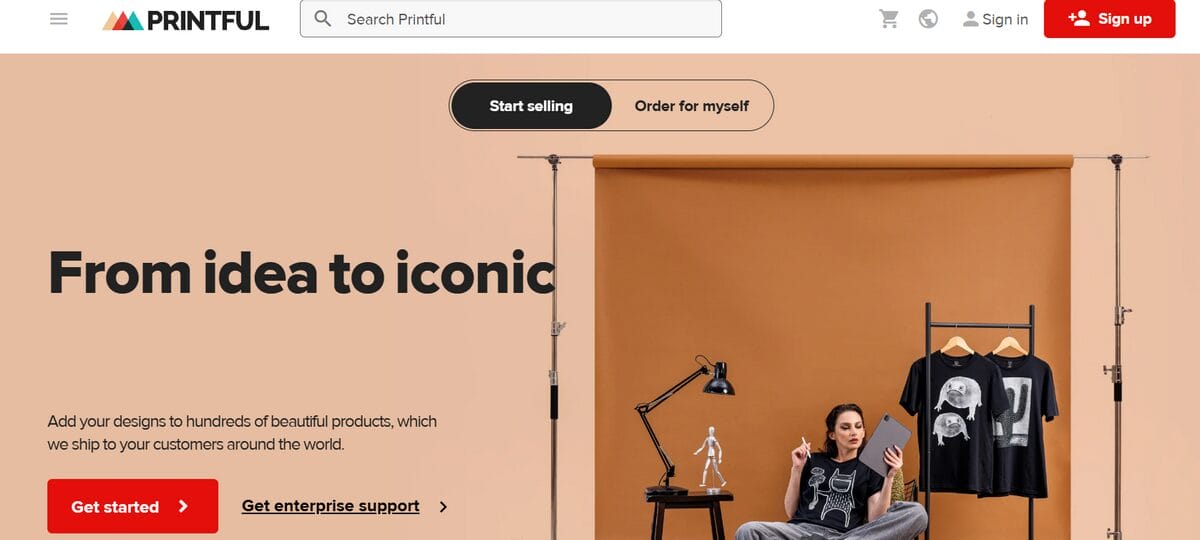
Printful is a print-on-demand and white-label fulfillment platform built around one simple idea: your products are only made once a customer orders them. You can choose from 548 customizable products, add your own designs using its Design Maker, connect your store, and let Printful handle production, packing, and shipping.
For private label sellers, though, the interesting part goes beyond printing a logo on a T-shirt. Printful ships orders without its own branding and lets you build more of your identity into the experience through custom inside and outside labels, branded packing slips, pack-ins, and custom packaging on eligible products and fulfillment locations. That gives you room to make both the item and the unboxing experience feel like they belong to your brand.
- MOQ: No MOQ; products can be made and fulfilled one at a time.
- Starting cost: Free to start, with no setup or required monthly subscription; you pay for product, printing, shipping, and applicable extras when an order is placed.
- Standout feature: On-demand customization plus additional branding options.
AliExpress
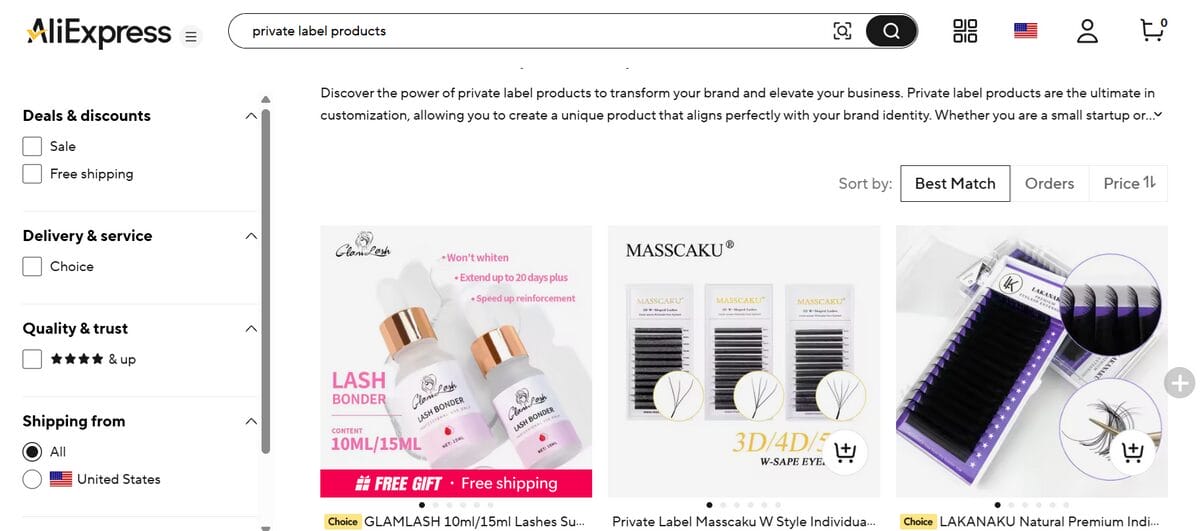
AliExpress is already a familiar name in dropshipping, but it can also work as a stepping stone into private label. Its massive marketplace makes it easy to source and test existing products first, often one unit at a time, before approaching individual sellers about customization once you know what deserves your investment.
And that distinction matters: AliExpress itself isn’t a private label manufacturer. Branding options depend on the seller, but some offer customized products or are open to arrangements involving your logo, labels, packaging, colors, or other modifications. In practice, that means reaching out directly, explaining what you want, and asking about samples, setup costs, lead times, and the MOQ attached to your specific request. AliExpress formally supports purchases of customized products, but the terms of each arrangement remain seller-specific.
- MOQ: Varies by seller and customization request; many standard products can be purchased individually, while custom branding may require a larger order.
- Starting cost: No required platform subscription for sourcing; product, sample, shipping, and customization costs vary by seller.
- Standout feature: An easy bridge between traditional dropshipping and private label, letting you test existing products before negotiating branding or customization with individual sellers.
AliBaba
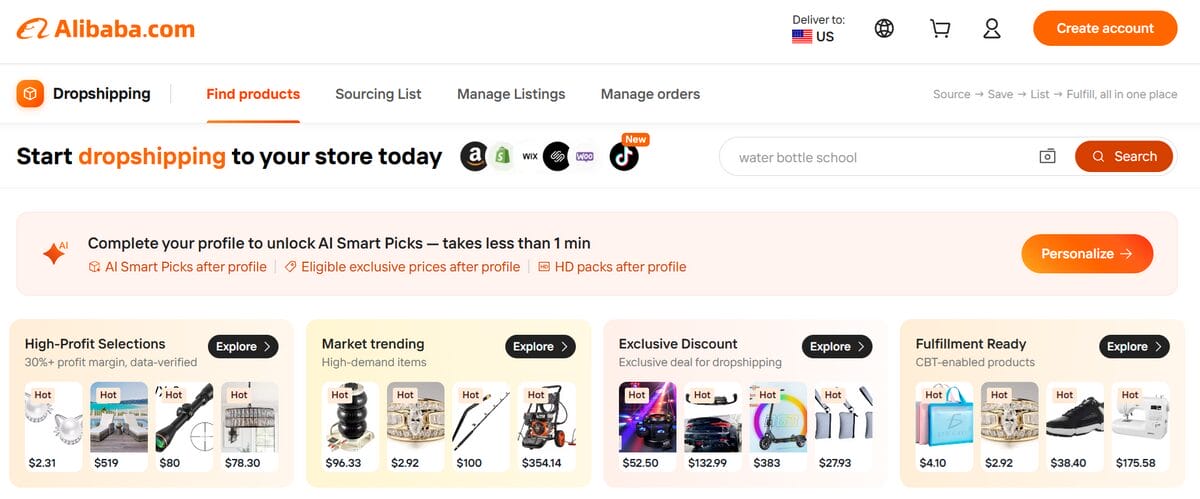
Alibaba takes private label a step further by connecting you directly with manufacturers and wholesale suppliers across a huge range of categories. Instead of simply adding your logo to an existing item, you can find partners willing to customize materials, dimensions, colors, packaging, features, or even develop a product around your specifications.
That deeper customization changes the relationship, though. You’ll typically need to request quotes, order samples, negotiate MOQs, confirm production lead times, and discuss branding requirements directly with the manufacturer. Unlike the no-MOQ platforms above, there’s no universal minimum or starting price: both depend on the product, factory, and complexity of what you want to create.
So, Alibaba makes the most sense when you’re ready to move from testing an idea to investing in a more distinctive version of it. It asks for more capital and planning than standard dropshipping, but that commitment buys you something valuable in private label: much more say over what ultimately carries your name.
- MOQ: Varies by manufacturer and product; custom/private-label orders commonly involve production minimums.
- Starting cost: No universal starting cost; samples, unit pricing, customization, packaging, shipping, and potential deposits are quoted by each supplier.
- Standout feature: Direct manufacturer relationships and deeper customization, making it a strong route for sellers ready to turn a validated idea into a more proprietary branded product.
Supplements & Wellness
Supliful
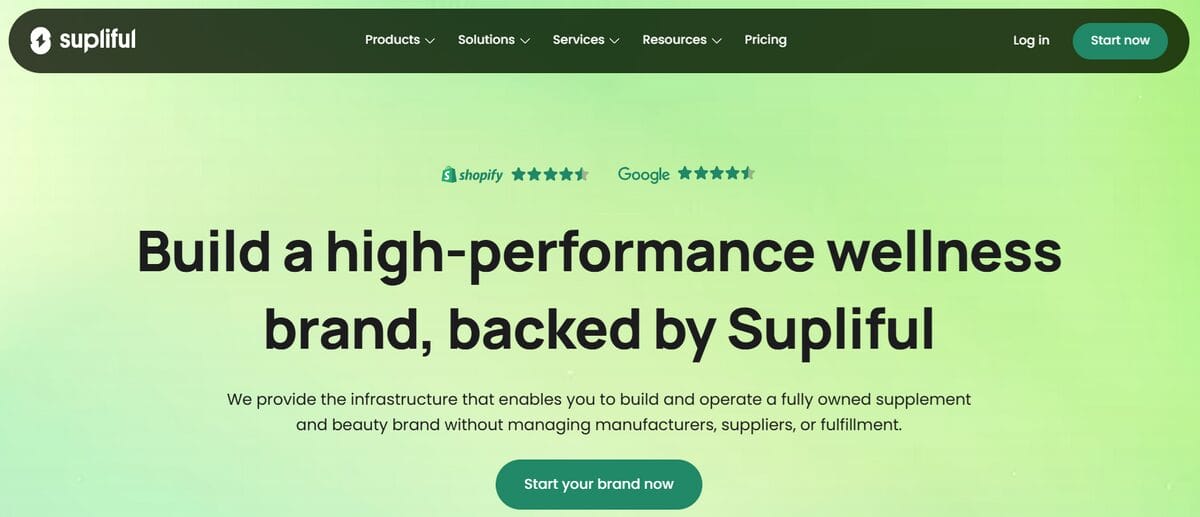
Supliful is a private label platform focused on supplements, wellness, and related products, making it possible to launch your own private label supplements line without ordering inventory in bulk. Instead of developing a formula from scratch, you choose from its ready-made catalog, customize the label and branding, connect your store, and Supliful produces and ships each order directly to your customer.
That catalog-based model removes one of the biggest barriers to entering this niche: you can start with no MOQ and pay for products as orders come in. Supliful also works with products manufactured in FDA-registered, GMP-compliant facilities, an especially relevant consideration when you’re putting your brand on supplements. Just remember the distinction we covered earlier: that manufacturing setup can simplify part of the process, but your brand still needs to make sure its labels and marketing claims meet the applicable requirements.
- MOQ: No MOQ; products can be fulfilled individually as customers order.
- Starting cost: No inventory investment required upfront; you pay product and fulfillment costs as orders come in (optional paid plans and additional services may add costs).
- Standout feature: Ready-to-brand supplement and wellness catalog with on-demand fulfillment, removing the need for a traditional bulk production run.
Nutribl
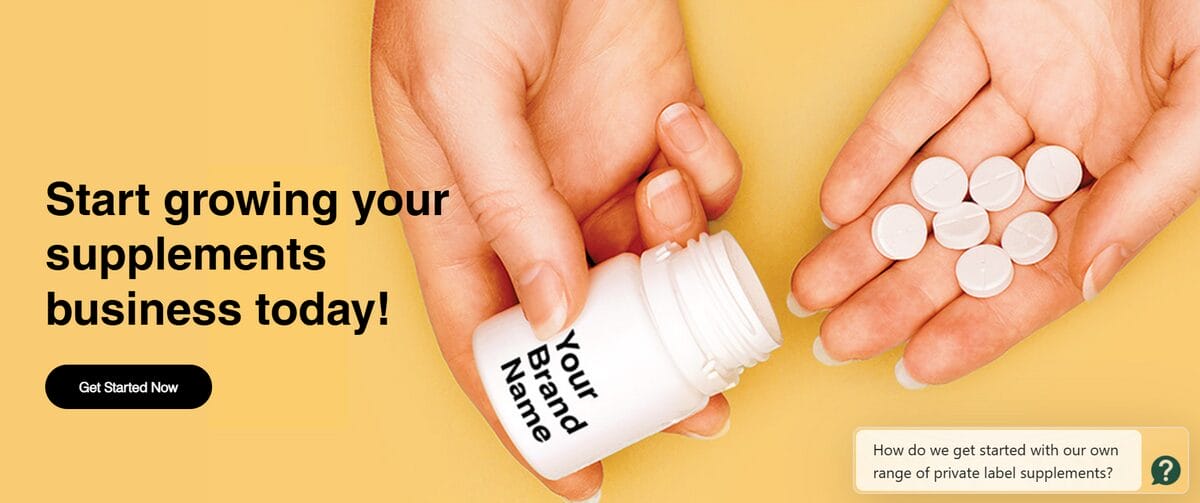
Nutribl is a UK-based private-label supplement supplier that lets you build a branded wellness range without handling fulfillment yourself. Its catalog covers vitamins, minerals, herbal extracts, oils, probiotics, and other supplements, with dozens of products specifically available for private/white labeling.
For dropshippers, the useful part is how those two services connect. Nutribl can apply your own private label and ship individual customer orders on your behalf, so you don’t have to receive, repackage, and resend every bottle yourself. Its dropshipping system even distinguishes dedicated private-label SKUs, making branded fulfillment part of the ordering workflow rather than a separate step.
- MOQ: No traditional bulk MOQ for products available through its private-label dropshipping program; individual customer orders can be fulfilled directly.
- Starting cost: Product and shipping costs vary by SKU/order; Nutribl’s published dropshipping guide lists per-order shipping charges rather than a universal startup price.
- Standout feature: Private-label supplements combined with direct-to-customer dropshipping, giving you a ready-made product catalog without having to fulfill branded orders yourself.
Beauty & Skincare
Blanka
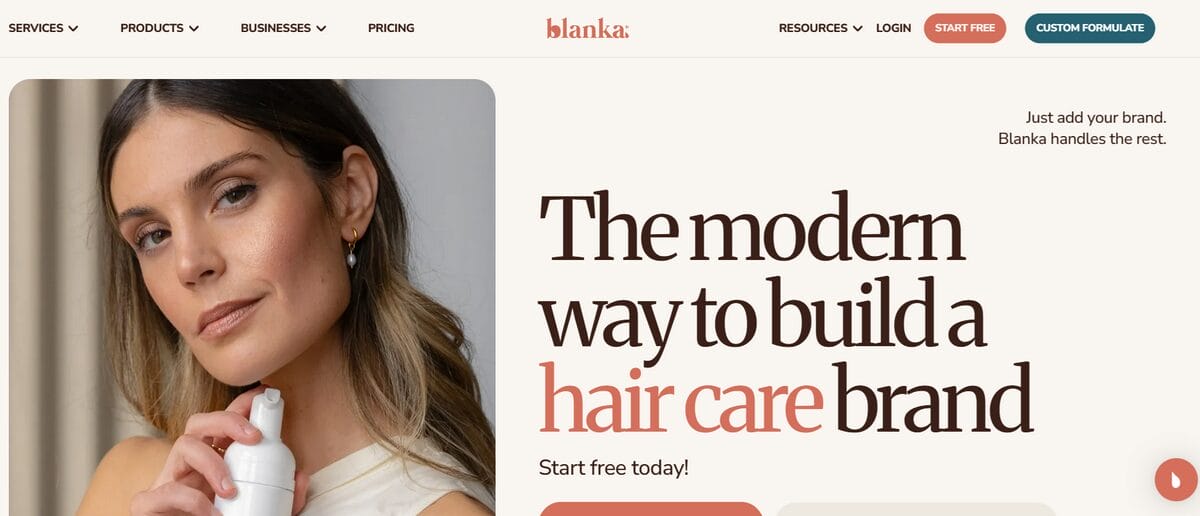
Blanka is a private label beauty and skincare platform built for brands that want their own product line without developing every formula from scratch. You can choose from 450+ ready-to-brand products, add your logo and custom labels, connect your ecommerce store, and have Blanka dropship orders directly to customers.
What makes Blanka particularly flexible is that you’re not locked into that entry-level model as your brand grows. Its standard private label service uses existing formulas and supports custom labels and packaging, while Blanka Labs lets you go further with custom ingredients, packaging, and formulas you own.
That progression fits private label especially well: start small, build the beauty brand, then deepen product differentiation when the business is ready. Blanka also states that its formulas are FDA and EU-compliant, which is particularly relevant in a category where product and labeling requirements deserve extra attention.
- MOQ: No MOQ for its ready-to-brand private label catalog.
- Starting cost: Free to start; product, shipping, branding, and optional service costs vary depending on what you use.
- Standout feature: A clear path from zero-MOQ private label beauty to custom formulation, letting you increase product ownership as your brand grows.
Jubilee
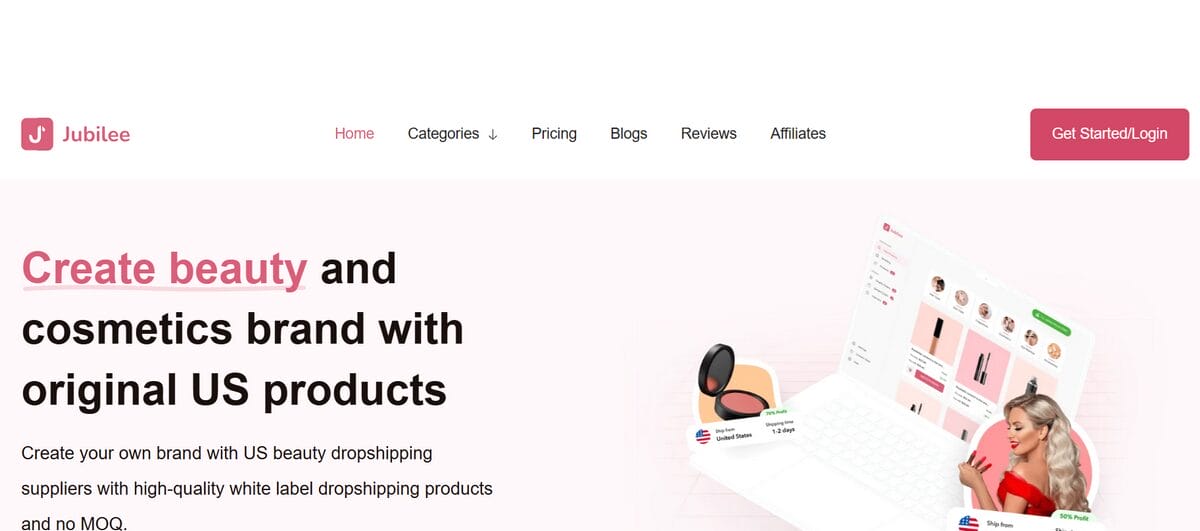
Jubilee is a beauty dropshipping marketplace built around white and private label products, giving you another inventory-light route to launching your own cosmetics or skincare brand. Its catalog spans skincare, makeup, haircare, body care, fragrances, and accessories, with no MOQ required to start selling under your own identity.
Branding is where Jubilee becomes particularly relevant for private label. You can customize products with your logo and branded packaging elements, add branded invoices to customer orders, and order samples directly from the dashboard before putting an item in your store. There’s also a useful logistics angle: most of Jubilee’s suppliers are based in the US or Europe, which can make it particularly interesting if those are the customers you plan to serve.
- MOQ: No MOQ for its white/private-label dropshipping products.
- Starting cost: Free plan available to explore the platform and its products before choosing a paid subscription.
- Standout feature: Beauty-focused dropshipping with built-in branding and sample ordering, plus a supplier network concentrated in the US and Europe.
Fashion & Apparel
Trendsi
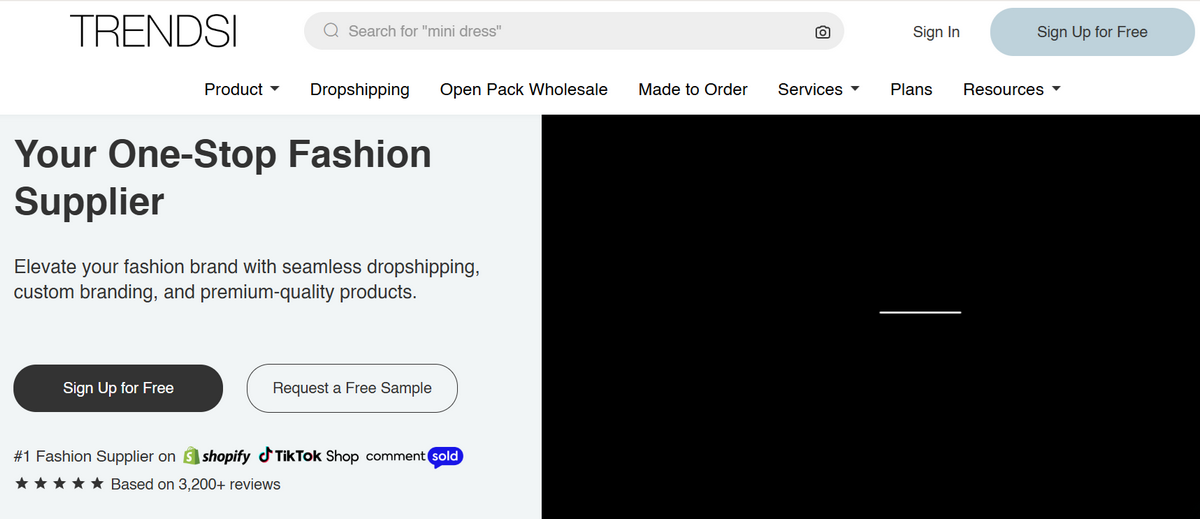
Trendsi is a fashion dropshipping and wholesale platform that offers apparel brands plenty of opportunities to grow into private-label status. You can start by dropshipping existing clothing and accessories with no MOQ, avoiding a large inventory commitment while you figure out which styles actually connect with your customers.
Once you’re ready to put more of your identity into the experience, Trendsi’s private labeling options include custom neck labels, hang tags, garment bags, and branded packaging. And the progression doesn’t stop there: Open Pack Wholesale lets you move into small-batch inventory starting at 6 units per style/color variant, while its Made-to-Order service can take you into original apparel designs with minimums starting at 60 pieces.
- MOQ: No MOQ for standard dropshipping.
- Starting cost: Free to join for standard dropshipping; you pay product and shipping costs as orders come in, while private-label and custom-production costs depend on the service.
- Standout feature: A scalable path from no-MOQ fashion dropshipping to private labeling and custom apparel production, letting your level of product ownership grow alongside your brand.
How to Start a Private Label Dropshipping Business
Now that you know which suppliers are worth considering, it’s time for the practical part: turning that opportunity into a store customers can actually buy from.
The best part? You don’t have to manage every moving piece manually. Platforms like AutoDS can support much of the workflow along the way, from research and importing to fulfillment. Let’s see how it all comes together.
1. Research What You Want To Sell
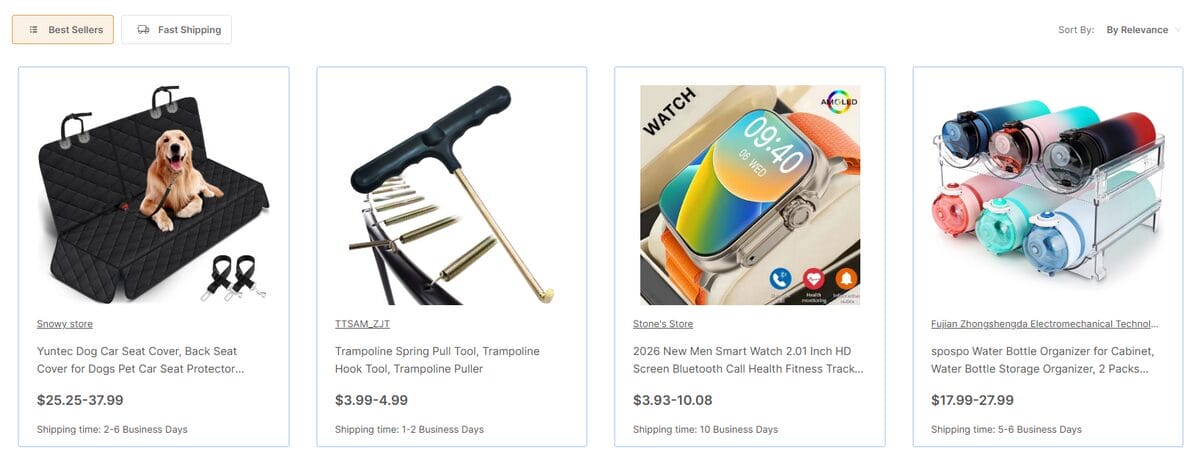
Every private label brand needs something worth putting its name on. Start by looking for real signs of demand: products already generating sales, emerging search interest, customer problems you could solve better, or existing items with obvious room for differentiation.
This is also where the validation strategy I covered earlier comes into play. You don’t necessarily need to customize your idea immediately. Test demand first if that makes sense for your situation, then use what you learn to decide what deserves the private label treatment.
For research, you can combine sources like Google Trends, supplier bestseller sections, social platforms, and competitor stores. And if you want to bring more actual performance data into the process, AutoDS gives you several ways to investigate potential products:
- Trending Products: Explore items gaining traction using real-time performance data, with metrics around demand, competition, profitability, and social engagement.
- Hand-Picked Products: Browse products selected by AutoDS specialists, with additional research such as target audiences, competitor insights, and marketing material.
- TikTok Analytics: Go beyond likes and views with actual TikTok Shop performance data, including units sold, 7-day order growth, GMV, store performance, and viral videos.
You don’t need every signal to point to the same product. The idea is to replace as much guesswork as possible with evidence that people are already interested and, even better, actually buying.
2. Choose Your Private Label Supplier
Got a promising idea? Now you need the right partner to turn it into something you can actually put your name on.
As you saw above, there are several ways: a no-MOQ platform like Supliful or Blanka, POD if your differentiation comes mainly from design and branding, or a manufacturer through Alibaba when you’re ready for deeper customization.
Start by defining what you actually need, then compare suppliers against those requirements. Look beyond the catalog price: check MOQs, customization and packaging options, production times, fulfillment, shipping coverage, relevant certifications, and total landed costs. Once you have a shortlist, order samples to experience the quality, packaging, and delivery, much like your customers will.
AutoDS gives you another path through its network of supported and private suppliers. You can work with established sources like AliExpress and Alibaba or explore verified Private Suppliers directly through the AutoDS Marketplace.
3. Build The Store Around Your Brand
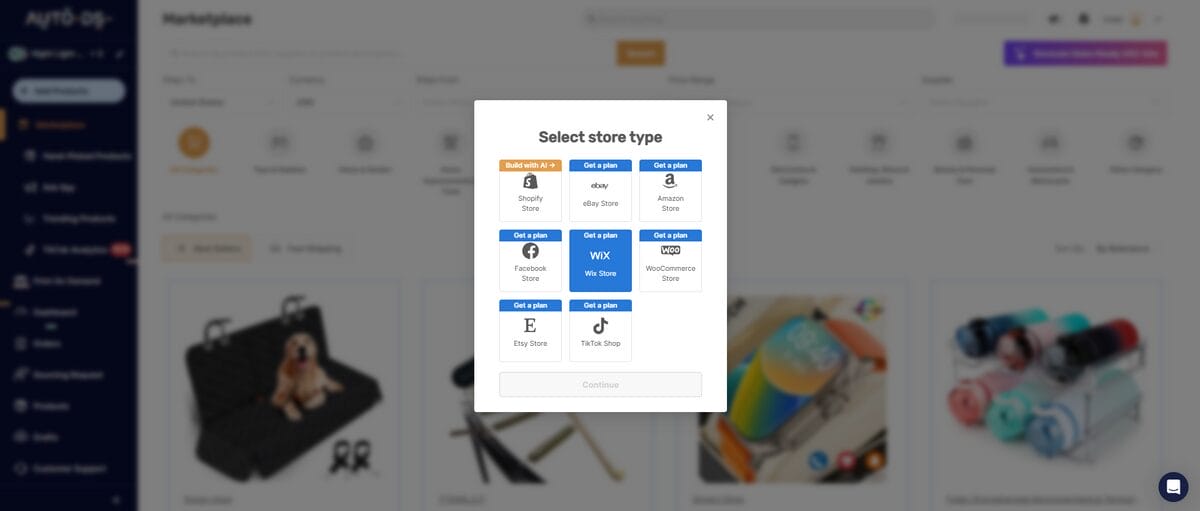
You have the product and a supplier behind it. Now your brand needs somewhere to live. Your first decision is whether to join an existing marketplace or build a storefront of your own.
Marketplaces like Amazon or eBay put you in front of an existing customer base, but give you less control over how shoppers experience your brand. Platforms like Shopify, Wix, or WooCommerce flip that equation: you’re responsible for attracting visitors, but you have much more freedom to shape the store around your identity.
💡 Pro Tip: Starting with Shopify? AutoDS’ AI Store Builder can get your storefront up and running in minutes. Use that head start to focus on what makes it yours: your products, positioning, and brand identity.
For private label, that freedom can matter. Think beyond uploading a logo: your product pages, photography, copy, policies, visual identity, and overall positioning should reinforce why someone should choose your version over the alternatives already available.
Whichever route fits your strategy, AutoDS can connect the store to the workflow you’ve already started building. It currently supports Shopify, Wix, WooCommerce, Amazon, eBay, Etsy, TikTok Shop, and Facebook Shop/Marketplace, allowing you to manage supported channels from the same platform as you move into the next step: getting your products listed.
4. Import And Optimize Your Listings
Your store is ready. Now it needs products. You can import them manually (copying over titles, descriptions, images, variants, specifications, and pricing from the supplier), but that gets repetitive pretty quickly.

A smarter route is using an importer. With AutoDS, you can use Single Import when you want to add and review products one by one, or Bulk Import when you need to bring multiple items into your store at once. Either way, you can save products as drafts first, giving you a chance to review the details before they go live.
But remember: a private label listing shouldn’t simply be a supplier page with your logo attached. Use AutoDS’ AI tools to optimize titles and descriptions, adjusting the tone and creativity to fit your store. From there, add the final layer yourself: your differentiators, positioning, visuals, and anything else that makes the listing unmistakably yours.
Importing gets the product into your store. Optimization turns it into part of your brand.
5. Turn The Product Into A Brand People Notice
Now it’s time to give customers a reason to remember who they bought it from. Go back to what you learned during research: who wants this product, what problem are they trying to solve, and what could your version offer that the alternatives don’t?
Turn those answers into your positioning, then make sure customers encounter the same idea wherever they find you, from the product page and packaging to the ad that first gets their attention. You don’t need to market everywhere at once. A Shopify store might lean heavily on Meta or TikTok ads, SEO, and email, while marketplaces offer their own promotional systems.
Pick the channels where your audience already spends time, test different messages and creatives, and learn what actually gets a response. AutoDS can keep product and operational tasks centralized while you focus on the part automation can’t decide for you: what your brand should say and why customers should remember it.
📢 Marketing Tip: Need fresh creatives to test those angles? CreateUGC turns a product link into UGC-style video ads with AI avatars and customizable scripts, so you can test different concepts without filming every video yourself.
6. Automate Fulfillment As Orders Grow
The first order is exciting. The hundredth shouldn’t create a hundred manual tasks. Your supplier may handle the physical shipment, but you still need to send over order details, keep tracking updated, and make sure stock or price changes don’t create problems in your store.
You can manage all of that manually at first, but volume changes the equation. AutoDS can automate much of that: supported orders can be processed automatically, tracking information can be updated as it becomes available, and price and stock monitoring can keep your listings aligned with changes on the supplier side.
The result is simple: fewer repetitive tasks between “customer placed an order” and “customer received it.” You still need to oversee the business and step in when something requires attention, but you don’t have to treat every sale like a brand-new administrative process.
7. Use Customer Experience To Make The Brand Better
Delivery isn’t the finish line for private label. It’s where you start finding out whether the experience you designed actually worked. So:
- Respond quickly when customers need help.
- Make returns and refunds straightforward.
- Pay close attention to reviews, recurring questions, complaints, and product feedback.
Remember the insulated bottle from earlier? If buyers keep mentioning the lid, size, or packaging, those are clues for what your next version could do better.
That’s one of the advantages of building a private label business: what you learn from customers can feed directly into your next product decision, packaging update, or customization request.
And that brings the process full circle: research helped you decide what to sell; real customers now help you decide what to improve next. That’s how a product starts becoming a brand rather than simply another listing.
Compliance Note for Regulated Categories
One final thing before moving on. If your brand is going on supplements, skincare, or other regulated goods, what you put on the label matters just as much as what’s inside the package. Choosing suppliers that manufacture in appropriately registered facilities and follow GMP (Good Manufacturing Practices, guidelines for consistent quality and safe production) gives you a stronger foundation, but you still need to make sure your labeling and marketing claims comply with the rules in your market.
That’s part of the private label deal: more ownership over what you sell also means knowing the responsibilities that come with it.
Frequently Asked Questions
What is the difference between private label and white label dropshipping?
The main difference between private label and white label dropshipping is how much control you have over the product. Private label lets you work with a supplier to create or customize a product for your brand, while white label typically involves adding your branding to an existing product that other sellers may also offer.
How much money do you need to start private label dropshipping?
There’s no universal startup figure. No-MOQ platforms can keep initial costs relatively low, while custom manufacturing may involve samples, design fees, deposits, packaging, and minimum production runs. Your niche and desired level of customization will ultimately shape the budget.
Which niches work best for private label dropshipping?
The best niches for private label dropshipping include beauty, skincare, supplements, wellness, apparel, accessories, and print-on-demand products. But I wouldn’t choose a niche from a “best” list alone: look for proven demand, room to differentiate, workable margins, and suppliers that fit your business model.
Is private label dropshipping worth it in 2027?
Yes. Private label dropshipping is worth it in 2027 because it combines the low-inventory model of dropshipping with greater product differentiation, stronger branding, and more pricing power. Instead of competing over identical listings, you can build an offer customers associate with your brand and create more room for loyalty and healthier margins as you grow.
Do private label suppliers require a minimum order quantity?
Not always. Platforms such as Supliful, Blanka, and many POD services offer no-MOQ options, while traditional manufacturers may require minimum production runs for customization. Always check the MOQ for the specific item and branding service you want before committing.
How do I find a reliable private label supplier?
To find a reliable private label supplier, start by checking reviews, samples, communication, fulfillment capabilities, production times, and relevant certifications. A sample order is particularly valuable: it lets you experience the quality, packaging, and delivery much like your future customer will.
Are there compliance requirements for private label supplements or skincare?
Yes. Requirements vary by product and market, but regulated categories can carry specific rules around manufacturing, labeling, ingredients, and marketing claims. Working with an experienced supplier helps, but your brand still needs to ensure what it sells and claims meets the applicable requirements.
Should I test a product before turning it into a private label brand?
Yes! For an unproven idea, testing a product through traditional or white label dropshipping is a smart first move, as it reduces risk. Real sales and customer feedback can tell you whether demand exists (and even what’s worth improving) before you put money into samples, MOQs, packaging, or deeper customization.
Start Your Private Label Dropshipping Store With AutoDS
Private label is where dropshipping stops being about finding a good product and starts being about building one customers recognize as yours. How far you can push that idea depends almost entirely on the supplier you pick.
Use this guide to narrow the field, pick the level of commitment that fits where you’re at today, and leave yourself space to grow into something bigger tomorrow.
The same logic carries over to how you actually run the store. As your listings and orders start piling up, your time is better spent sharpening the brand than getting buried in backend work. AutoDS steps in to automate and centralize a lot of that day-to-day grind, so you can manage products, inventory changes, and orders without quietly building a mess behind the scenes.
🏷️ Your label deserves more than a manual workflow. Start your AutoDS trial for $1 and turn your private label idea into a business you can actually run.
Not done yet? I’ve got a few more good reads for you:
- What Is Private Label Dropshipping?
- Private Label vs. White Label Dropshipping
- Private Label vs. Dropshipping
- Quick Comparison Table
- Private Label Dropshipping Pros & Cons
- Should You Start With Private Label?
- Private Label Dropshipping Best Practices
- Best Private Label Dropshipping Suppliers
- How To Start A Private Label Business
- Compliance Note For Regulated Categories
- FAQ
- Conclusion