


AI shopping and agentic commerce keep evolving. In September, Anthropic released Claude Commerce Agents, an open-source framework for creating AI agents on both sides of the shopping experience: guiding customers from product discovery to purchase, while giving merchants new ways to handle operations behind the scenes.
For dropshippers, that sounds like a pretty big deal. And it could be. The reality, though, is less immediate: for now, Claude Commerce isn’t a ready-made tool you can simply add to your store. It is developer infrastructure that requires technical expertise and custom integration before it can become part of a working ecommerce operation.
So, what did Anthropic actually release, and where does dropshipping fit into the picture? In this article, I’ll break down what Claude Commerce is, and what you can (and can’t) do with it right now.
By the end, you’ll have a clearer idea of how you can already put Claude to work in your dropshipping business, and what becomes possible when you connect it with the tools you already rely on.
Claude Commerce brings agentic AI into online shopping, with Claude Commerce Agents providing reference implementations for customer-facing shopping and merchant operations.
Claude Commerce Agents can move from conversation to action, helping shoppers find and compare products while supporting merchants with tasks that remain under human approval.
Claude Commerce Agents requires real development and code work, making it more suitable today for retailers and platforms with engineering resources than solo dropshippers looking for a ready-to-use app.
Claude itself is already useful for AI dropshipping, helping you research products, explore customer pain points, develop ad angles, write copy, and think through store decisions without coding.
The AutoDS Claude MCP connector makes Claude actionable for dropshipping, connecting it with real product and store data for research, imports, reports, supported changes, and multichannel management. 👇
What Is “Claude Commerce”?
Claude Commerce brings together Anthropic’s work around using Claude in online commerce. It’s not one specific product, but an ecosystem of tools, infrastructure, and partnerships designed to weave AI into how businesses sell and customers shop online.
At the heart of that vision is AI agentic commerce. Instead of stopping at questions and product recommendations, AI takes a more active role across the shopping journey: searching a catalog, comparing options, building a cart, or assisting with the operational work happening on the merchant side. In other words, the AI starts moving from advising you on what to do toward carrying out parts of the process.
That approach is now taking shape with Claude Commerce Agents, Anthropic’s open-source blueprint for bringing these agentic experiences into real shopping environments. It provides the building blocks for creating customer-facing shopping agents and back-office merchant agents that businesses can adapt to their own system, which is where things get more interesting.
Claude Commerce Agents: Analysis of What Anthropic Released
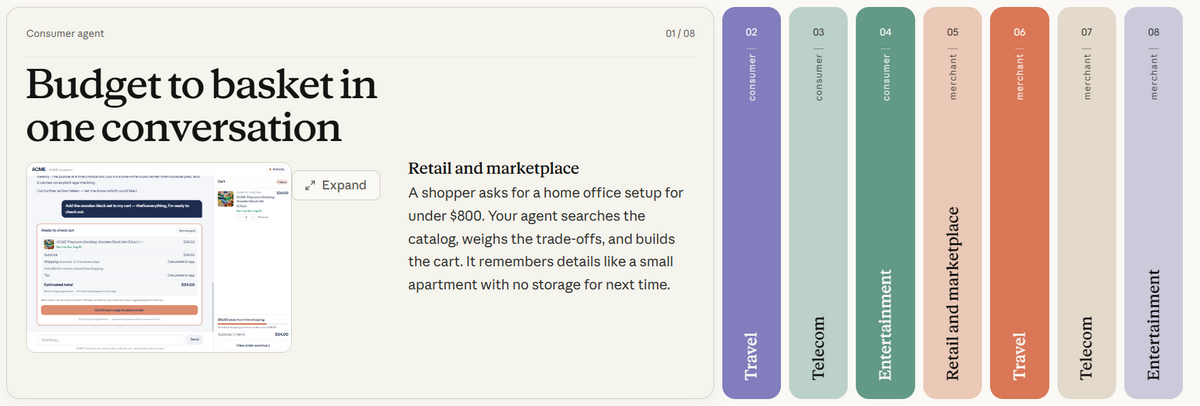
So, what do you actually get with Claude Commerce Agents? Anthropic released working reference implementations for two roles: a customer-facing shopping agent and a merchant agent for store operations. The architecture extends beyond retail to travel, telecom, and entertainment, with several ways for developers to adapt it, including the Claude Agent SDK and a dedicated Claude Code plugin.
The shopping agent is the easier side to picture. Say a customer needs an affordable outfit for an outdoor wedding. They can describe that in natural language, and the agent can take it from there:
- Find and narrow down the right products: Claude searches the retailer’s inventory, compares options, and factors in preferences the customer has already shared.
- Turn those choices into a purchase: Once the customer decides, the agent can assemble several items into a cart and hand the transaction over to checkout.
- Stay useful after the sale: The same conversation can continue with questions about an order, an exchange, a return, or what the store allows.
The merchant agent brings that same ability to act behind the storefront. Imagine one of your products has been sitting in inventory longer than expected. Here, the agent could help you:
- Spot what needs attention: Claude can surface the slow-moving product rather than waiting for you to catch it manually.
- Work out a response: It could suggest a discount and prepare the promotion based on what it finds.
- Keep the final call in your hands: Claude can prepare the change, but consequential actions sit behind human approval. Nothing has to go live until you authorize it.
The release also reveals an important boundary: Anthropic provides the agent layer; the business still has to provide the commerce infrastructure underneath it. Claude can only work with the information and functions a retailer makes available to it, while payments aren’t included in Anthropic’s reference implementation at all.
That dependency goes deeper than simply granting access. An agent can’t reason around information your store hasn’t properly captured. If “waterproof,” for example, matters to a shopper but that attribute isn’t structured in the product data Claude receives, the agent can’t reliably use it to narrow down the results. Better reasoning doesn’t compensate for missing or messy commerce data.
That’s what makes Claude Commerce Agents more substantial than another shopping chatbot, but also less turnkey than the name might suggest.
Is Claude Commerce a Tool Dropshippers Can Use Today?
Claude Commerce is available today. Does that mean it’s accessible to the average dropshipper? Well, not really.
Claude Commerce Agents is a developer toolkit, not a no-code app you can connect to your store and switch on. Even running Anthropic’s demos requires Python 3.11+, Node 22, and an Anthropic API key. And moving from that demo to your own store is a much bigger job. Claude has to understand your product data, know what a returning customer has already told you, and turn a conversation into something your existing checkout can actually process. Making those connections work requires custom development.
For a solo dropshipper, this is where “available” and “usable” start to mean very different things. Claude Commerce Agents asks for actual engineering work. Unless you have those skills yourself (or a developer to handle the implementation), you’re unlikely to get it running as part of your store today.
And Anthropic is clear about what it released. It describes the code as a reference implementation: a concrete starting point for development teams that will need to customize, deploy, and maintain their own version.
For now, that puts Claude Commerce Agents much closer to infrastructure for large retailers and commerce platforms than the kind of tool you could realistically set up and run on your own.
How to Actually Use Claude AI for Dropshipping Right Now
Claude Commerce Agents may be out of reach for now, but using Claude itself is a different story. You don’t need to write a line of code to put it to work. This is where AI dropshipping becomes much more practical: Claude can become part of the decisions and creative work you already handle every day.
And you can use it across different stages of running your store:
- Before you choose what to sell: Ask Claude to research niches, compare product ideas, map customer pain points, or challenge your assumptions before committing to a test. You can take a broad idea and use the conversation to figure out whether there’s actually an audience and angle worth pursuing.
- When you’re figuring out how to sell it: Once you have a product in mind, move into positioning. Who would buy it? What problem should the product page lead with? Which angles are worth testing in an ad? Claude can then turn those decisions into product descriptions, ad copy, and creative variations, so you’re working from a strategy rather than a blank page.
- Once your store is running: Claude can draft a response to a frustrated customer without making it sound canned, brainstorm store name ideas while you’re shaping the brand, or help you think through pricing, bundles, audience positioning, and what to test next.
The useful part isn’t any single prompt, but being able to carry context from one decision into the next. Product research can inform positioning; positioning can shape your copy; and what you learn from customers can feed back into what you test next.
There is still one limitation, though. Claude can help you think through and create all of this, but the result still has to make its way into the tools you use to run your store. That gap between advice and action is where connecting Claude to a dropshipping automation platform starts to matter.
How AutoDS and Claude AI Work Together
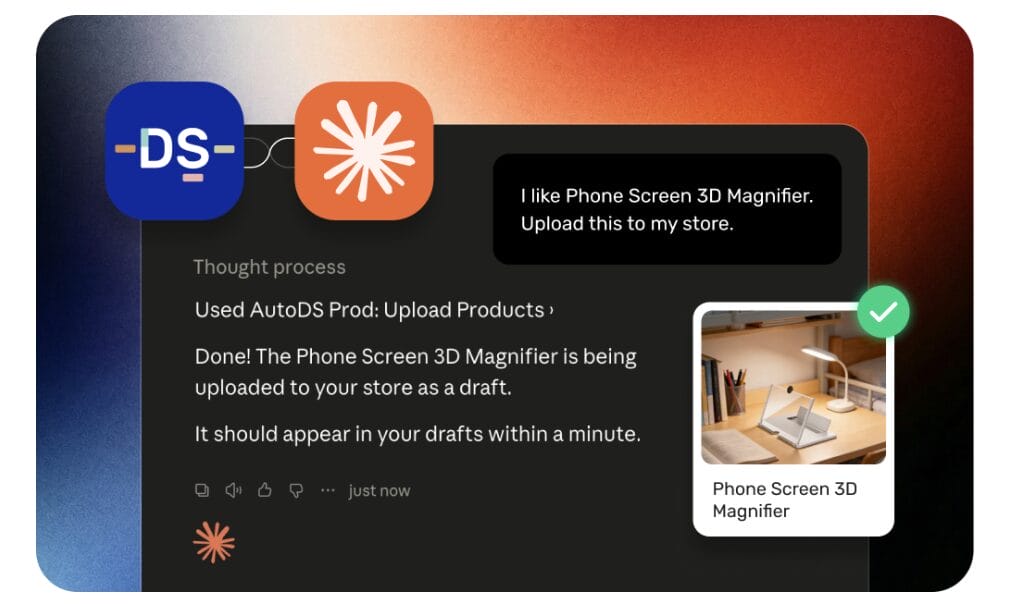
Let me introduce the AutoDS Claude MCP connector, the integration that makes Claude much more useful for your dropshipping business. MCP (Model Context Protocol) is an open standard developed by Anthropic that lets Claude connect to external tools and data. Link it to AutoDS, and Claude can work with information from your actual business and help you get things done directly from the chat.
Think back to product research. On its own, Claude can help you evaluate a niche or define what a promising product should look like. With AutoDS connected, you can ask for a wireless charger under $10 with fast shipping, have Claude search the catalog, review the options, and import a promising product to your drafts. And product discovery is only the beginning. You can also:
- Get live store reports: Ask about products, margins, profit, or other store metrics and get the numbers right in the conversation.
- Import products from the chat: Find an item and send it to your drafts without opening the AutoDS dashboard.
- Make bulk changes: Update pricing, listings, and other supported settings across multiple products with a single request.
- Manage multiple sales channels: If you sell through stores or marketplaces like eBay, Shopify, and WooCommerce, you can manage them through the same conversation instead of jumping from one storefront to another.
Here’s the important part: unlike Claude Commerce Agents, you don’t have to develop that connection yourself. The AutoDS connector is available through Claude’s Connectors directory. Authorize your AutoDS account, choose what Claude can access, and you can start using the two together right away.
That’s the distinction that matters for a dropshipper. Claude Commerce Agents gives development teams a foundation for creating their own agentic commerce experiences. The AutoDS MCP connector starts one step further ahead: you can bring Claude into the work you’re already doing and go from asking what to do next to actually getting that next step done.
🆕 Beginner’s Tip: New to Claude connectors? There’s a lot more you can bring into Claude besides AutoDS. This Claude Connectors guide covers the top tools available and what you can actually do with them.
Frequently Asked Questions
What is Claude Commerce?
Claude Commerce (or “Claude for commerce”) is Anthropic’s broader approach to bringing AI into online shopping and store operations. Its latest centerpiece is Claude Commerce Agents, an open-source blueprint businesses can adapt to create customer-facing shopping agents and merchant-facing operational agents.
Is Claude Commerce a shopping app or website I can use?
No, Claude Commerce isn’t a standalone shopping app or website. Claude provides the intelligence layer, while retailers and platforms can use Anthropic’s model to build agent experiences inside their own commerce environments.
Can I use Claude Commerce to build a dropshipping store myself?
You can, but only if you have the technical resources to develop and integrate it. Claude Commerce Agents is reference code, so launching it for a real dropshipping business requires development work and connections to the commerce tools you already use.
Is Claude Commerce free to use?
The Claude Commerce Agents blueprint is open source, but running your own implementation isn’t necessarily free. Depending on how you deploy it, you may need paid Claude API usage or other infrastructure, plus the development resources required to customize and maintain your version.
What’s the difference between Claude (the AI assistant) and Claude Commerce Agents?
Claude is the AI you can already use for tasks like research, writing, analysis, and brainstorming; Claude Commerce Agents is a developer blueprint powered by Claude. Think of Claude as the intelligence, while Commerce Agents provides an architecture for putting that intelligence to work inside shopping workflows.
Can AI really help you make money dropshipping, like YouTube videos claim?
Yes, AI can help you make money dropshipping when you use it strategically. Claude can support product research, copywriting, customer communication, and decision-making, while integrations like the AutoDS Claude Connector can bring those capabilities directly into your dropshipping workflow. You still need viable products, healthy margins, traffic, testing, and strong execution to turn those efficiencies into revenue.
Will AI shopping agents change how dropshipping stores need to be built?
Potentially, yes, especially if conversational shopping becomes a bigger part of product discovery and purchasing. Stores may need cleaner product data, well-structured attributes, accurate inventory and policies, and integrations that agents can reliably access.
Make Claude Practical for Dropshipping With AutoDS
Claude Commerce Agents gives us a useful glimpse of where online shopping may be heading. But you don’t need to rebuild your store around AI agents to benefit from Claude today. Look at the work already on your plate: pressure-test a product idea, sharpen an ad angle, or think through your next store decision. Each gives you a practical way to experiment with Claude without developers or a custom implementation.
From there, pay attention to where conversation alone reaches its limit. Maybe you want Claude to pull numbers from your store rather than analyze figures you pasted into the chat, or help execute a decision once you’ve made it. That’s where the AutoDS MCP connector becomes the practical next step, giving Claude direct access to the data and tools behind your dropshipping business.
You don’t have to jump straight into the most advanced version of agentic commerce. Put Claude to work on something useful now and expand from there as AI commerce evolves.
🧠 Ready to bring AI closer to your store? Try AutoDS for $1 and simply connect it with Claude to turn product research and store decisions into real actions.
Claude is changing what AI can do for dropshippers, but it’s not doing it alone. These related reads explore the other pieces worth understanding: