


Building a passive income stream is an understandable goal: generating revenue with the minimum effort possible. Sounds great, right? A business model with these characteristics is entirely achievable today thanks to automation.
Of course, this does not mean generating money while doing absolutely nothing. However, building a business focused on shifting from active operations to automated systems allows us to maximize efficiency without sacrificing our time and personal freedom.
In this guide, we will delve into how you can achieve this with tools like AutoDS, which facilitate passive income for dropshippers worldwide and can do the same for you.
Passive income is about building smart systems that generate revenue with minimal daily involvement.
Dropshipping is one of the most accessible paths to passive income, requiring no inventory management and allowing up to 90% of operations to be automated.
Tools like AutoDS handle order fulfillment, price monitoring, tracking updates, and product importing, freeing you to focus on high-level strategy.
While automation covers the backend, human input is still needed for marketing direction, product curation, and scaling decisions.
The biggest mistake beginners make is expecting instant results, passive income is the reward for solid upfront system-building, not a shortcut around it.
What Is Passive Income?
A passive income business is, as its name implies, what it implies. In a traditional model, revenue is directly tied to active labor; you trade a specific number of hours for a corresponding amount of money.
Passive income breaks this linear dependency. It refers to earnings derived from an enterprise or investment in which the individual is not actively or continuously involved on a day-to-day basis.
Achieving this financial structure does not imply creating money out of thin air or avoiding work entirely. Instead, a passive income business model requires a strategic upfront investment of either capital, time, or system architecture. Once the foundation is properly built and optimized, the system self-sustains with minimal ongoing oversight.
Pros of Passive Income:
✅ Time Freedom: Decouples your daily hours from your revenue generation.
✅ Location Independence: Allows you to manage operations from anywhere in the world.
✅ Scalability: Automated systems can handle increased sales volume without extra manual labor.
✅ Financial Security: Diversifies your revenue streams to reduce reliance on a single source of income.
Cons of Passive Income:
❌ Upfront Work: Requires significant time or capital investment to set up initially. Of course, as we will discuss later in this article, tools like AutoDS significantly reduce the initial workload and the time it takes to start seeing profits.
❌ Delayed Gratification: Profits rarely appear overnight; systems take time to mature.
❌ Market Fluctuations: External factors like platform changes or trends still require monitoring. However, this is also much easier to handle through AutoDS features such as Price & Stock Monitoring.
Is Dropshipping Really Passive Income?
Yes, dropshipping can be passive income, but only if you build it that way. By its default nature, running an online store requires continuous administrative maintenance.
However, dropshipping is uniquely structured to transition into a hands-off venture because you never handle physical inventory. The passivity of your store depends entirely on your system integration.
What Parts of Dropshipping Can Be Automated?
The modern e-commerce ecosystem allows you to automate up to 90% of daily operational tasks. By leveraging an all-in-one automation tool, the manual workflow of matching customer data with supplier platforms is completely eliminated.
- Order Fulfillment: Advanced software instantly forwards customer order data to your supplier the moment a purchase is made, processing the payment and initiating shipping without your manual intervention.
- Price & Stock Monitoring: Automated scripts continuously scan your suppliers’ inventory. If a supplier raises prices or runs out of stock, your storefront updates instantly to protect your profit margins.
- Product Tracking Updates: Once the supplier ships the package, the tracking number is automatically retrieved and uploaded to your store, notifying the customer without you having to open a single email.
🚀 Thousands of dropshippers have already streamlined these processes, and many more are using AutoDS. Experience these automated features firsthand by starting your trial for just $1!
What Still Requires Active Work?
To keep the business healthy, an entrepreneur must shift from a “worker” mindset to a “manager” mindset. While software handles the repetition, human oversight is required for high-level decision-making.
- Strategic Product Selection: Finding winning products requires analyzing market trends and consumer behavior. While tools provide the data, choosing the final catalog alignment remains a human task.
💡 Pro Tip: Your search for winning products can be much easier and more effective if you leverage Google Trends, best-seller sections from marketplaces like Amazon, and the AutoDS Hand-Picked Products Hub, a curated and continuously updated selection of trending items.
- High-Level Marketing & Ad Strategy: Setting up ad funnels, designing creative assets, and optimizing your marketing budget require human creativity and psychological insights.
- Complex Customer Relations: Automated systems can handle basic tracking inquiries, but handling complex returns or specialized customer disputes requires a personal touch to protect your brand reputation.
Why Most Beginners Misunderstand Passive Income
The primary reason new dropshippers fail is the “set-it-and-forget-it” myth. Many beginners launch a store, import a few random products, and expect profits to accumulate while they sleep. They confuse passive income with zero effort.
In reality, dropshipping passive income operates on a front-loaded work model. You must invest heavy energy into market research, store design, and supplier vetting during the first few weeks.
Only after this solid infrastructure is built can you connect automation tools to take over the heavy lifting. Passive income is the reward for successful initial systemization, not a shortcut to avoid work.
How Automation Makes Dropshipping More Passive
The bridge between an active, time-consuming store and a truly passive revenue stream is automation software. Without a centralized system, a dropshipper spends hours manually copying data, checking supplier websites, and updating tracking codes.
By integrating specialized software into your daily operations, you can offload repetitive tasks and transition into a purely managerial role.
Here is how specific automation features transform the traditional dropshipping workload into a hands-off operation:
1. Automated Product Importing
Manually downloading product images, copying descriptions, and uploading them to your selling channel can take hours per item. The AutoDS Automated Importing feature lets you transfer single products or entire bulk categories from your supplier to your store with a single click.
💡 Pro Tip: Importing is just the first step! You can significantly optimize your listings and increase conversion rates by using the AutoDS AI Product Title & Description Generator to automatically craft high-converting copy.
2. Price & Stock Monitoring
Supplier inventory and pricing fluctuate constantly. Checking these changes manually across hundreds of items is practically impossible and leads to costly errors, such as selling an out-of-stock item or losing profit margins.
AutoDS automated scripts monitor your suppliers around the clock, instantly syncing any changes to your storefront to protect your business reputation and finances.
3. Automated Order Fulfillment
The most time-sensitive part of dropshipping is placing supplier orders after a customer buys from you. Automated order fulfillment eliminates this bottleneck entirely. Systems like Fulfilled by AutoDS automatically route order details and payments to your suppliers the moment a sale occurs, managing the entire backend without requiring you to log in.
4. Tracking Updates & Customer Notifications
Providing tracking details is essential for customer trust, but manually copying tracking numbers from suppliers to your customers is a massive time sink.
Automation tools automatically retrieve tracking links from the supplier as soon as the item ships, update the selling channel, and notify the customer seamlessly.
5. AI Product Research Tools
Finding winning items used to require hours of manual data scraping across multiple marketplaces. Modern automation incorporates advanced AI systems and curated selection hubs, like the AutoDS Marketplace, to instantly filter high-demand, low-competition items, allowing you to build a profitable catalog based on data rather than guesswork.
6. Multi-Platform Management
Managing separate dashboards for different stores or selling channels (like Shopify, Amazon, or eBay) fragments your focus and increases your workload.
Centralized automation lets you connect to and monitor all your storefronts from a single, unified interface, making it significantly easier to scale passively.
What Tasks Still Need Human Involvement?
True passive income does not mean running a business on autopilot indefinitely without any human input. It means reducing operational friction to a minimum so your time is reserved for high-leverage decisions.
Even the most automated dropshipping operation still requires a human in the loop for the following areas:
1. Marketing & Creative Strategy
While automated ad pixels track data and software handles delivery, the core creative concept still relies on human psychology. You must define your target audience, analyze consumer pain points, and craft compelling visual narratives.
However, even the execution phase can be streamlined; for instance, you can use specialized tools like CreateUGC to automate the production of user-generated content, drastically reducing the time spent editing video assets.
2. Testing and Analyzing Performance
Automation tools generate massive amounts of data on your conversion rates, traffic sources, and profit margins, but humans must interpret it.
An entrepreneur needs to review performance metrics periodically to determine which ad campaigns are profitable, which products are underperforming, and where the overall business strategy needs adjustment based on hard numbers.
3. High-Level Customer Support
Basic customer inquiries, such as order status updates or tracking links, can be entirely handled by automated email notifications or AI chatbots.
However, complex customer situations still require a personal, human touch. Resolving intricate refund disputes, managing communication breakdowns with suppliers, or handling high-value order issues are tasks that require empathy and negotiation to protect your brand reputation.
4. Product Research Strategy
Automated software can instantly scrape marketplaces and present you with hundreds of trending items, but you must define the criteria for that search.
A human must decide the overarching niche strategy, analyze seasonal market trends, and determine whether a trending product aligns with the brand’s identity or if it is just a short-lived fad.
5. Brand Building
A sustainable e-commerce business relies on customer loyalty, which requires deliberate brand building.
Defining your store’s visual identity, establishing a mission statement, creating custom packaging guidelines, and building a community around your niche are deeply creative processes that software cannot replicate.
Brand building is what separates a short-term dropshipping store from a long-term asset.
6. Scaling Decisions
When a store becomes highly profitable, deciding how and when to scale requires human judgment about risk. You must decide whether to diversify your income by expanding into new sales channels, launching a private-label venture, or reallocating capital to aggressive marketing campaigns. Automation manages the stability of your current volume, but human leadership dictates future growth.
How to Build a More Passive Dropshipping Business
Step 1: Choose the Right Selling Platform from the Start
Your platform choice directly impacts how automated your store can become. Shopify, eBay, Amazon, and Etsy all integrate with AutoDS, but each has different automation capabilities and audience dynamics. Choose based on your product category and target market, not just what seems easiest to start.
Step 2: Source from Reliable, Automation-Compatible Suppliers
Your automation is only as reliable as the suppliers behind it. Prioritize suppliers that offer real-time stock and pricing data feeds, fast and trackable shipping, and consistent product quality.
AutoDS integrates with hundreds of verified suppliers globally, from AliExpress and Amazon to US-based warehouses, giving you options that balance cost with reliability.
Step 3: Set Up Automation Before You Scale
Many dropshippers make the mistake of building manually first and automating later. Do the opposite. Connect your AutoDS account from the start so that order fulfillment, price monitoring, and tracking updates are automated from your very first sale.



Step 4: Optimize Your Listings with AI
Before driving traffic to your store, make sure your product listings are built to convert. Use the AutoDS AI Product Title & Description Generator to create compelling, SEO-optimized copy that works around the clock, even when you are not. Strong listings reduce the burden on your ads by improving organic visibility and conversion rates.
Step 5: Define Your Marketing System
Automation handles the backend, but your marketing needs a system too. Set up evergreen ad campaigns that run within a defined budget, use retargeting audiences to automatically re-engage visitors, and build an email sequence that nurtures leads without your daily involvement.
Once configured, a well-structured marketing system requires only periodic review rather than constant hands-on management.
Step 6: Shift into Manager Mode
Once your store is live and automated, your job changes. Schedule a weekly review to monitor key performance metrics: profit margins, conversion rates, supplier reliability, and ad performance. Identify what to optimize, make the changes, and step back again. This is the manager mindset that transforms a dropshipping side project into a genuinely passive income stream.
➡️ Start your AutoDS trial for just $1 and set up your automation infrastructure from day one, before your first product goes live. The time you invest in proper setup pays dividends every single day your store runs without you.
Biggest Mistakes People Make Chasing Passive Income
The concept of passive income attracts a lot of optimism, and, unfortunately, a lot of costly mistakes. Here are the most common ones and how to avoid them:
- Expecting Instant Results: Passive income is the result of a well-built system, not an immediate outcome. Stores take time to generate data, build SEO traction, and optimize ad performance. Entrepreneurs who expect profitability within the first two weeks almost always quit before the system has had a chance to work.
- Ignoring Marketing: A fully automated store with no traffic is still a failing store. Many beginners over-invest in the technical setup and completely neglect customer acquisition. Understanding the basics of paid advertising, organic SEO, and social media is non-negotiable, even if you eventually outsource execution.
- Neglecting Customer Experience: Passive income does not mean ignoring your customers. Poor review scores, unresolved disputes, and slow response times will tank your seller metrics and tank your store alongside them. Even a minimal customer service system needs to be in place from launch.
- Skipping Automation Setup Running a dropshipping store manually and calling it a passive income business is a contradiction. Without automation handling fulfillment, price monitoring, and tracking updates, you will quickly find yourself spending more hours than a traditional part-time job demands.
- Quitting Too Early The compounding nature of a well-built dropshipping store means that results accelerate over time, not linearly. Most successful dropshippers report a slow initial phase followed by a meaningful inflection point once the algorithm, SEO, and ad performance data mature. Quitting at week three means abandoning a system that may have been weeks away from turning profitable.
How Much Passive Income Can Dropshipping Generate?
This is the question everyone asks, and the honest answer is: it depends entirely on the effort you invest upfront and the systems you put in place.
In the first one to three months, most new dropshippers operate at thin margins while they test products, refine their ads, and optimize their listings. Breaking even early on is normal, and even a sign of progress. Expecting $5,000 per month from week one is how people get disappointed and quit.
➡️ Many automated dropshipping stores generate between $500 and $3,000 per month as a supplementary income stream, enough to cover bills, a car payment, or a vacation fund without requiring daily involvement. Scaling to full-time income levels ($5,000–$15,000+ per month) is achievable but typically requires a more significant upfront investment in advertising, a larger product catalog, and several months of optimization.
Scaling Examples
- A store with 50 well-chosen products, automated fulfillment, and a modest $500/month ad budget can realistically generate $2,000–$4,000 in monthly revenue with 15–30% net margins.
- Operators who reinvest profits into ad scaling and expand across multiple platforms (Shopify, eBay, and Amazon, all managed through AutoDS) regularly report $10,000–$30,000 in monthly revenue after 6–12 months of consistent operation.
The difference between a dropshipper who burns out in three months and one who builds a long-term income stream is not luck or a secret product; it is the quality of their systems.
Automated stores generate compounding returns: every optimization compounds over time, every positive review builds your ranking, and every well-configured ad learns from an ever-growing dataset.
The Role of Virtual Assistants in Building Passive Income
Automation software handles the repetitive, data-driven tasks in your dropshipping business, but there is a category of work that sits between full automation and high-level strategy: operational tasks that require human judgment, but not necessarily your own. This is where virtual assistants (VAs) become a core pillar of a truly passive income model.
A virtual assistant is a remote worker, typically hired on a part-time or task-based basis, who takes over the day-to-day operational responsibilities that software alone cannot handle. By delegating these tasks to a VA, you remove yourself entirely from the operational loop while keeping a skilled human in the process when needed.
What Tasks Should You Delegate to a Virtual Assistant?
Not everything in a dropshipping business can or should be automated. The following tasks are ideal candidates for VA delegation:
- Customer Support Escalations: While automated systems handle basic tracking inquiries, a VA can manage refund disputes, supplier communication breakdowns, and complex complaints, protecting your seller metrics without requiring your direct involvement.
- Product Research Execution: You define the niche strategy and the criteria; a VA executes the research using tools like the AutoDS Marketplace, compiling shortlists of potential winning products for your final review.
- Listing Optimization: A VA can review and refine AI-generated product titles, descriptions, and images to ensure brand consistency across your storefront.
- Supplier Coordination: When order issues arise that require direct communication with a supplier, a VA handles the back-and-forth so you never have to.
- Ad Performance Monitoring: A VA can track key metrics from your ad campaigns on a daily basis, flagging underperforming campaigns or budget anomalies for your weekly review.
How VAs and Automation Work Together
The most effective passive income systems are not built on automation or virtual assistants; they are built on both working in tandem. Think of it as a two-layer system:
Layer 1 Automation (AutoDS): Handles all repetitive, time-sensitive, and data-driven tasks: order fulfillment, price and stock monitoring, tracking updates, and product importing.
Layer 2 Virtual Assistant: Handles all tasks that require human communication, nuanced judgment, or brand-specific decision-making that fall outside your strategic responsibilities.
This structure means your involvement as the business owner is reduced to only the highest-leverage decisions: setting strategy, reviewing weekly metrics, and approving scaling decisions.
How AutoDS Helps Create a More Passive Dropshipping Business
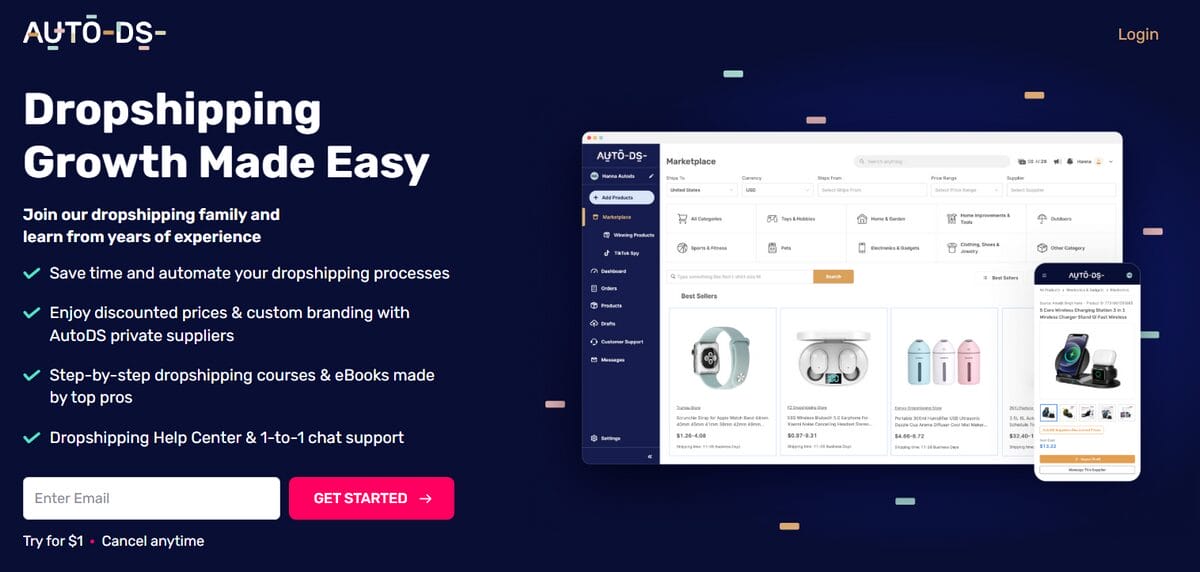
AutoDS is purpose-built to eliminate the manual overhead that keeps most dropshipping businesses stuck in active-operation mode. Rather than offering isolated tools, it provides an end-to-end automation infrastructure that covers every stage of the dropshipping workflow.
🔵 Product Research at Scale: The AutoDS Marketplace and Hand-Picked Products Hub give you instant access to curated, trending products filtered by demand, competition, and profit potential. Instead of spending hours scraping marketplaces manually, you can identify and import winning products in minutes.
🔵 One-Click Product Importing: Transfer products, including images, descriptions, and variants, from hundreds of supported suppliers directly to your store with a single click. The AI Title & Description Generator then optimizes each listing automatically for higher conversion rates and better search visibility.
🔵 24/7 Price & Stock Monitoring: AutoDS continuously monitors your suppliers’ pricing and inventory levels. The moment a price changes or a product goes out of stock, your store updates automatically—protecting your margins and preventing the frustrating (and reputation-damaging) situation of selling items you cannot actually fulfill.
🔵 Fulfilled by AutoDS: This is where the passivity becomes real. Fulfilled by AutoDS is a virtual assistant that automatically processes your customer orders, routing payment and delivery details to your supplier the moment a purchase is made, with no manual input required from you.
🔵 Automatic Tracking Updates: Once the supplier ships the order, AutoDS retrieves the tracking number and uploads it directly to your selling channel, triggering automatic customer notifications. The customer gets their update; you never have to open a supplier portal.
🔵 Multi-Store, Multi-Platform Management: Whether you are running one Shopify store or managing listings across eBay, Amazon, Etsy, and Wix simultaneously, AutoDS centralizes everything in a single dashboard. This unified visibility is what makes scaling passive rather than chaotic.
Frequently Asked Questions
Can you automate a dropshipping business?
Yes, and to a significant degree. Tools like AutoDS automate the majority of daily operational tasks, including order fulfillment, price and stock monitoring, product import, and tracking updates.
How long does it take to become profitable?
Most dropshippers begin seeing consistent profit within 2–4 months of launching, assuming they invest time in product research, listing optimization, and advertising from the start.
How much money can you make with automated dropshipping?
Income varies widely based on product selection, marketing investment, and platform. Part-time operators commonly generate $500–$3,000 per month. Full-time, scaled operations can reach $10,000–$30,000+ monthly.
What tasks can AutoDS automate?
AutoDS automates product importing, price and stock monitoring, order fulfillment (via Fulfilled by AutoDS), tracking number retrieval, customer notifications, and AI-driven product listing optimization. It also supports multi-platform store management from a single dashboard.
Can beginners start automated dropshipping?
Absolutely. AutoDS is designed for beginners, offering guided onboarding, a curated product hub, and an interface that does not require technical expertise. The learning curve is in understanding e-commerce fundamentals; the platform itself handles the operational complexity.
Do you still need to run ads and marketing?
Yes. Automation optimizes your backend operations but does not generate customer traffic. Marketing, whether through paid ads, SEO, social media, or influencer partnerships, remains an active responsibility.
What’s the best platform for automated dropshipping?
Shopify is widely considered the most automation-friendly platform due to its extensive app ecosystem and seamless AutoDS integration. eBay and Amazon are strong alternatives for sellers looking to reach built-in audiences.
Start Your Dropshipping Journey with AutoDS
Passive income through dropshipping is not a myth, but it is not magic either. It is the outcome of building the right systems, choosing the right tools, and making intelligent decisions during the setup phase so that the business can run efficiently with minimal daily involvement over time.
The key insight is this: the more work you invest in automation infrastructure upfront, the less work the business will demand of you long-term. Every manual task you eliminate through a tool like AutoDS is time and mental energy returned to you, permanently.
Whether your goal is a reliable side income that covers your monthly expenses or a scalable operation that replaces a traditional salary, the path runs through the same foundation: smart product selection, reliable suppliers, optimized listings, and a fully automated backend that works while you sleep.
The entrepreneurs who build genuinely passive dropshipping income are not the ones who work harder. They are the ones who build smarter, and then let their systems do the work.
🚀 Ready to start? Launch your automated dropshipping store with AutoDS and begin your trial for just $1. The system is waiting to be built, and once it is, it works for you around the clock.
If you want to keep learning about dropshipping, e-commerce, and related topics, check out these articles:
- What Is Passive Income?
- Is Dropshipping Really Passive Income?
- How To Automate Dropshipping
- What Tasks Still Need Human Involvement?
- How To Build A More Passive Business
- Biggest Mistakes Dropshippers Make
- How Profitable Is Passive Dropshipping?
- The Role of VAs In Building Passive Income
- How AutoDS Helps Create A Passive Business
- FAQ
- Conclusion