



You can spend hours testing AI tools and still have no idea what someone would actually pay you for. You can make money with AI by selling something useful: a product, better content, or help with a task someone’s tired of doing themselves.
AI can help with research, design, writing, and repetitive tasks, but choosing what to sell (and finding buyers) still takes work. Another subscription won’t make that decision for you.
I’d start with a simpler question: What problem can you help someone solve? A store owner might need better product photos. A local business might need help handling routine inquiries. Or you might want to build your own ecommerce store and use AI to make the workload more manageable.
In this guide, I’ll break down practical ways to make money online with AI in 2026, the skills each one requires, and tools that can help. I’ll help you figure out what you could try now, which skills you’ll need, and which tools are worth a look.
Sell a useful result: AI can help you create products and deliver services, but customers need a reason to buy.
Start with skills you have: Writing, design, marketing, or organization can become the foundation of your first offer.
Explore 23 ways to earn: Options include ecommerce, creative services, education, consulting, and specialized support.
Match tools to your offer: Use AutoDS for dropshipping, writing assistants for content, or creative tools for visuals and audio.
Test before spending more: Create a sample, get customer feedback, and account for your time and expenses before scaling.
Is It Possible To Make Money With AI?
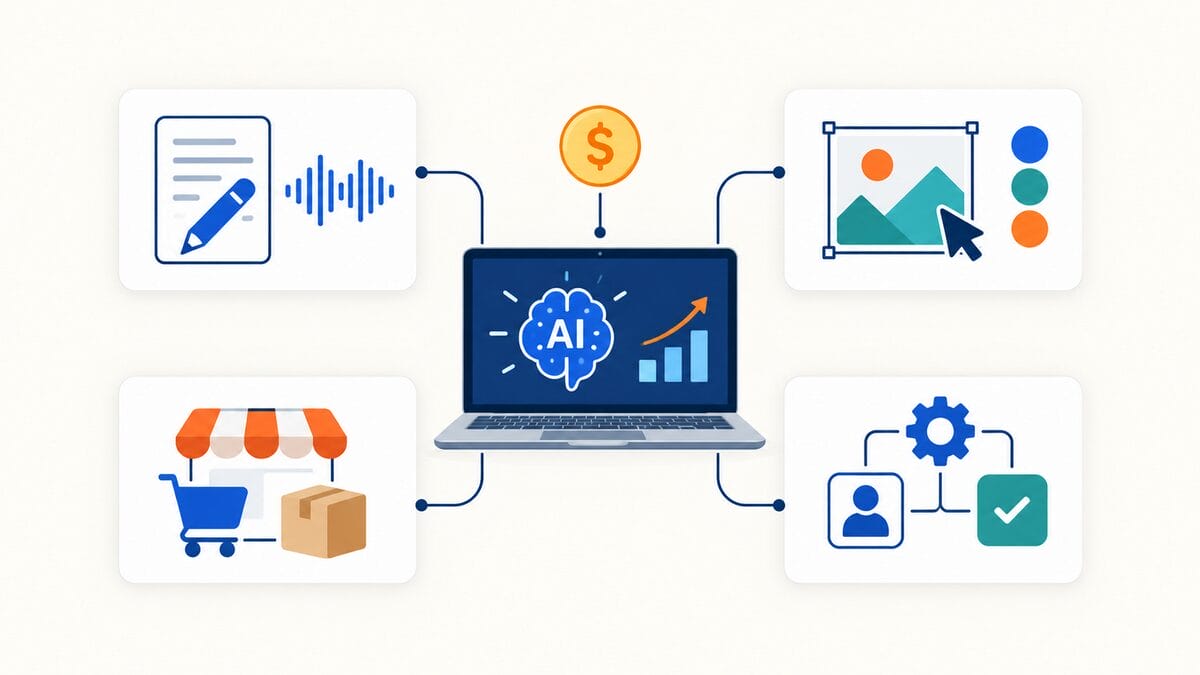
Yes, you can make money with AI by selling products, offering services, or improving an existing business. Customers pay for what you deliver, whether that’s a finished website, an edited video, or a useful digital template.
AI is already part of everyday business operations. For the survey period ending May 3, 2026, the U.S. Census Bureau reported that 19.8% of U.S. businesses used AI in a business function during the previous two weeks. For your own business, I’d bring it back to one question: what could you help a customer do better or faster?
You can approach this in three ways:
- Offer a service: Use AI to support writing, design, research, or administrative work.
- Sell a product: Create templates, educational resources, digital artwork, or merchandise.
- Improve your business: Reduce repetitive work and costs, freeing up time for customers and sales.
For example, a store owner might pay you to improve product descriptions. AI can draft variations while you verify details and sharpen the message. The client gets copy they can actually use, and you need to charge enough to make the editing time worthwhile.
🆕 Beginner’s Tip: Test one small offer first. Create a sample for one type of customer and ask potential buyers for feedback before paying for several tools. I’d rather improve one useful service than juggle five subscriptions without a customer.
Best Ways To Make Money Online With AI
The best starting point depends on what you can already do and who you can reach. If you’re comfortable editing videos, a small content package gives you something concrete to offer clients. If you want to sell products, you’ll need to spend more time on sourcing, pricing, and attracting shoppers.
Use this comparison to narrow your options before choosing a method. Earning potential depends on demand, pricing, costs, and your capacity to deliver, so the table explains how each category can generate and grow revenue.
| Category | Skills you’ll need | Initial effort | How you earn | What shapes earning potential |
|---|---|---|---|---|
| Ecommerce & selling | Product research, marketing, customer service | Moderate–high | Product sales or website-building fees | Margins, acquisition costs, repeat purchases |
| Content & creatives | Writing, editing, design, or production | Moderate | Project fees, ongoing packages, digital sales | Quality, specialization, repeat clients |
| Courses & education | Subject knowledge, teaching, content creation | Moderate–high | Course sales, resources, workshops | Credibility, audience reach, learner outcomes |
| Prompt & AI expertise | Workflow design, testing, problem-solving | Moderate–high | Prompt products, setup fees, consulting | Business usefulness, customization, support |
| Data & research | Data literacy, source evaluation, analysis | Moderate–high | Reports, dashboards, recurring analysis | Accuracy, complexity, value to decisions |
| Tech & automation | Process mapping, integrations, testing | High | Implementation fees and maintenance | Reliability, project scope, ongoing contracts |
| Marketing & social media | Audience research, copywriting, analytics | Moderate | Monthly packages, consulting, commissions | Client retention, measurable results, audience trust |
| Niche/professional services | Relevant subject skills, communication, quality control | Varies by service | Individual projects, packages, ongoing support | Specialization, efficiency, repeat demand |
Ecommerce & selling
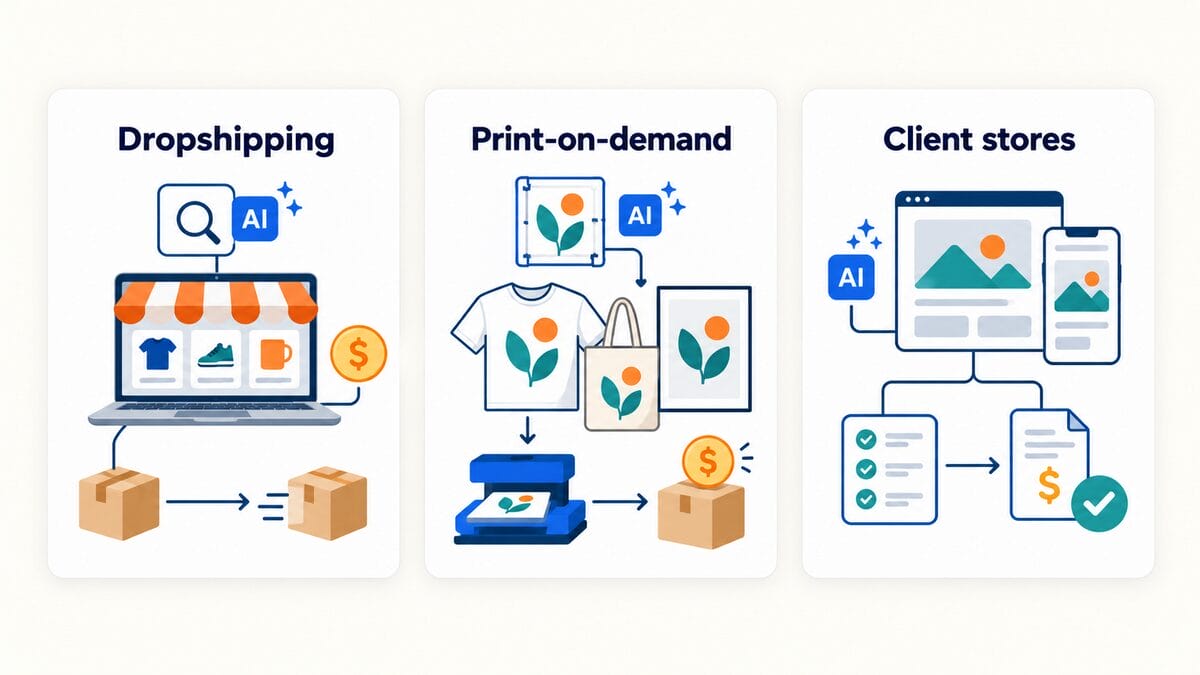
AI can support both selling your own products and building stores for other businesses. These paths have different workloads: selling products involves suppliers, margins, and customer service; building websites for clients involves finding prospects, managing revisions, and delivering a working site.
1. Build and manage a dropshipping store with AI
Dropshipping lets you sell products through an online store while a supplier fulfills customer orders. Your revenue comes from product sales, and what remains after product costs, shipping, marketing, fees, and other expenses determines your profit.
Dropshipping with AI can help you organize product research, draft storefront content, and develop marketing ideas. Inventory syncing and order routing can also reduce manual work, although not every automation feature uses AI. You still need to evaluate suppliers, check listings, set viable prices, and handle customer issues.
Start with one audience and a focused product selection, such as practical travel accessories for dog owners. Review samples, delivery options, and costs before investing heavily in promotion. An AI store builder can speed up setup.
2. Sell print-on-demand merchandise with AI-assisted designs
Print-on-demand lets you sell shirts, posters, and other products that a fulfillment partner prints or customizes after each order. Your profit is what’s left after production, shipping, selling fees, marketing, and other expenses.
Use AI to explore designs for a target audience, such as gardening enthusiasts. You can begin with a small collection, refine the artwork, check commercial-use terms, and order samples before promoting it.
3. Build AI-assisted ecommerce websites for clients
Some businesses have products ready to sell but need help turning them into a usable online store. You can offer store setup as a paid service, using AI to assist with page layouts, draft copy, and other parts of production.
Getting the first draft online is only part of the job. You’ll also organize collections, check the mobile layout, set up delivery options, and test checkout. Clients need a store their customers can use, which takes more than generating a homepage.
Build a demonstration store for a specific business type, such as a local ceramics maker, then define a manageable package. Specify the pages, product uploads, revisions, and handover support included. I’d set a clear project scope before quoting a fee, so a simple setup doesn’t quietly become months of unpaid maintenance.
Content & creatives
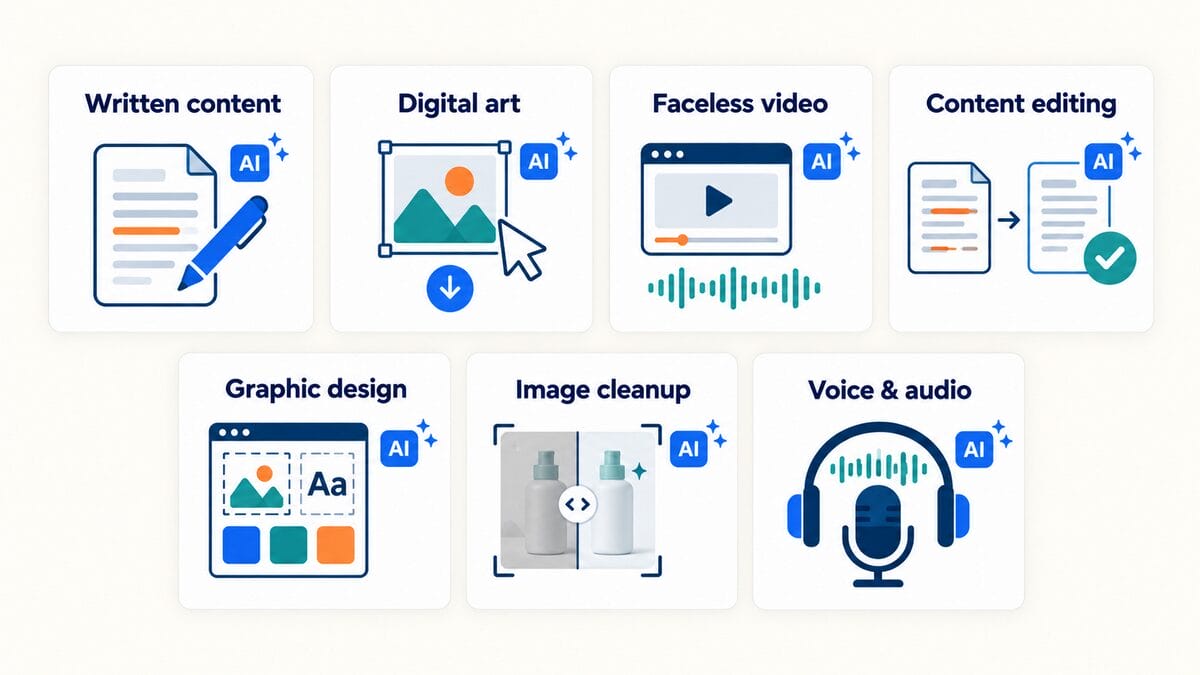
Businesses and creators need content, but generating more of it isn’t always the priority. Often, they need someone who can make it usable: clearer writing, consistent visuals, or videos that get to the point. AI can speed up production while you handle the creative decisions and quality checks.
1. Sell AI-assisted written content
You can offer blog posts, newsletters, articles, or eBooks, using AI to help organize research and draft sections. Before you send it over, check the facts, make it sound like the client, and give the reader something useful to take away.
Choose a subject you understand and create a few relevant samples. For example, a monthly newsletter package for independent pet stores is a more specific offer than “I write anything with AI.” Knowing the subject helps you catch mistakes and add details that a generic draft would miss.
2. Create and sell digital artwork
Digital artwork can generate income through downloadable prints, custom illustrations, or visual assets for businesses. Unlike print-on-demand, you deliver the digital file, so there’s no physical production or shipping to manage.
You could develop coordinated wall-art sets or custom backgrounds for product launches. AI helps explore concepts, but you’ll need to refine the results, prepare suitable files, and check commercial-use terms. Show buyers where the artwork fits: on a nursery wall, in a café menu, or across a product launch.
3. Build a faceless AI-assisted video channel
A faceless channel uses formats such as screen recordings, animation, or narrated demonstrations without putting the creator on camera. Potential income sources include sponsorships, affiliate commissions, your own products, and advertising where eligible. Building an audience comes first, so this takes patience.
AI can assist with outlines, captions, narration, and editing. I’d choose a topic where you can contribute original demonstrations or analysis, such as practical spreadsheet tutorials. Faceless doesn’t have to mean personality-free; your explanations, examples, and editorial choices give viewers a reason to return.
4. Offer AI-assisted content editing
Businesses may already have AI-generated drafts that sound generic, repeat themselves, or miss important details. You can charge to turn those drafts into publishable content by checking facts, improving structure, and adapting the language to their audience.
Create before-and-after samples that show your judgment. For a product page, that might mean removing unsupported claims and replacing vague descriptions with verified specifications. Agree on whether research and fact-checking are included, because a light proofread and a full rewrite require different amounts of work.
💡 Pro Tip: Show the decisions behind your edits. A short explanation of what you changed and why helps potential clients see the value of your work beyond grammar corrections.
5. Offer freelance graphic design services
Social media graphics, presentation slides, promotional banners, and downloadable guides can all become paid design projects. AI can help with concepts and visual elements, while you shape the finished layout around the client’s message and brand.
Define a package, such as a set of launch graphics for a small online store. Keep typography, colors, and spacing consistent, and supply the agreed file formats. A cohesive set of usable assets gives the client more value than a folder of disconnected generated images.
6. Provide photo and image enhancement services
Sellers may need cleaner backgrounds, consistent crops, or better lighting across their product photos. You can offer catalog image cleanup packages, using AI-assisted editing to reduce repetitive work while reviewing every result.
Accuracy matters here: an edit shouldn’t change the product’s color, texture, proportions, or included accessories. Start with a small batch of client-approved images and establish a reference style. Make the product easier to see while keeping the image faithful to what the buyer will receive.
7. Offer voiceover and audio-editing services
You can help clients produce narrated tutorials, training materials, podcast edits, or audio versions of existing content. AI voice and editing tools can assist with production, but pronunciation, pacing, and sound quality still need careful review.
Offer a small, clearly scoped project, such as polishing a short training recording or producing narration from an approved script. Confirm that you have the necessary permissions for any voices and audio you use, and specify revisions upfront. A natural, accurate final recording is the service the client is paying for.
Courses & education
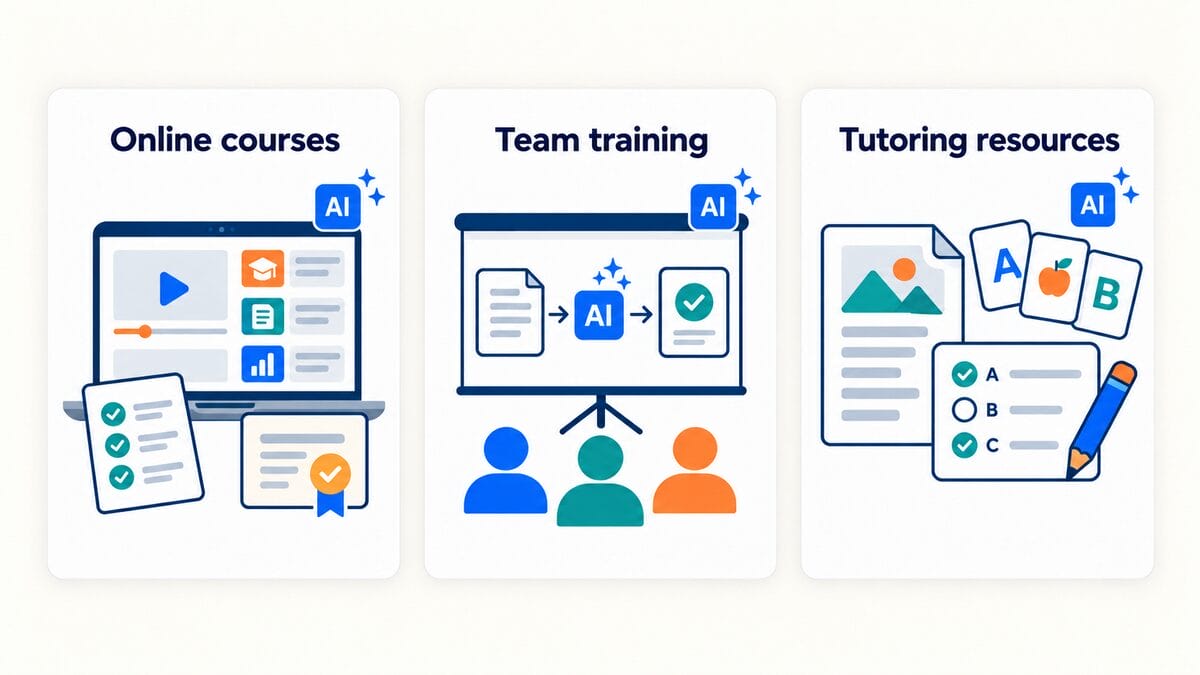
If you know how to do something useful, AI can help you organize that knowledge into lessons, exercises, or learning resources. Think about the parts beginners usually get stuck on. If you can explain those clearly and give them a chance to practice, you have a useful starting point.
1. Create and sell AI-assisted online courses
You can earn money by building a course around a skill you already understand, using AI to help outline modules, draft exercises, or prepare supporting materials. Choose one learning outcome, such as helping handmade sellers take better product photos with their phones.
I’d test a short paid workshop before recording an entire course. Questions from participants can reveal missing steps and confusing explanations, helping you improve the material. Build around what learners actually need, and budget time for feedback, updates, and promotion after launch.
2. Offer AI tutorials and team training
Businesses may need help applying AI to everyday tasks, from preparing meeting summaries to drafting customer emails. You can charge for live workshops, recorded tutorials, or team training that demonstrates a practical workflow people can repeat.
For example, teach a small ecommerce team how to draft product descriptions from verified specifications, then review them for accuracy and brand voice. Include practice tasks and explain when human review is necessary. Teach a process you’ve tested, with clear limits, rather than presenting every generated answer as reliable.
3. Create tutoring resources, lessons, and quizzes
Teachers and tutors may buy editable worksheets, revision activities, lesson plans, or question banks that save preparation time. AI can help generate variations and organize exercises, while you check accuracy and learning value.
Try a tightly defined resource, such as beginner Spanish vocabulary activities for adult learners. Review every answer, adjust the difficulty, and include clear instructions. If you already tutor, your students’ recurring questions can help identify useful topics.
Prompt & AI expertise services
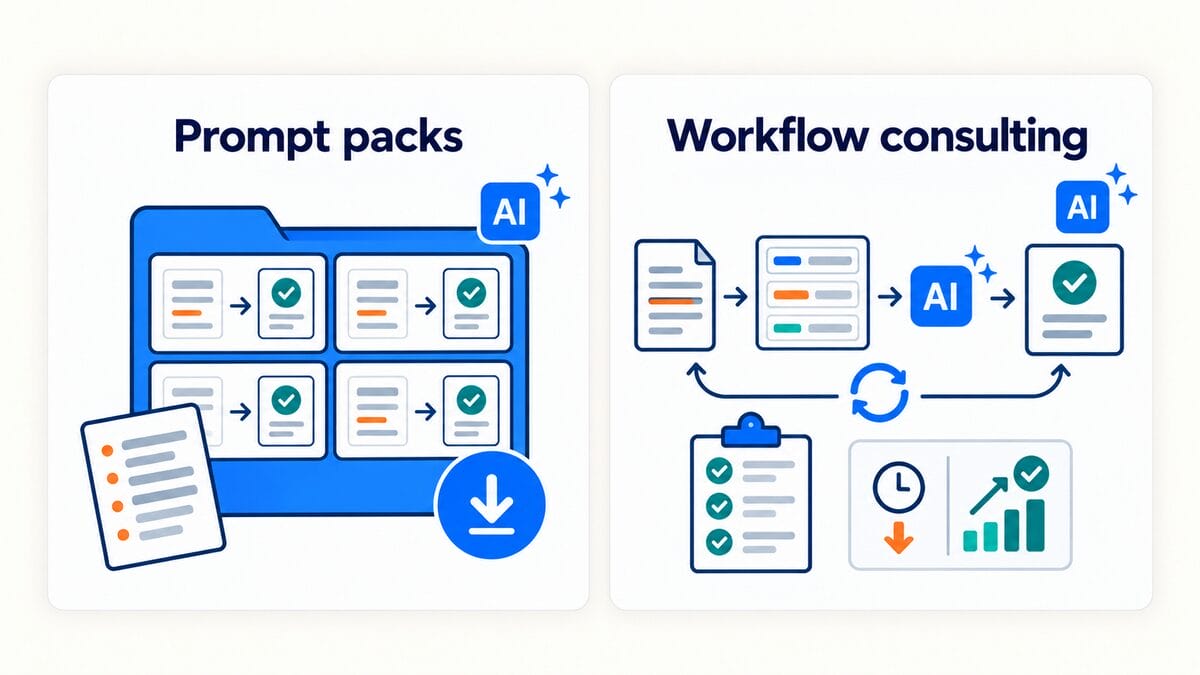
Getting a useful AI response takes context, clear instructions, and testing. If you’re good at translating messy tasks into repeatable processes, you can package that expertise into products or services. Look for a task people keep getting disappointing results from, even after trying AI themselves.
1. Sell specialized prompt packs and libraries
Prompt packs are reusable instructions designed for particular tasks, such as turning product specifications into listing drafts or preparing questions for customer interviews. You earn through sales of a focused digital resource, ideally with examples and instructions that help buyers use it successfully.
A useful pack should explain what information to provide, how to adapt the prompts, and what to check in the output. I’d build one around a task you know well and test it with different inputs. Show what the prompts help accomplish; a giant folder of generic instructions gives buyers little reason to pay.
2. Offer freelance prompt design and AI workflow consulting
Businesses may need something more tailored than a downloadable pack. You can charge to examine a recurring task, design instructions around their requirements, and test the process with representative examples. The deliverable is a working process, supported by documentation and a clear review step.
For instance, an ecommerce team might need to turn supplier information into consistent product-page drafts without inventing specifications. Your job could include defining required inputs, handling missing details, and checking outputs against an agreed standard. Price around a defined project scope, including testing and revisions, rather than selling a supposedly perfect prompt.
First, go with a small paid pilot for one task and measure whether it improves the client’s workflow. Compare editing time and error rates before and after, and document where human input remains necessary. Demonstrated improvements make a stronger offer than broad promises about transforming a business with AI.
Marketing & social media
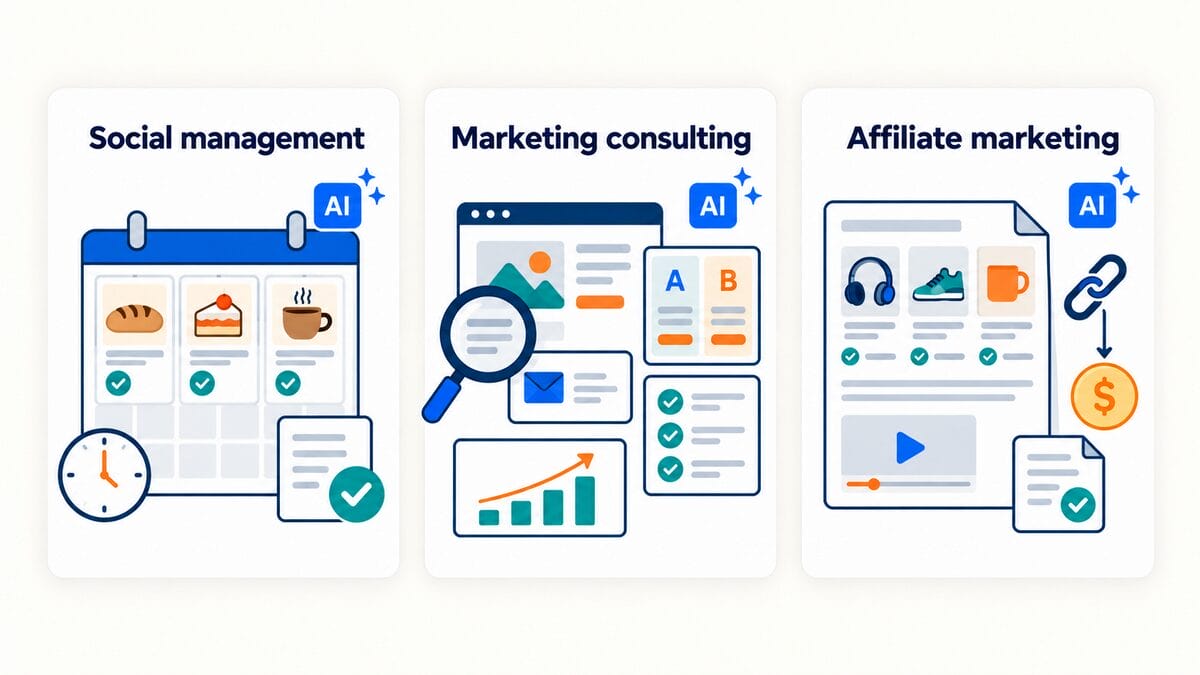
Coming up with a caption is one task. Understanding what a business should post, keeping campaigns consistent, and learning from the results is a service. AI can help with drafts and repurposing, leaving you more time to plan what’s worth posting and see how people respond.
1. Offer AI-assisted social media management
Small business owners often have photos, customer questions, and promotions sitting unused because nobody has time to turn them into posts. You can sell monthly content and scheduling packages, using AI to draft captions, repurpose material, and organize a publishing calendar.
For a local bakery, that could mean turning weekly specials and behind-the-scenes footage into a manageable mix of posts. You’d handle the editing, brand voice, and approval process. Define what the package includes, especially whether filming, replying to comments, and reporting cost extra. Otherwise, “a few Instagram posts” can quietly become a full-time job.
2. Provide digital marketing and sales consulting
If you already understand marketing, AI can help you analyze campaign material, develop messaging variations, and organize test ideas. Clients pay for your ability to identify what needs improving, whether that’s an unclear offer, a confusing landing page, or an email sequence that leaves buying questions unanswered.
Offer a focused audit with prioritized recommendations and a clear testing plan. For example, review an online store’s product pages and follow-up emails, then propose changes based on customer objections. Measure the results of those changes before recommending a wider rollout.
3. Build an affiliate marketing business with AI support
Affiliate marketing earns you a commission when someone completes a qualifying purchase or action through your referral link. AI can help organize comparison notes, outline tutorials, and repurpose your content, while your recommendations give people a reason to trust you.
Choose a topic you can cover credibly, such as tools for handmade sellers or equipment for home coffee enthusiasts. Publish useful comparisons and demonstrations, verify product details, and clearly disclose affiliate relationships. Never invent firsthand experience to make a recommendation more convincing.
This approach takes time because you need to attract people who find your content useful. I’d start with a few detailed resources answering specific buying questions, then improve them as you learn what readers need. Traffic and commissions aren’t automatic, so account for the work of maintaining content and building an audience.
Niche/professional services
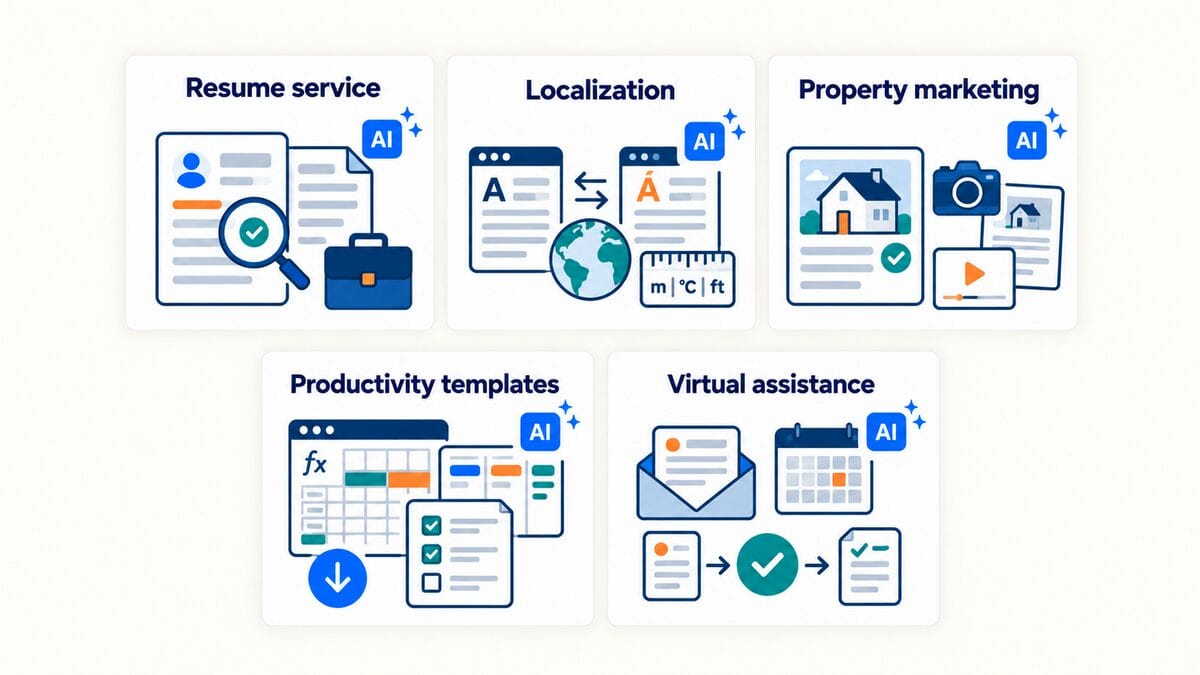
Some useful AI-assisted services tackle everyday tasks: improving a job application, adapting a product page for another market, or organizing a busy inbox. A specific customer need gives your offer direction, especially when you bring relevant experience to the work.
1. Start a resume and cover letter writing service
Job seekers may need help explaining their experience clearly and tailoring applications to relevant roles. AI can assist with structure and wording, while you help uncover the details worth highlighting through a questionnaire or conversation.
Offer a package with a resume review, a tailored cover letter, and a defined number of revisions. Check every achievement against the client’s actual experience, and avoid promises about interviews or hiring outcomes. Make their real qualifications easier to understand without inventing metrics or stuffing the document with keywords.
2. Offer translation and localization services
Businesses expanding into another market need content that makes sense to local customers. You can charge to adapt product pages, emails, or website copy, using AI for an initial draft and your language skills for the final version.
Localization also involves tone, measurements, cultural references, and buying habits. A joke that works in English might land like an awkward group-chat message in Spanish. Only offer languages you can confidently review, and define which formats and revisions your fee covers.
3. Provide property marketing support
Real estate agents and property managers may need listing descriptions, brochures, social posts, or video scripts. AI can help turn approved property details into drafts, while you check accuracy and keep the messaging consistent across formats.
A per-property package could include a listing description, several captions, and a short walkthrough script. Work from verified specifications and client-supplied material, checking every claim about amenities and location. Keep descriptions faithful to the property so prospective buyers or renters know what to expect.
4. Sell productivity templates and digital products
Useful spreadsheets, project planners, checklists, and workspace templates can generate income through individual sales or bundles. AI can help draft instructions and develop formulas, but the product needs to work reliably for someone who didn’t build it.
For an ecommerce audience, you could create a product-testing tracker with fields for supplier costs, sample feedback, and campaign results. Test it with realistic inputs and include a short walkthrough.
5. Offer AI-assisted virtual assistant services
Business owners may pay for ongoing help organizing email, preparing meeting notes, maintaining records, or drafting routine communications. AI can assist with summaries and drafts, allowing you to package dependable administrative support around an agreed set of tasks.
At the beginning, choose a limited weekly scope and establish which actions need approval. Drafting a customer reply and sending it carry different responsibilities, so make those boundaries explicit. Reliability and communication drive repeat work: clients need to know what’s been handled, what’s pending, and where you need their input.
Top AI Tools To Make Money Online
Start with tools that support your offer, then expand as your workload grows. The categories below include AI assistants alongside platforms for editing, selling, and delivering your work.
Ecommerce & selling
- BuildYourStore.ai: BYS is an automated store builder that uses artificial intelligence to do the heavy lifting of starting an online store.
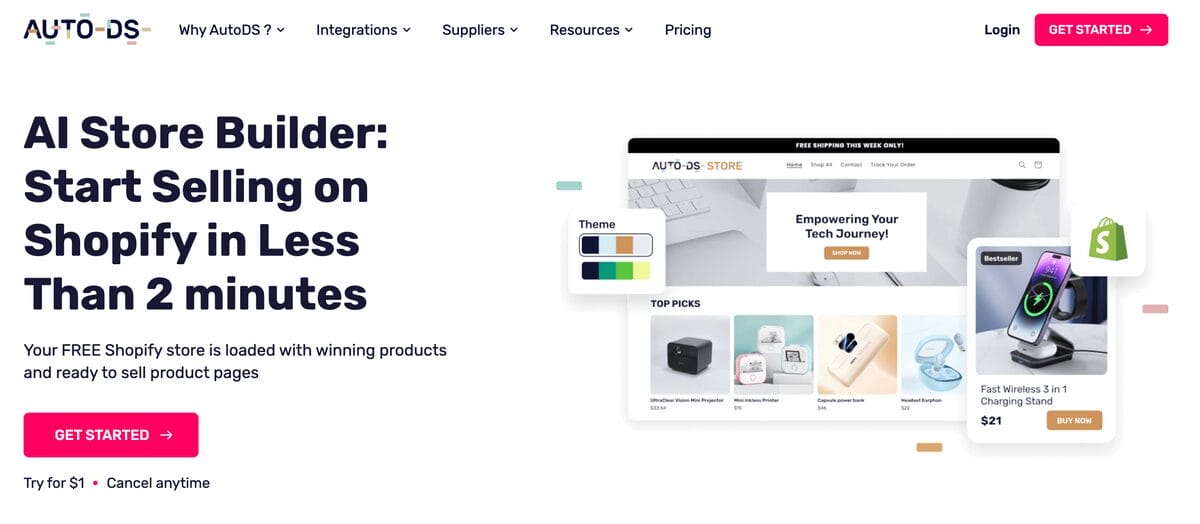
- AutoDS: An all-in-one dropshipping platform with AI store-building and listing tools, plus product research, importing, stock monitoring, and order automation.
- Shopify Magic: Helps draft product descriptions inside Shopify. Sidekick provides broader AI assistance for running your store.
- Printful / Printify: Handle print-on-demand production and fulfillment, turning your designs into physical merchandise.
- Midjourney: Supports artwork and design concepts for merchandise; review and prepare files before production.
Content & creative
- ChatGPT / Claude: Help outline, draft, edit, and repurpose articles, newsletters, and video scripts.
- Midjourney / ChatGPT image generation / Ideogram: Generate visual concepts and illustrations for digital products or client projects.
- ElevenLabs / Murf: Create AI narration for explainers, lessons, and videos.
- Descript / Pictory / Runway: Support transcript-based editing, turning scripts into videos, and generating footage, respectively.
- Adobe Firefly / Canva AI: Assist with image creation, editing, and visual content. GIMP is a free conventional editor for refining finished assets.
Courses & education
- ChatGPT / Claude: Help turn your expertise into curriculum outlines, lesson drafts, and quizzes. Review explanations and answer keys before sharing.
- Notion AI: Helps organize teaching notes, draft lesson plans, and manage course materials in one workspace.
- ElevenLabs: Creates narration for lessons and tutorials from approved scripts.
- Teachable / Udemy: Platforms for hosting and selling courses. Teachable supports your own course business, while Udemy lets you publish within its course marketplace.
Prompt & AI expertise services
- ChatGPT / Claude / Midjourney: Help you develop and test prompts for writing, business tasks, and visual projects. Include sample inputs and expected results in your deliverables.
- Gumroad: Supports selling downloadable resources, such as specialized prompt libraries with instructions and examples.
- Upwork / Fiverr: Freelance marketplaces for offering prompt design, AI workflow setup, and consulting services.
Etsy isn’t an option for prompt bundles: its AI policy prohibits selling them, although qualifying finished AI-assisted artwork is permitted with disclosure.
Data & research
- ChatGPT: Helps analyze uploaded spreadsheets, explore patterns, and create charts. Review calculations and assumptions before delivering findings.
- Python with pandas / scikit-learn: pandas supports data cleaning and analysis; scikit-learn supports machine-learning models. Both require coding and analytical skills.
- Tableau / Microsoft Power BI: Turn business data into dashboards and reports for tracking sales, costs, and performance.
- Perplexity: Helps find sources and summarize research. Check the original references before including claims in a client report.
Tech & automation
- GitHub Copilot / Replit Agent: Assist with writing, debugging, and building software. Review and test the results before delivering client projects.
- Zapier / Make: Connect apps and automate workflows, such as organizing inquiries, updating records, and generating AI-assisted drafts.
- Chatbase / Botpress / Tidio: Support building AI assistants and customer-support chatbots. Use approved business information and test when conversations should reach a person.
- Bubble: Combines AI assistance with visual development for building apps, client portals, and subscription software without writing every component from scratch.
Marketing & social media
- Buffer / Hootsuite: Combine social media management with AI assistance for post ideas, captions, and content repurposing.
- Canva AI: Helps create social graphics and campaign visuals that you can refine around a client’s brand.
- Jasper / Writesonic: Support marketing content creation, with Jasper focused on brand-aligned campaigns and Writesonic emphasizing search content and AI visibility.
- Surfer / Frase: Help research, structure, and optimize search-focused content. Use their recommendations alongside original insights and editorial judgment.
Niche/professional services
- ChatGPT / Jasper: Help draft resumes, cover letters, and property descriptions from verified client information.
- DeepL: Supports text and document translation. Apply your language skills to review meaning, terminology, and local phrasing.
- Grammarly: Helps check grammar, clarity, and tone when polishing client documents and communications.
- Notion AI / Zapier: Help organize information and automate recurring administrative tasks, supporting virtual assistant services.
Frequently Asked Questions
Can you really make money with AI in 2026?
Yes. You can use AI to help deliver paid services, create products, or improve an existing business. Your income depends on customer demand, quality, pricing, and expenses. Access to an AI tool alone doesn’t create a profitable offer.
What is the easiest way to make money with AI as a beginner?
A small service that builds on a skill you already have is a practical starting point. If you write well, try content editing; if you’re organized, consider administrative support. Choose a task you can confidently check and deliver.
Can I use ChatGPT to make money online?
Yes. ChatGPT can help you prepare content, analyze data, develop digital resources, and support client work. You earn by selling the resulting product or service. Review outputs for accuracy and follow the relevant tool terms, client agreements, and marketplace rules.
How much money can you realistically make with AI?
There’s no reliable income figure that applies to everyone. You may earn nothing while testing an offer, and revenue isn’t the same as profit. As a hypothetical example, four projects priced at $150 generate $600 in revenue before software costs, fees, taxes, and the time you spend delivering them.
Do I need coding skills to make money with AI?
No. Writing, design, social media, ecommerce, and many administrative services can use AI without coding. Custom software and advanced integrations require more technical knowledge. Either way, you need enough understanding to evaluate the work you sell.
Is it legal to sell AI-generated content or art?
It can be, depending on the tool’s commercial-use terms, marketplace policies, applicable law, and whether the work infringes someone else’s rights. Permission to sell also differs from copyright protection: the U.S. Copyright Office explains that protection requires human authorship. Check disclosure requirements before listing your work.
Can AI income be considered passive income?
Some products, such as templates or recorded courses, can sell repeatedly after the initial work. However, marketing, updates, customer support, and quality checks still take time. AI can reduce parts of that workload, but fully hands-off income isn’t a realistic assumption.
How do I avoid AI money-making scams?
Be skeptical of guaranteed earnings, pressure to pay immediately, and claims that require no skills or ongoing work. Verify the seller, check independent complaints, and read the costs and refund terms. The FTC’s action against Automators AI shows why AI-powered income claims deserve scrutiny.
What’s the fastest way to start earning money with AI with no experience?
Start by learning one narrowly defined task, creating a sample, and offering a small paid pilot to a relevant customer. Caption editing or basic image cleanup could work if you can deliver them reliably. There’s no guaranteed timeline; prioritize a manageable offer over a complicated business launch.
Conclusion
Making money with AI starts with giving someone a reason to invest. That could be a useful product, a well-edited video, or a service that takes a recurring task off their plate. Pick something you can do well enough that someone would happily pay you to take it off their list.
I’d choose one method, create a sample, and put it in front of potential customers before adding more subscriptions. Let real feedback guide your next move. You don’t need an Avengers-sized lineup of AI tools to test whether someone wants what you’re selling.
If ecommerce feels like your direction, you can get started with AutoDS to explore product research, store-building tools, and automation. Focus the product selection, check your costs, and build around what customers respond to.
For a closer look at putting these ideas into practice, keep exploring with these guides: