

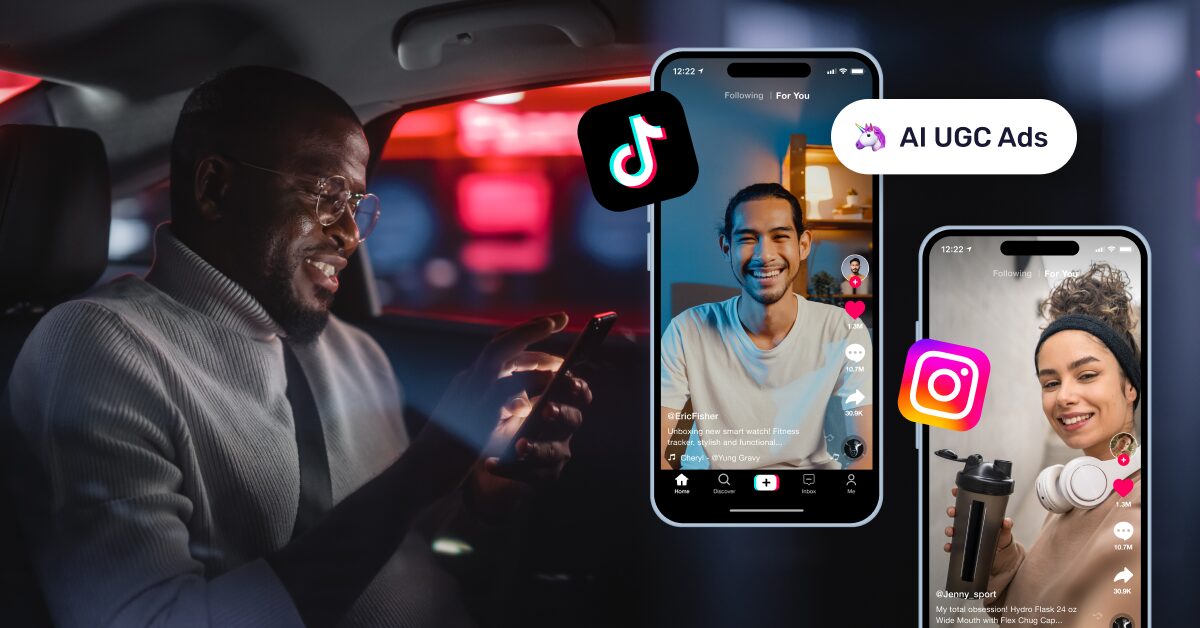
If your TikTok or Instagram ad looks like an ad, the scroll may have already happened. People open social media apps for entertainment, ideas, and recommendations, not to admire another spotless product commercial with elevator music.
UGC ads are paid social creatives designed to look and sound like organic content made by a customer or creator. They usually use vertical video, direct-to-camera delivery, product demonstrations, testimonials, unboxings, or relatable point-of-view stories.
For a dropshipper, this is the creative side of a broader TikTok dropshipping strategy: the content engine that turns a useful product into something people understand, remember, and want. This guide focuses on creating and testing that content.
UGC is a creative format, not a guarantee. A casual-looking video still needs a strong angle, clear proof, and a useful offer.
Real customer UGC, hired creator UGC, and AI UGC are different. Each has its own cost, speed, credibility, and usage-rights considerations.
A simple structure works best: hook the viewer, show the problem, demonstrate the product, add proof, and give one clear next step.
TikTok and Instagram need different finishing touches. You can reuse the core footage, but the pacing, caption style, audio, and CTA should feel native to each placement.
Creative testing matters more than chasing one “perfect” ad. Test meaningful variations, read the data, and build new versions from what actually works.
What Are UGC Ads?

UGC stands for User-Generated Content. And a UGC ad is an advertisement that uses the visual language of UGC. It feels personal, useful, and native to the feed, even when a brand commissioned the video and paid to distribute it.
Picture a creator holding a portable blender and saying, “I keep forgetting breakfast, so I tried this for a week.” They show the product, make a smoothie, mention one honest limitation, and end with a simple CTA. That is much closer to a recommendation than a traditional product montage, which is exactly why the format suits discovery-driven platforms.
However, not everything labeled “UGC” comes from a genuine customer. The cleaner terminology is worth learning:
| Content type | Who makes it? | Where it appears | What you are paying for |
|---|---|---|---|
| Customer UGC | A real buyer | Customer or brand account | Permission to reuse an authentic customer experience |
| Creator UGC | A hired creator | Usually the brand’s account or ads | The content asset, production skills, and agreed usage rights |
| Influencer content | A creator with an audience | The creator’s account | Content plus access to that audience |
| UGC-style brand content | You or your team | Brand account or ads | In-house production with a native social look |
| AI UGC | An AI video tool | Brand account or ads | Fast, synthetic UGC-style creative and variations |
A follower count is not automatically valuable in a UGC-only deal. If the creator delivers a file and never posts it, you are mainly buying their performance on camera, scripting, and editing, as well as the right to use the asset. Reach becomes part of the price when the creator also publishes to their audience.
Why UGC Ads Fit Dropshipping So Well
Dropshipping products often need to be understood quickly. A good UGC video closes that comprehension gap. Instead of listing “three speed settings” in a caption, it shows the viewer how the gadget solves a small but annoying problem in real life.
UGC also gives you more creative angles without rebuilding the entire campaign. One product can become a demo, comparison, routine, reaction, objection-handling video, or before-and-after story. That flexibility is useful when creative fatigue arrives and yesterday’s winner suddenly starts behaving like it has entered witness protection.
TikTok’s own creative guidance recommends a hook-body-close structure and reports that TikTok-first ads drive more actions than repurposed, non-native creative. The useful lesson is not “make it messy”; it is “make it belong.” Shoot vertically, show the product early, use platform-native editing cues, and write for someone who did not wake up planning to buy from you.
🔍 Research Tip: Read comments on organic videos and ads for similar products. Questions like “Does it work on thick hair?” or “Can I clean it in the dishwasher?” are ready-made hooks, objections, and demonstration ideas.
UGC is still only the creative. It cannot rescue a weak product, a vague offer, a slow landing page, or an unreliable delivery experience. I like to treat it as an amplifier: it makes a strong product-market match easier to see, but it also exposes a bad one faster.
What Makes a High-Converting UGC Ad?

The best UGC ads depend on a clear sequence of ideas. A useful starting structure looks like this:
- Hook: Give the right viewer a reason to stop.
- Problem: Name the frustration or desire behind the purchase.
- Product reveal: Introduce the item as the bridge, not the hero of a 40-second feature lecture.
- Demonstration: Show the product doing the thing you promised.
- Proof: Add a truthful detail, result, comparison, or objection answer.
- CTA: Tell the viewer what to do next.
1️⃣ A hook with a specific promise
“You need this” is not a hook; it is a sentence wearing a hook costume. Stronger openings create relevance, curiosity, or tension immediately.
For example, instead of “This mini vacuum is amazing,” try: “The five-minute desk reset that stops crumbs from living under my keyboard.” It names the use case, visualizes the outcome, and gives the demonstration somewhere to go.
Useful hook formulas include:
- Problem-first: “If your fitted sheet turns into a closet avalanche, try this.”
- Unexpected result: “I bought this for my car and now I use it in every room.”
- Objection-first: “I thought this would be another useless kitchen gadget.”
- Comparison: “Here’s the difference between wiping this stain and actually lifting it.”
- Routine: “One tiny thing that made my 7 a.m. routine less chaotic.”
2️⃣ A visible product demonstration
Show the mechanism, not only the outcome. If you sell a fabric shaver, let viewers see the worn sweater, the tool moving across it, and the collected lint. That visual proof answers more questions than a generic “five stars” graphic ever could.
The product should appear early enough that the viewer understands the subject of the video. Keep hands, texture, movement, and scale in frame. You do not need to shoot the next season of Euphoria; you do need enough light for people to see what is happening.
3️⃣ Natural but intentional delivery
UGC should sound conversational, but “authentic” does not mean unplanned. Give the creator talking points and a target outcome rather than a stiff, word-for-word script when possible. Natural pauses, personal phrasing, and small reactions can make the delivery believable.
At the same time, do not ask a creator to pretend they achieved a result they did not experience. A fictional testimonial is still a fictional testimonial, even when the camera is handheld and the captions use a trendy font.
4️⃣ One clear call to action
The CTA should match the viewer’s next step. “See how it works,” “Choose your color,” and “Shop the bundle” are clearer than stacking five instructions at once. If the platform adds its own CTA button, make the spoken and on-screen message support it rather than compete with it.
📢 Marketing Tip: Ask for clean raw footage as a separate deliverable. A few extra product close-ups, reactions, and silent demonstrations can become dozens of new openings without paying for a complete reshoot.
TikTok UGC Ads vs. Instagram UGC Ads
You can reuse the same central idea across TikTok and Instagram, but posting the identical export everywhere is rarely the best move. The platforms share a vertical-video language, yet viewers use them differently and each placement adds its own interface around the creative.
| Element | TikTok UGC ads | Instagram UGC ads |
|---|---|---|
| Default feel | Fast, direct, trend-aware, creator-led | Native but often slightly cleaner and more lifestyle-led |
| Strong placements | In-feed ads and Spark Ads | Reels, Stories, and Feed |
| Opening | Pattern interrupt, bold statement, immediate action | Clear visual payoff, relatable situation, or lifestyle context |
| Editing | Faster cuts, text-led storytelling, platform-native sounds | Clean captions, visually consistent framing, placement-aware CTA |
| Social proof route | Comments, creator identity, organic post engagement | Creator identity, profile context, partnership ads, comments |
| Best repurposing move | Test several hook and creator variations | Recut the winner for Reels and Stories safe zones |
On TikTok, Spark Ads let an advertiser promote an authorized organic post while retaining the post’s identity and engagement. That makes creator permissions operational, not optional. You need the correct authorization route and a final caption before the post becomes an ad.
On Instagram, creator-led assets may run from the brand account or through partnership ads when the appropriate permissions are in place. Either way, keep key text and the product away from interface-heavy edges, and review the creative inside the actual placement preview.
If this is not exactly what you’re looking for and you want the media-buying side (including campaign objectives, targeting, budgeting, and TikTok Shop-native formats), use this TikTok ads for dropshipping guide. If you want to build reach without paying for every view, the TikTok organic dropshipping guide covers that workflow.
How To Get UGC for Your Dropshipping Products
You have four realistic production routes. The right one depends on whether you need authenticity, speed, volume, creative control, or all four yesterday.
❓ Ask customers for permission
Real customer content can provide the strongest proof because the experience already happened. Use post-purchase emails, package inserts, loyalty rewards, or a small content incentive to invite submissions. Never assume that a public tag gives you unrestricted advertising rights.
Ask for explicit permission, state where you want to use the content, and keep a record. Organic reposting and paid advertising are different permissions. If you want to edit the footage, run it for six months, or use it across TikTok and Meta, put those terms in writing.
🤝 Hire UGC creators directly
Direct outreach gives you more control over creator fit and may reduce platform fees. Look for clear speech, credible demonstrations, a visual style that matches your customer, and examples of paid social work. A huge audience is optional when the creator is not posting.
Send a concise brief, agree on deliverables, and use a contract. Define video length, aspect ratio, raw footage, hook variations, revisions, posting obligations, paid usage, duration, territories, exclusivity, and delivery date. The boring admin is what prevents the exciting invoice dispute later.
💻 Use a UGC creator platform
Platforms such as TikTok One, Billo, Insense, JoinBrands, and Collabstr can simplify discovery, briefs, payments, and licensing. They are useful when managing creators becomes the bottleneck. Costs and services vary: some charge subscriptions or marketplace fees, while others price creators or content packages separately.
TikTok One is TikTok’s own collaboration environment for eligible regions. It can help brands and creators manage opportunities within TikTok, while third-party platforms may offer broader support across TikTok, Instagram, Meta partnership ads, and reusable content assets.
🤖 Create UGC-style videos with AI
AI is the fastest route for script, avatar, voice, and creative variations. It is especially useful for testing hooks, languages, audience angles, and products before funding a larger creator shoot. It is not a license to fabricate reviews or hide synthetic media.
You can use tools like CreateUGC. It is a creative tool that lets you paste a product link, select an AI avatar, customize or generate a script, and export social-ready aspect ratios. Its annual billing entry plan is listed at $19.90 per month for 10 monthly videos (pricing and credit consumption may change, so check the live plan before publishing or budgeting).
🆕 Beginner’s Tip: Use AI for variation before you use it for volume. Ten videos that repeat the same weak promise are not ten tests; they are one bad idea wearing ten outfits.
How Much Do UGC Ads Cost?
There is no universal UGC rate card. Your total cost depends on who creates the asset, whether they post it, production complexity, revision rounds, raw footage, delivery speed, usage duration, paid-ad rights, and creator-handle authorization.
For human-created UGC, current marketplace guidance offers a useful planning anchor. Billo’s updated UGC rate guide places many short-form assets around $200, with beginner work sometimes starting around $50-100, mid-level creators commonly ranging from $150-500, and experienced creators charging $500 or more before licensing.
Customer UGC
Customer UGC may cost a free product, discount, store credit, reward, or negotiated fee. Its biggest advantage is genuine customer proof, but the quality and consistency can vary. Always obtain explicit paid-use permission before turning a customer’s post into an ad.
Direct UGC creators
Hiring a creator directly gives you more control over the concept, creator fit, and final deliverables. Budget for more than the base video fee: samples, shipping, raw footage, extra hooks, revisions, licensing, exclusivity, and creator posting can all affect the quote.
UGC creator platforms
A creator platform usually adds a subscription, marketplace fee, managed-service cost, or content-package price on top of creator payments. You are paying partly for the workflow: discovery, briefs, payments, approvals, and licensing become easier to manage as production volume grows.
In-house UGC
Filming your own content may only require a product sample, phone, basic lighting, a microphone, and editing software. It offers maximum creative control on a small cash budget, although your time, editing ability, and comfort on camera are real production costs too.
AI UGC
AI UGC tools generally use subscriptions or credits rather than per-creator fees. They are useful for fast scripts, avatars, languages, and creative variations, but every output still needs a human review for product accuracy, realistic movement, disclosures, and supportable claims.
💰 Financial Tip: Compare cost per usable variation, not just cost per video. A $300 shoot that includes three hooks, raw footage, and paid rights may be more useful than a $100 video you cannot legally edit or advertise.
Best UGC Tools for TikTok and Instagram
The “best” tool depends on the missing piece in your workflow. Do you need a human creator, an AI presenter, better editing, or permission to amplify an existing post? This shortlist covers those different jobs instead of pretending five tools do the same thing.
CreateUGC

CreateUGC is an AI video generator built around e-commerce products. It is ideal for producing scripts, AI-presenter videos, languages, formats, and creative variations quickly. CreateUGC’s annual billing plan is listed at $19.90 per month, although pricing and credit requirements may change.
TikTok One

TikTok One is TikTok’s own creator collaboration environment. It makes the most sense when you want TikTok-native talent and a workflow that stays close to the platform. Availability depends on the creator’s country or region, while project costs vary according to the collaboration and the creator.
Billo

Billo focuses on human-created UGC for brands and performance marketing teams. It is useful when you want vetted creators and reusable content assets without managing every outreach conversation yourself. Its packages and managed services vary according to the campaign scope and production needs.
Insense

Insense combines creator sourcing with workflows for UGC, product seeding, TikTok Spark Ads, and Meta partnership ads. It is a stronger fit for sellers who want to manage both content production and creator-led amplification. Its membership and marketplace costs sit alongside the individual creator payments.
CapCut

CapCut is an editing tool rather than a creator marketplace. Use it to turn raw footage into platform-ready videos with captions, cuts, resized formats, templates, effects, and mobile-first finishing. It offers free and paid features, with pricing that can vary by plan and region.
Do not choose software before choosing the production route. If credibility depends on a person physically testing the product, hire a creator and send a sample. If you need 20 hook concepts before lunch, AI and editing tools are the better first move.
How To Create UGC Ads Step by Step

1️⃣ Choose a product that can be demonstrated
The easiest UGC products have a visible use case, a clear audience, and a quick payoff. A viewer should understand the “before,” action, and “after” without reading a product manual. Beauty tools, organizers, cleaning products, pet accessories, kitchen gadgets, and problem-solving home items often fit this pattern, provided the claims are honest, and the product quality holds up.
Order a sample before commissioning content. You need to verify how it looks, feels, operates, and arrives. Supplier photos can help with research, but they cannot tell a creator whether a lid leaks or a button feels flimsy.
2️⃣ Pick one audience and one angle
Avoid writing for “everyone who likes convenient products.” Choose a specific situation: a student with a tiny desk, a parent cleaning a car after school pickup, or a renter who cannot drill into the wall.
Then choose one central angle: save time, remove frustration, improve a routine, compare alternatives, or answer a common objection. One ad can carry one main idea well. Asking it to cover six features, a founder story, three testimonials, and free shipping is how a 25-second video develops an identity crisis.
3️⃣ Build a creator brief
Give the creator enough direction to hit the business goal without deleting their personality. A practical brief includes:
- Target viewer: Who should recognize themselves?
- Problem and promise: What changes after using the product?
- Required shots: Product opening, setup, close-up, use, and result.
- Talking points: Two or three facts that must be accurate.
- Avoid list: Unsupported claims, restricted language, competitor trademarks, or misleading scenes.
- Deliverables: Length, format, hooks, raw footage, captions, and revision count.
- Rights: Organic use, paid use, duration, platforms, territory, and creator-handle access.
4️⃣ Write several hooks before the full script
The opening is the cheapest place to create meaningful variation. Write five to ten hooks around different motivations, then keep the rest of the video reasonably consistent. That gives you cleaner learning than changing the actor, offer, script, soundtrack, and landing page at the same time.
A simple script template is:
“I was tired of [specific problem]. I tried [product/category] because [reason]. Here’s what happened when I [visible demonstration]. My favorite part is [truthful benefit or detail]. If you also [audience situation], [clear CTA].”
Use this as scaffolding, not dialogue carved into stone. Rewrite it in the creator’s natural vocabulary and remove any statement they cannot personally or visually support.
5️⃣ Film for the feed
Shoot in a vertical 9:16 frame, use clear audio, and keep important action away from UI overlays. Start with movement or a strong first frame, show the product early, and record more B-roll than you think you need. Captions should help silent viewers without covering the demonstration.
Create clean footage first, then make platform-specific edits. For TikTok, test faster pacing, native text, and culturally relevant formats. For Instagram, prepare clean Reels and Stories cuts with placement-safe text and a visually clear CTA. Use commercial-safe audio when the content will run as an ad.
6️⃣ Secure rights and review disclosures
Before launch, confirm that you have the rights to the video, voice, music, likeness, and product footage. Paid usage should be explicit and time-bound unless you negotiated a broader license. Get separate authorization when running an ad through a creator’s account or organic post.
If a creator received money, a free product, commission, or another benefit and posts an endorsement, disclose that relationship clearly. Keep disclosures easy to notice and understand. AI-generated people should not be presented as real customers, and synthetic media should follow the applicable platform labeling rules.
7️⃣ Launch a controlled creative test
Start with several distinct hooks or angles, not microscopic edits no human would notice. Keep the offer, audience, and landing experience stable enough to understand what the creative changed. Give each variation a fair opportunity within a budget and time window appropriate to your account.
Watch both attention and business metrics:
- Early attention: Thumb-stop or opening view behavior.
- Retention: How long people continue watching and where they leave.
- Engagement: Saves, shares, comments, and useful questions.
- Click-through rate: Whether the creative earns the next step.
- Conversion rate: Whether the page and offer complete the job.
- CPA and ROAS: Whether sales are profitable after ad spend.
Diagnose the stage that is failing. Weak opening retention usually points to the first frame or hook. Strong watch time but weak clicks may signal a vague CTA or low buying intent. Healthy clicks but weak conversions often shift the investigation to the product page, price, offer, trust signals, or delivery promise.
8️⃣ Iterate without cloning the winner forever
When a video works, break it into components: creator, first frame, hook, angle, demonstration, proof, CTA, length, and offer. Keep the winning principle and refresh the execution. You might retain the problem-solution story but test a new creator, objection, setting, or proof shot.
This is where a hybrid workflow becomes powerful. Human footage supplies credibility and product truth; AI and editing tools help create scripts, hooks, captions, translations, and new combinations faster. Meanwhile, AutoDS can support product research, importing, price and stock monitoring, eligible order fulfillment, and tracking updates, so the operational side does not become the bottleneck once a creative starts selling.
UGC Ad Examples You Can Adapt
The most useful examples are repeatable structures. Forget about copying viral videos shot for shot. I built these creative briefs you can use as templates; rebuild them around your product’s actual strengths.
Problem-solution demo
Hook: “If pet hair reappears five minutes after you clean, watch this.”
Body: Show the fabric before, the tool collecting hair, and the cleaned surface.
Proof: Empty the collected hair into frame.
CTA: “See the sizes available for your sofa or car.”
Skeptic-to-fan review
Hook: “I thought this was another overhyped kitchen gadget.”
Body: Explain the objection, demonstrate the product, and show one honest surprise.
Proof: Compare the result with the old method.
CTA: “Watch the full demo on the product page.”
Routine integration
Hook: “The 30-second step that fixed the messiest part of my morning.”
Body: Place the product inside a recognizable routine.
Proof: Show the saved space, time, or effort without inventing an exact result.
CTA: “Choose the version that fits your setup.”
Comment-reply ad
Hook: Put a real, common question on screen.
Body: Answer it while demonstrating the relevant feature.
Proof: Zoom in on the detail the viewer asked about.
CTA: “Check the product details for compatibility.”
The comment-reply format is especially efficient because it turns research, objection handling, and social-native presentation into one short video.
Common UGC Ad Mistakes
❌ Making “authentic” look careless
UGC can be casual without being hard to watch. Poor audio, bad lighting, hidden products, and rambling scripts reduce comprehension. Native creatives should feel like a good creator post, not accidental footage from someone’s pocket.
❌ Copying trends without a product connection
A trending sound may earn attention, but attention that never reaches the product is expensive entertainment. Use trends as storytelling templates only when they strengthen the hook or demonstration.
❌ Treating TikTok and Instagram as identical
Cross-posting can save time, but each platform version still needs a final native pass. Review caption density, safe zones, sound, pacing, CTA, and whether the creator identity makes sense in that placement.
❌ Buying a video without buying the right to advertise it
A content file is not automatically a perpetual, worldwide paid-media license. Write down the platforms, duration, territory, edits, and creator-handle permissions before launch. Otherwise, your new winning ad may become unusable just as it starts performing.
❌ Using fake testimonials or unsupported claims
Do not script “this cured my acne,” “I lost ten pounds,” or “it works for everyone” because the line sounds persuasive. Advertising claims need to be truthful and supportable. This matters even more in health, beauty, financial, and safety-related categories.
❌ Testing too many variables at once
If every variation changes everything, the result tells you which ad won but not why. Test at the level of a useful hypothesis: problem-first versus outcome-first, creator A versus creator B, or demo-first versus testimonial-first.
Frequently Asked Questions
What is a UGC ad?
A UGC ad is paid social content designed in the style of an organic customer or creator post. It commonly uses vertical video, direct-to-camera speech, product demonstrations, testimonials, unboxings, or everyday routines.
Do UGC ads work for dropshipping?
Yes, they can work well when the product has a clear use case, the video demonstrates it honestly, and the offer and landing page support the creative. The format itself does not guarantee sales; product quality, targeting, pricing, delivery, and testing still matter.
What is the difference between UGC and influencer marketing?
With UGC, a brand usually pays for a content asset and the rights to use it. With influencer marketing, the brand also pays for access to the creator’s audience because the creator publishes the content. One person can provide both services, but they should be scoped and priced separately.
How much does a UGC video cost?
Prices vary widely according to the creator’s experience, production complexity, deliverables, and license. Paid usage, raw footage, extra hooks, revisions, exclusivity, and creator posting can all increase the final quote.
Can I use the same UGC ad on TikTok and Instagram?
You can reuse the core footage if your license covers both platforms, but create platform-specific edits. TikTok and Instagram have different interfaces, audience behaviors, creator features, music considerations, and ad permissions, so review each export in its intended placement.
What are AI UGC ads?
AI UGC ads are synthetic videos made to follow the style of creator or customer content. They may use AI avatars, voices, scripts, product images, and generated scenes. They are useful for fast creative testing, but they should not impersonate real customers or make fabricated first-person claims.
Do I need permission to use customer videos in ads?
Yes. Ask for explicit permission that covers paid advertising, the platforms you will use, the usage period, and any edits you plan to make. A customer tagging your brand or posting publicly does not automatically grant unrestricted commercial rights.
How long should a UGC ad be?
There is no single ideal length. Make it long enough to communicate the problem, demonstration, proof, and CTA without filler. Shorter cuts can work for simple visual products, while higher-consideration items may need more explanation. Test multiple lengths using the same core angle.
What metrics should I track for UGC ads?
Track early-view behavior, retention, click-through rate, conversion rate, cost per acquisition, and return on ad spend. Use attention metrics to diagnose the creative, then use conversion and profitability metrics to decide whether it deserves more budget.
Final Thoughts: Build a UGC Testing System, Not One Lucky Ad
UGC works because it translates a product into a human situation. The winning question is not “How do I make this look less like an ad?” but “How do I make the value easier to believe and see?” That shift produces better hooks, clearer demonstrations, and more honest creative.
Start with one sample, one audience, and several genuinely different angles. Get the rights in writing, adapt the winner for each platform, and keep feeding performance data back into the next brief. That is how UGC becomes a repeatable acquisition system instead of a folder full of random videos.
When the content starts generating orders, the backend has to keep up. You can start your AutoDS trial for $1 to bring product importing, price and stock monitoring, supported fulfillment, and tracking updates into one workflow while you focus on the next creative test.
UGC is the content engine behind TikTok dropshipping, but it works best when the rest of the machine is healthy too. If you want to keep building from here, these guides are the natural next reads:
- What Are UGC Ads?
- Why UGC Ads Fit Dropshipping So Well
- What Makes A High-Converting UGC Ad?
- TikTok VS Instagram UGC Ads
- How To Get UGC For Your Products
- How Much Do UGC Ads Cost?
- Best UGC Tools For TikTok and Instagram
- How To Create UGC Ads Step-By-Step
- UGC Ad Examples You Can Adapt
- Common UGC Ad Mistakes
- FAQ
- Concclusion