



The best AI tools for dropshipping today fall into the four main categories: product research (finding what to sell), pricing and inventory automation (keeping listings accurate and competitive), fulfillment (getting orders to customers without manual work), and, newest of all, chat-based store management, where you run your store by typing plain-language requests instead of clicking through a dashboard. Every major dropshipping automation software product on the market fits somewhere in that framework, whether it’s a single-purpose tool or an all-in-one platform.
Below, we break down what each category actually does, compare the tools worth knowing in each one, and go deep on chat-based management specifically, since it’s the part of this space that’s changed the most in the last year.
AI tools for dropshipping now cover four core categories: product research, pricing/inventory automation, fulfillment, and chat-based store management.
Yes, AI can find winning products for you — tools like AutoDS’s Trending Products scan sales data, reviews, and social signals to surface products before they go viral, rather than you scrolling supplier sites manually.
Yes, there’s AI that manages your store automatically — through chat-based tools built on MCP (Model Context Protocol), you can now message an AI assistant plain-language requests (“raise prices on my top sellers by 5%”) and have it execute directly on your store.
Dropshipping automation software has matured past simple price-checking — the newest tools handle judgment calls (which products to promote, how to phrase a listing) that used to require a human decision.
What “AI For Dropshipping” Covers Today
A few years ago, “AI for dropshipping” mostly meant a chatbot you could ask for product ideas. That’s changed. Today, the term spans four distinct categories, each solving a different part of running a store:
- Product research: surfacing products worth selling, based on real sales and trend data rather than guesswork.
- Pricing & inventory automation: keeping your listed prices and stock levels accurate against what your supplier actually has, in real time.
- Fulfillment: placing and tracking supplier orders automatically once a customer buys, without you manually re-entering order details.
- Chat-based store management: the newest category, where an AI assistant with direct access to your store’s data can take action based on a plain-language request, instead of you navigating a dashboard yourself.
So, Can AI Find Winning Products For You?
Yes, this is one of the more mature use cases in the space. Tools like AutoDS’s Hand-Picked Products scan sales volume, customer reviews, and social platforms like TikTok and Instagram to flag products showing early demand, often before they’ve fully taken off. That’s a meaningfully different process from manually scrolling through supplier catalogs, hoping something looks promising; it’s based on actual demand signals rather than a hunch.
General-purpose AI assistants like ChatGPT or Perplexity can also help with the research process itself: brainstorming niches, summarizing what’s trending in a category, or naming a store, though they work from general knowledge and web data rather than live sales figures, the way a purpose-built product finder does.
💡Pro Tip: Stop losing hours to manual tasks! AutoDS automates product research, pricing, and fulfillment, all in one place. Try it for $1 and feel the difference.
Pricing, Inventory & Fulfillment: The Automation Backbone
This is the category that quietly does the most work. AutoDS’s Price & Stock Monitoring continuously checks supplier prices and stock levels, automatically updating your store if anything changes — so you’re not caught selling an item that’s actually out of stock or losing margin because a supplier quietly raised their price. Automatic Price Optimization goes a step further, adjusting your prices up or down based on how each listing is actually performing, rather than requiring you to review your catalog by hand.
On the fulfillment side, Automatic Orders and Fulfilled by AutoDS handle the part that used to be the most tedious: once a customer buys, the corresponding supplier order is placed and tracked without you manually copying order details between two systems.
The Newest Category: Chat-Based (MCP) Store Management
This is genuinely new, and it’s worth understanding even if you’re not ready to use it yet. MCP (Model Context Protocol) is a standard that lets an AI assistant, like Claude, connect directly to a piece of software’s data and take real actions in it, instead of just answering questions about it in a separate chat window.
Applied to dropshipping, this means you can now chat-to-sell with AutoDS and Claude: instead of logging into your dashboard, clicking through your product list, and manually updating listings one at a time, you type a plain-language request, something like “show me which listings haven’t sold in 30 days” or “raise the price on my top 10 sellers by 5%”, and the AI assistant executes it directly against your actual store data.
Is there an AI that manages your store automatically? With this category, the answer is genuinely yes; in a way, it wasn’t a year ago. This doesn’t replace strategic decisions (you still decide what to sell and how to position it), but it does replace a lot of the manual navigation and repetitive clicking that used to be required to act on those decisions.
Creative & Marketing AI Tools Worth Knowing
AI Store Builders
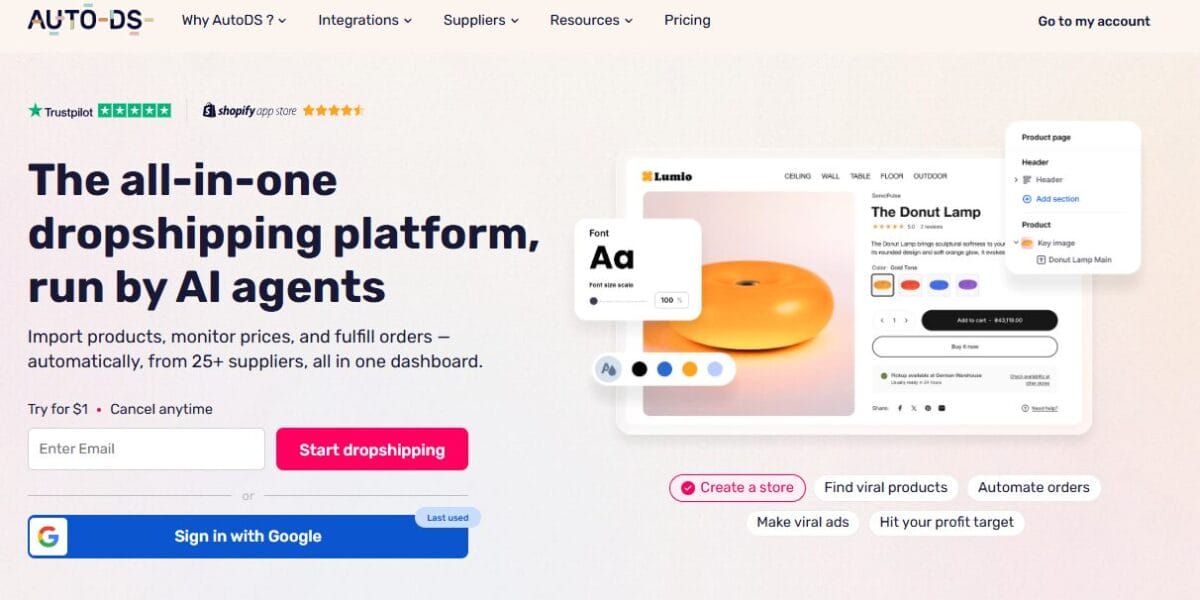
AI store builders create an online store for you, including layout, product listings, and design, instead of requiring you to build one manually from scratch. AutoDS’s AI Shopify store builder is a strong example of this: it automates the time-consuming parts of setting up a store, from designing the layout to writing product descriptions, so a professional-looking Shopify store is ready in about 2 minutes instead of the hours it would normally take. It also optimizes product listings for search visibility during setup, which matters for organic discovery once the store is live.
AI Virtual Assistant (ChatGPT & Perplexity)
General-purpose AI assistants can support the research and creative side of running a store, even though they’re not purpose-built dropshipping tools. ChatGPT is useful for brainstorming store names, drafting copy, and answering general questions in a conversational format. Perplexity is better suited to fact-finding and summarizing, useful when you want a quick, sourced answer about a market or niche rather than a creative brainstorm. Both offer usable free versions, with paid tiers (ChatGPT Plus at $20/month, Perplexity Pro at $9.99/month) unlocking faster responses and higher usage limits if you rely on them heavily.
AI Ads Creation

Creating ad content manually is one of the more time-consuming parts of marketing a dropshipping store, and a couple of AI tools now handle most of it. Pencil generates static and video ad concepts based on your product and target audience, and can predict how an ad is likely to perform before you spend money running it. Pricing ranges from a Self-Serve plan at $119/month to a Full-Service plan starting at $999/month for teams that want ad management handled for them. CreateUGC takes a different approach, turning a product listing directly into a short marketing video, with a script, voiceover, avatars, and captions generated automatically — which is useful if you want video ads without having to film anything yourself. It also supports multiple languages and rapid A/B testing of different versions.
AI Graphic Design

Product listings, social posts, and ad creative all need visuals, and AI-assisted design tools make that possible without design skills. Canva remains the most accessible option, with a drag-and-drop editor, built-in photo editing, and a library of over 250,000 templates covering everything from social posts to banners. It’s free to start, with Canva Pro at $14.99/month unlocking premium templates and extra storage, and a Canva for Teams plan at $29.99/month for collaborative design work. Other tools worth knowing in this category include Kittl, Adobe Firefly, Shutterstock, and Microsoft Designer’s Image Creator, if Canva’s template style doesn’t match your store’s aesthetic.
How To Choose The Right AI Tool For Your Store
The honest answer to “what’s the best AI tool for dropshipping” depends on what’s actually eating your time right now:
- If product research is your bottleneck, start with a dedicated product finder rather than a general AI assistant — you’ll get results grounded in real sales data instead of general knowledge.
- If you’re spending hours manually checking prices and stock, pricing and inventory automation will save you more time than any single creative tool.
- If order fulfillment is the tedious part, look for automated ordering and tracking specifically —this is usually where solo sellers feel the most relief once it’s handled.
- If you’re comfortable typing instructions instead of clicking through menus, chat-based (MCP) management is worth trying — it’s the category that most changes how day-to-day store management actually feels.
- If you’re choosing between a single-purpose tool and an all-in-one platform, factor in how many separate subscriptions you’d otherwise be juggling — a platform that covers research, pricing, and fulfillment together (like AutoDS) usually costs less than stitching together three or four single-purpose tools.
Frequently Asked Questions
What does an AI tool for dropshipping do?
It automates tasks that used to require manual work: product research, supplier price monitoring, inventory management, order processing, and customer support. The goal is to reduce operational time and allow a store to scale without proportionally increasing human workload.
Can AI find winning products for dropshipping?
Yes, though with some nuance. AI systems analyze sales volume, reviews, and social media activity to detect products showing early demand. This offers a more objective basis than manually browsing supplier catalogs, but it doesn’t guarantee success — final validation still depends on real market testing.
What dropshipping tasks can be automated with AI?
The most common ones are: syncing prices and inventory between supplier and store, automated order fulfillment, generating product descriptions, trend detection, and automated responses to customers. The level of automation varies widely depending on the tool.
Are there AI tools that manage a store conversationally?
Yes. Some platforms now integrate protocols like MCP (Model Context Protocol), which allow instructions to be given in natural language — for example, through Claude — to update prices, review orders, or edit listings without using a traditional dashboard. This is still a fairly new category within e-commerce automation.
Does AI fully replace manual store management?
Not entirely. It significantly reduces repetitive work, but strategic decisions — such as choosing a niche, negotiating with suppliers, or defining a brand — still require human judgment.
What are the risks of relying on AI to choose products or suppliers?
AI models are based on historical and trend data, which can create bias toward already-saturated products or short-lived fads. There’s also a risk of recommending unverified suppliers if the tool doesn’t cross-check reliability data (shipping times, reviews, disputes).
How do you choose an AI tool for dropshipping?
It’s worth evaluating: how well it integrates with suppliers and platforms (Shopify, eBay, Amazon, etc.), whether it automates fulfillment or just research, the transparency of its data sources, and whether it supports scaling to multiple stores.
Conclusion
In conclusion, now is the perfect time to embrace AI tools for dropshipping and elevate your experience. These tools are essential for streamlining operations, enhancing efficiency, and boosting profits. AI is a game-changer that can revolutionize how you run your store, making it more competitive and successful.
Thousands of dropshippers have already scaled their stores with AutoDS. Want to see what it could do for yours? Start your $1 trial now.
From automating tedious tasks to optimizing your pricing and managing inventory effortlessly, AI tools are here to help you succeed. Dive into the world of AI-powered dropshipping and see your business thrive. For more insights and tips, here are a few recommended reads from the AutoDS blog: