


Understanding how dropshipping automation works is crucial, as it provides a competitive edge that is simply too significant to overlook in today’s market.
In this guide, we are going to dive deep into what dropshipping automation actually looks like, how to manage it, and what we still need to do as sellers to achieve maximum performance.
At this stage, tools like AutoDS pave the way for many dropshippers by streamlining key tasks, freeing up time to focus on high-priority strategic aspects.
In 2026, manual dropshipping is unsustainable. Automation is the only way to scale without burnout.
Setting up smart profit rules and minimum profit thresholds prevents selling at a loss when supplier prices rise.
Automation builds the skeleton, but human creativity is needed for brand voice, strategy, and complex support.
Automation builds the skeleton, but human creativity is needed for brand voice, strategy, and complex support.
A successful store requires weekly performance reviews via the dashboard to pivot niches and optimize winners.
How to Automate Dropshipping with AutoDS
1. Join AutoDS
Starting with this first step will make everything feel like riding a bike downhill without pedaling. AutoDS functions as the command center of your dropshipping business — from one dashboard, you can manage your store, find suppliers, automate orders, and track every moving part without switching between tools or doing things manually.
To follow along, create your AutoDS account first — then move through each step below at your own pace.
2. Create Your Store
You can’t have a business without a storefront, right? Naturally, this step is among the most critical. However, there are different “virtual terrains” where you can build your store. Depending on the selling channel you choose, your strategies will vary:
- Marketplaces (like eBay or Facebook Marketplace): In these channels, you can leverage the massive, built-in traffic of globally recognized platforms. While this offers high initial exposure, it comes with fewer options for customizing your store’s finer operational details.
- Customizable E-commerce Sites (like Shopify or WooCommerce): Here, you start from scratch in terms of audience building, requiring a larger investment in marketing. However, you do things your way. You decide the customer journey, the aesthetics, and the payment methods. You are the boss.
Building a professional store is easier than it looks. The AutoDS AI Shopify Store Builder is a specialized tool designed to eliminate the technical friction of building a store from scratch. By simply answering a few questions about your niche, the AI generates a functional, high-converting Shopify store, complete with products, descriptions, and a professional layout, ready to launch in less than five minutes.
3. Find suppliers that support automation
Not all suppliers are created equal. To run a truly automated business, you need partners whose systems can talk to your software. You should look for suppliers that offer reliable data feeds for stock and price updates.
AutoDS simplifies this by connecting you with over 25+ professional suppliers (like Amazon, Walmart, and AliExpress) and its own private warehouse.
These suppliers are fully integrated into the ecosystem, ensuring that when they change a price, your store is notified instantly. This eliminates the risk of working with unreliable sources that could break your automation chain.
Moreover, choosing a supplier isn’t a matter of following a hunch. There are several key factors that you must consider to ensure your business remains reliable:
- Shipping Times: A supplier that takes a month to deliver is useless to your business, especially if your website promises faster delivery. Aligning your supplier’s speed with your customer’s expectations is crucial for maintaining trust.
- Stock Variety: While it’s beneficial to focus on specific niches, it is always better to work with a supplier that allows you to diversify. Having access to multiple categories ensures that you can expand your offer whenever you decide to scale or pivot your strategy.
- Product Quality: This is the most important factor. You must ensure that the supplier delivers exactly what they advertise. Remember, customer complaints will be directed at you, not the supplier, and poor quality can permanently damage your store’s reputation.
- Return and Replacement Policies: As noted above, you need a supplier whose policies align with your own. This consistency allows you to respond to your customers coherently and assertively when issues arise.
📦 Supplier’s Tip: Before making a final decision, always order samples. This allows you to personally evaluate product quality and the shipping experience before committing your brand to a specific partner.
4. Connect Your Store to an Automation Tool
Once your store is ready, you need to define your business logic. This is where you define how the automation should behave. You don’t want to manually calculate profits for every item; you want a system that does the math for you. Spoiler alert: AutoDS is your ideal partner.
5. Set Up Product Importing and Pricing Rules
Importing products is significantly easier with AutoDS. What would manually require you to download all the information for every single product, including images, videos, and GIFs, or create your own audiovisual content before uploading it, is now resolved by simply pasting the product URL into a single box.
Furthermore, you can perform this action for multiple products simultaneously.

Regarding pricing, once you automate your system, you can better protect your margins by defining the limits within the platform. As shown in the Profit settings section, you can enter your selling channel fees (e.g., eBay or Shopify transaction fees) directly in the system.
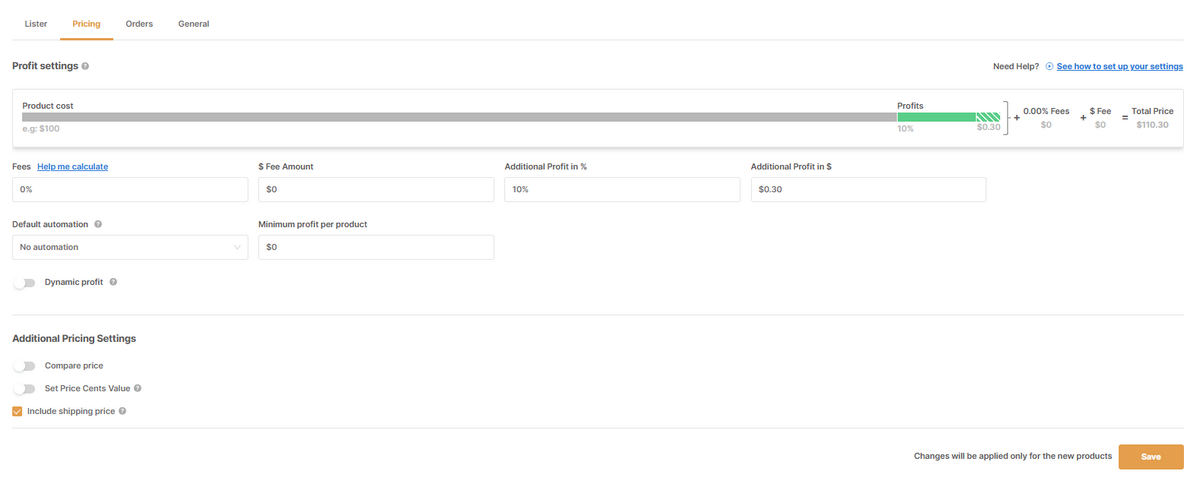
This is crucial because it ensures that your total price calculation always accounts for the platform’s cut. By entering a fee amount (e.g., 10% or 15%), the system automatically adds that overhead to the supplier’s cost before calculating your net profit.
You can set a baseline percentage to maintain consistent margins across your entire catalog, while also adding a flat dollar amount to cover fixed operational costs. For instance, setting a 10% profit plus a $0.30 fixed fee ensures that even low-ticket items remain worth your time.
One of the most important safety features is the minimum profit per product field. This acts as a hard floor for your business. If a supplier’s price fluctuates in a way that would bring your profit below this specific dollar amount, the system will adjust the final price upward to meet your minimum requirement.
6. Enable inventory and price syncing
This is the security guard of your business. The monitoring system acts as a bridge, scanning your suppliers to ensure your store aligns with their current reality.
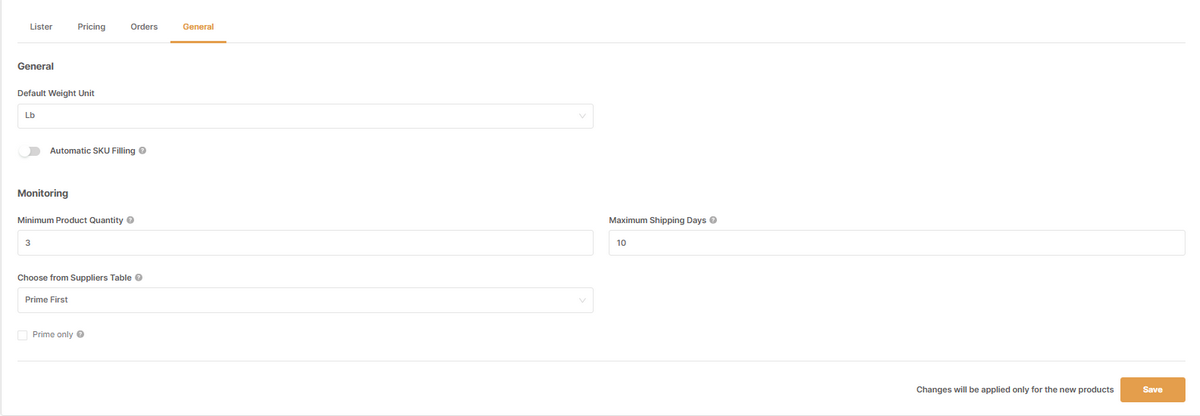
You can configure the “Minimum Quantity” setting. This is a critical safety net: if a supplier’s stock levels drop below your defined threshold (for example, fewer than 5 units), AutoDS will automatically set the product to “Out of Stock” in your store. This prevents you from selling an item that might sell out at the source before you can process the order.
7. Automate Order Processing and Tracking
To achieve a truly hands-off experience, you must configure the fulfillment settings.
- Fulfilled by AutoDS: By enabling this service, the system uses its own managed buyer accounts to purchase products from suppliers. This means you don’t need to use your own credit cards or worry about account locks on sites like Amazon or Walmart.
- Automatic Tracking Updates: Once the order is processed, the system monitors the supplier’s shipping status. As soon as a tracking number is generated, AutoDS automatically fetches it, updates the order status in your Shopify or eBay store, and sends a confirmation email to the customer without you lifting a finger.
8. Monitor Performance and Keep Human Oversight
Even the best automation requires a captain.
- Data Analysis: Once a week, you should review your dashboard to analyze total revenue, profit, and best sellers. This allows you to identify which niches are working and which products should be removed from your catalog.
- The Human Factor: While the software handles the tasks, you handle the strategy. Use the time saved by automation to focus on customer support for complex cases, scale your marketing ads, and explore new trending categories.



What Is Automated Dropshipping?
Automated dropshipping is a system that automates a dropshipper’s daily, repetitive tasks, such as importing products, managing prices, creating listings, and testing products. This allows the seller to concentrate on optimizing their marketing strategy and the unique aspects that ultimately differentiate them from the competition.
But let’s take a step back and review what dropshipping actually is: it’s a low-risk business model where we don’t manage or store inventory. Why automate something that seems simple at first glance? The answer is straightforward: just because dropshipping looks “easy” doesn’t mean you don’t have to work.
A dropshipper must stay on top of small tasks that, while not complicated, can become tedious and prone to human error.
Keep in mind that many dropshippers start their businesses as a side hustle, dedicating whatever weekly hours they can spare. At this point, time is the most valuable asset for building something stable, and that is exactly what automation provides: time.
Dropshipping can be done manually, but for beginners, especially, small details can pile up and turn into frustrations that lead to quitting. Automation doesn’t just make the process more flexible; it makes it far more efficient and scalable over time.
What Can You Automate in a Dropshipping Business?

Automation doesn’t mean handing over your entire business to software and expecting it to work by magic. It is more about a series of layers you can apply to different parts of your workflow.
By delegating technical and repetitive tasks to software, you ensure that your store remains active and accurate even when you are away from your computer. Here are the primary components of a dropshipping business that can be fully automated today:
Product Sourcing and Research
Finding the best dropshipping products to sell is often the most time-consuming part of the business. Automation tools like AutoDS utilize scanners that analyze thousands of products across global suppliers to identify winners based on sales trends and demand.
Instead of guessing, you can use automated filters to find items with high profit margins and fast shipping times, significantly reducing the research phase from hours to minutes.
Automated Product Importing
Once you find a product, manually moving it to your store involves downloading images and copying and pasting descriptions, which is highly inefficient. Automated import features like AutoDS’s let you grab all product data, including variations, high-quality images, and specifications, with a single click or a URL.
This process often includes AI-driven optimization, in which software automatically rewrites titles and descriptions to make them more SEO-friendly and appealing to your specific audience.
Price and Stock Monitoring
Supplier prices and inventory levels change constantly, and missing these updates can lead to selling out-of-stock items or losing money on a price hike. Automation software monitors your suppliers 24/7 and adjusts your store’s listings in real-time.
If a supplier raises their price by $2, the system automatically updates your retail price based on your pre-defined profit rules; if an item goes out of stock, the tool unpublishes the listing immediately to prevent unfulfillable orders.
Automatic Order Fulfillment
This is the core of a hands-off business. When a customer places an order in your store, an automated system can relay that information directly to the supplier, eliminating manual data entry.
Through features like Fulfilled by AutoDS, the system uses its own managed accounts to purchase the item and ship it to your customer. This eliminates the need for you to handle credit card transactions for every single order or worry about account locks on supplier sites.
Tracking Number Updates
Providing customers with tracking information is vital for trust, but manually sending emails for every sale is not scalable. Automation tools automatically retrieve tracking numbers from the supplier as soon as they are available and upload them to your store.
The system then notifies the customer, keeping them informed about their package’s journey while you avoid a flood of “Where is my order?” inquiries in your inbox.
Advantages of Automation
The primary advantage of automating your dropshipping business is eliminating the “bottleneck effect.” In a manual setup, your growth is largely limited by the number of hours you can physically invest in your business.
As mentioned before, if you have a 9-to-5 job and can only dedicate a limited amount of time to your store, it is vital that you optimize this time to the fullest.
Automation lets you handle 100 orders with the same effectiveness as if you were managing 5. But it’s not just about saving time; it’s also about minimizing the cost of human error. A simple typo in a customer’s address or a missed price increase from a supplier can cost you a buyer or severely impact your profit margins. By using automatic synchronization, you ensure 24/7 accuracy. Let’s see other automation pros:
📈 Unmatched Scalability: In a manual business, doubling your sales usually means doubling your workload. With automation, the infrastructure stays the same regardless of volume. This allows you to manage multiple stores across different platforms (like eBay, Shopify, and Amazon) simultaneously without feeling overwhelmed.
🕜 24/7 Operations: Your store never sleeps, even when you do. If a customer in a different time zone places an order at 3:00 AM, the automation system can process that order and update the supplier instantly. This speed results in faster shipping times and significantly higher customer satisfaction. Whether you are at the office of your other job or relaxing on a distant beach, your business keeps running.
📊 Data-Driven Decisions: Automation tools provide centralized dashboards that track your profits, best-selling items, and supplier performance. Instead of digging through spreadsheets, you have a clear visual overview of your business health, allowing you to double down on what works and cut what doesn’t.
✨ Consistency and Brand Reliability: Consistency is what builds long-term e-commerce brands. Automation ensures that every product listing follows the same formatting, every price follows the same profit margin logic, and every customer receives their tracking info at the same speed. This level of professional uniformity builds trust with your audience, making your store look like a high-end operation rather than a hobbyist project.
🧘🏻 Minimized Entrepreneurial Burnout: Dropshipping is a marathon, not a sprint. Many beginners quit because the manual workload becomes a second full-time job. Automation significantly lowers the entry barrier and the daily stress of “keeping the lights on.”
What Should Not Be Fully Automated?
As we mentioned before, this is not about magic or doing nothing. While it is tempting to try to automate 100% of your business, total detachment is a common trap that leads to generic, uninspiring stores. To build a brand that lasts, certain areas require your human touch. These are the elements that software cannot replicate:
💬 Brand Voice and Creative Copywriting
While AI can generate descriptions and titles in seconds, it doesn’t know your specific audience’s emotions or pain points. You should always review and tweak the copy for your hero products.
Adding a personal touch, a unique brand story, or a specific tone of voice is what turns a visitor into a loyal customer. Automation provides the skeleton; your creativity provides the soul.
☎️ Complex Customer Support
Automated emails and tracking updates handle 80% of inquiries, but the remaining 20%, the complex issues, shipping delays, or sensitive returns, require empathy and critical thinking. Handling a frustrated customer personally can turn a potential negative review into a repeat buyer. An angry customer can become a loyal one if there is a human on the other end who cares about their problems and validates their concerns. Keep that in mind.
📊 High-Level Strategy and Trend Analysis
An automation tool can show you what is selling now, but it cannot predict the next cultural shift or aesthetic trend. As the business owner, you need to step back and look at the big picture. Which niches are becoming oversaturated? Where can you find a market gap? Strategy is a human endeavor that requires intuition and market observation.
Common Mistakes When Automating Dropshipping

Automation is a powerful engine, but we must configure it correctly, or it will take us in the opposite direction of what we desire. To ensure everything goes smoothly, let’s review some common mistakes that can hold you back:
❌ Setting “Blind” Pricing Rules
One of the most common mistakes is setting global pricing rules without accounting for all hidden costs. Many sellers forget to factor in platform transaction fees, advertising costs, or varying shipping rates from different suppliers.
If your automation doesn’t account for these variables, you might end up with high-volume sales but zero net profit. Always double-check your “Profit Settings” to ensure every expense is covered.
❌ Neglecting Product Description Optimization
Relying 100% on raw supplier data can make your store look like a carbon copy of hundreds of others. Automation tools like AutoDS can import products in seconds, but leaving the “factory” titles and descriptions as they are is a mistake.
This leads to poor SEO and low conversion rates. Use automation to populate your store, but spend time manually optimizing the copy of your top-performing items to make them stand out.
📣 Marketing Tip: Get inspired by the AutoDS AI Product Title & Description Generator and optimize your listings. You can always edit every detail later.
❌ Automating Saturated or Low-Quality Niches
Automation makes it easy to add thousands of products, but quantity never beats quality. A common mistake is using automation to spam your store with hundreds of trending items without checking their quality or the level of competition.
Even with the best software, selling a low-quality product will result in high return rates and damage your brand’s longevity.
❌ Failing to Test the Fulfillment Flow
Don’t wait for your first 50 orders to find out there is a glitch in your payment method or supplier connection.
A critical mistake is not running tests to see exactly how the automation handles the process, from the customer’s purchase to the tracking number update. Doing a manual walkthrough of the automated flow at least once ensures everything is calibrated.
How AutoDS Helps Automate Dropshipping Workflows
To wrap up, let’s review how AutoDS acts as the central nervous system of your business. By integrating this platform, you are installing a specialized team that handles the boring parts of e-commerce:
✅ Instant Product Sourcing: Forget spending hours manually copying and pasting details. With the Winning Products Hub and the One-Click Importer, you can populate your store with high-potential items in seconds.
✅ Dynamic Price & Stock Protection: Sleep soundly, knowing the 24/7 Monitoring System protects your margins. If a supplier changes a price or runs out of stock, your store updates instantly to prevent losses.
✅ Hands-Free Order Fulfillment: Through Fulfilled by AutoDS, the entire purchasing process is automated. From using managed buyer accounts to automatic tracking number updates, the system handles the logistics from checkout to delivery.
✅ AI-Powered Content Creation: Every product you import can be optimized automatically. The AI Title & Description Generator ensures your listings are SEO-friendly and persuasive without you having to write a single word of code.
✅ Centralized Multi-Channel Management: Whether you sell on eBay, Shopify, Amazon, or Facebook, you can control your entire empire from one single dashboard. This consolidated view allows for total oversight of your profits and performance.
✅ Smart Pricing Logic: As seen in the Profit Settings, you can build complex financial rules that account for taxes, platform fees, and minimum profit thresholds, ensuring your business remains healthy and scalable.
Is Automated Dropshipping Worth It in 2026?
The e-commerce landscape in 2026 is more competitive and faster than ever. Customers now expect instant updates, professional storefronts, and rapid shipping. In this environment, manual dropshipping is a recipe for burnout and missed opportunities.
So, is the automated route worth it? The answer is a resounding yes. You no longer need professional technical skills to build a store, or entire days available to manage orders.
Automation has lowered the technical barrier, leveling the playing field for sellers and pushing them to differentiate themselves through their strategies. Of course, to think of strategies, you need time, and by automating everything else, you gain most of that time.
Frequently Asked Questions
Can I really leave my store running 100% on its own?
While AutoDS automation handles the “heavy lifting” (pricing, stock, orders, and tracking), total detachment is not recommended. As we discussed in the article, long-term success requires human oversight to analyze performance, scout for new trends, and provide exceptional customer support for complex cases.
What happens if my supplier suddenly changes their price?
The AutoDS monitoring system scans your suppliers every 30 to 60 minutes. If a price increase is detected, the software automatically adjusts your selling price based on the profit rules you configured. This ensures you never sell at a loss due to an external change.
Do I need programming skills to use these tools?
No. In 2026, tools like the AI Shopify Store Builder will allow you to create a functional store by answering just a few questions. The AutoDS interface is designed so that every action, from importing products to setting pricing rules, is done visually, without touching a single line of code.
Can I automate more than one sales channel at the same time?
Yes. AutoDS lets you centralize the management of multiple stores (e.g., one on Shopify and another on eBay or Amazon) from a single dashboard. This enables you to scale your business across different platforms without multiplying your manual workload.
How does automation prevent me from selling products that are out of stock?
This is managed through the Minimum Quantity rule. You can configure the system so that if your supplier has fewer than, for example, 5 units left, the product is automatically marked as “Out of Stock” in your store. This creates a safety buffer to prevent order cancellations.
Does the Fulfilled by AutoDS service work with all suppliers?
This service is compatible with the largest and most popular suppliers integrated into the platform. When activated, AutoDS uses its own managed buyer accounts to process orders, protecting you from personal account locks and fully automating the cycle from the customer’s payment to final delivery.
Start Your Dropshipping Journey with AutoDS
The transition from a manual, time-consuming operation to a streamlined, automated business is the single most important step you can take in 2026. As we have seen, automation is about saving time, but also about precision, scalability, and peace of mind.
By leveraging AutoDS, you are implementing a system that guards your profits 24/7, eliminates human error, and allows you to focus on what truly matters: your strategy and your brand.
The road to a successful e-commerce empire is paved with smart decisions. Don’t let the technical grunt work hold you back from your potential. Whether you are launching your first store or looking to scale an existing one to new heights, the best time to automate is now.
Ready to transform your business? Join AutoDS today and take the first step toward a truly automated and profitable dropshipping future.
To dive deeper into the benefits of eCommerce automation, check out the following articles!