


If you’re here, it’s because you’re probably wondering the same as every online seller: Is dropshipping dead? Well, good news: not really. The future of dropshipping looks brighter than many people think.
Despite constant claims that the business model is saturated, as long as e-commerce exists, dropshipping will just continue to evolve alongside new technologies and consumer habits. The reality is that dropshipping isn’t dying, it’s just changing. The secret to surviving? Adapting quickly.
In this guide, we’ll explore the biggest dropshipping trends to watch out for, the challenges facing the industry, and what successful dropshippers will look like in the years ahead.
Specifically, we’ll look at how AI is transforming every part of the process. For instance, AutoDS adds full automation and AI at every step of the dropshipping workflow to optimize decision-making, improve operational efficiency, and help sellers iterate and scale faster.
Dropshipping isn’t dying, it’s evolving. The business model remains profitable, but success increasingly depends on automation, branding, customer experience, and smart decision-making.
AI is transforming every stage of e-commerce. From product research and store creation to marketing, customer support, and fulfillment, AI is helping sellers operate faster and more efficiently.
Customer expectations will continue to rise. Faster shipping, personalized experiences, and seamless shopping journeys are becoming the standard, not the exception.
The future belongs to adaptable businesses. Multi-channel selling, creator-led commerce, and diversified traffic sources will become increasingly important as e-commerce grows more competitive.
Automation is no longer optional. Platforms like AutoDS help sellers streamline operations, leverage AI, and scale their businesses, allowing them to focus on growth instead of repetitive manual tasks.
Is Dropshipping Still Worth It in 2026?
If you’re wandering around e-commerce Facebook groups and Reddit communities, you’ve probably seen someone ask if dropshipping is dead.
It’s a fair question. The industry has changed a lot over the past decade. There’s more competition, more sophisticated ads, and more demanding customer expectations.
But none of that means dropshipping is disappearing. In fact, it’s quite the opposite. The dropshipping business model is evolving alongside technology, creating new opportunities for sellers who are willing to adapt.
The Short Answer
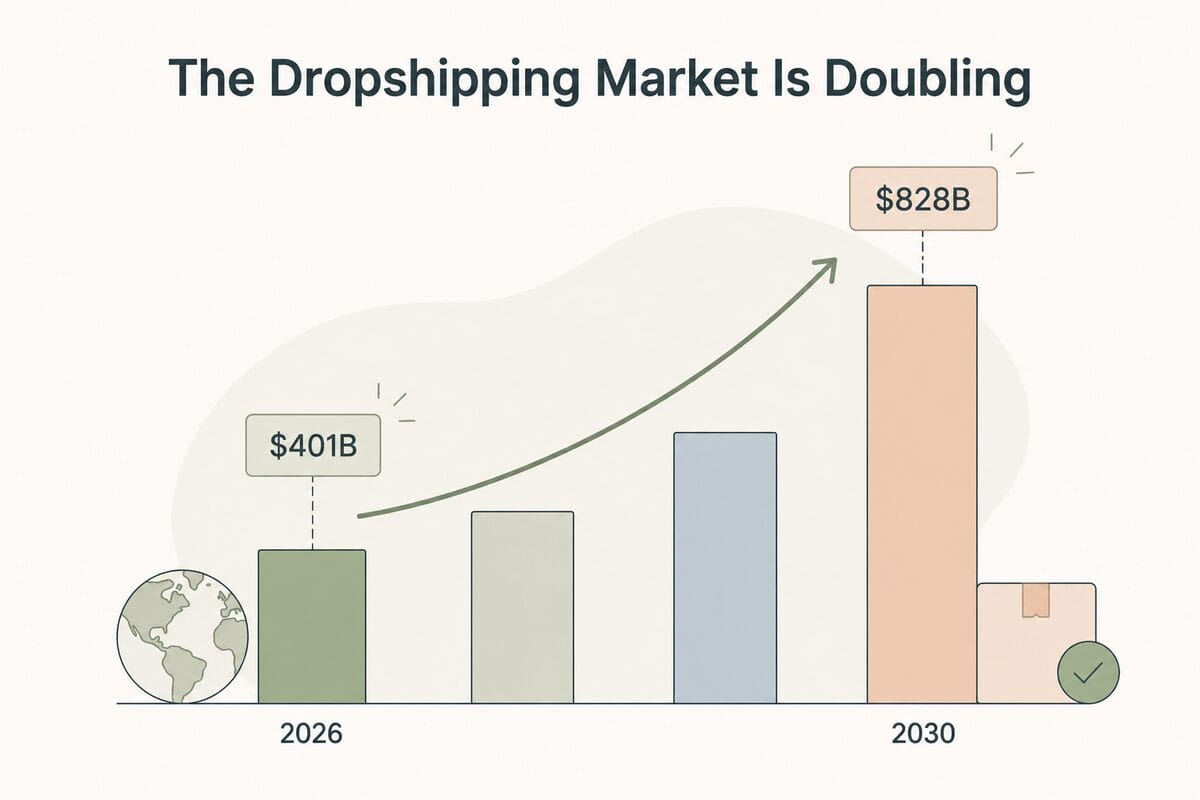
Yes, dropshipping is still worth it in 2026. And the numbers back it up. Let’s look at some industry analysis.
The global dropshipping market is valued at approximately $401 billion in 2026 and is on track to hit $828 billion by 2030. See the difference? It’s projected to double in just four years. That’s not the path of a model barely breathing.
In that context, outsourcing fulfillment is becoming increasingly popular. According to recent studies, 60% of online retailers already outsource at least part of their fulfillment, and 20% hand the entire process off to third parties. This shows adoption is accelerating.
Moreover, the share of Shopify stores using dropshipping has grown from 5.16% to 12.82%, signaling that sellers are leaning into the model, not walking away from it.
That said, what worked for dropshipping in 2017 doesn’t necessarily work in 2026. And while that requires huge adjustments from traditional sellers, it also brings new opportunities. That’s what I’ll cover throughout this article.
Why People Think Dropshipping Is Dying
The perception that dropshipping is dying usually comes from a few noticeable dropshipping industry trends:
- A more competitive market. E-commerce has become mainstream, meaning more people are launching stores and targeting similar audiences.
- The guru era left a bad taste. The 2016–2020 dropshipping boom was driven by a wave of YouTube gurus selling courses that promised passive income and overnight success. When most beginners failed, the narrative shifted to “dropshipping is a scam”. But what died was the hype and the false promise of becoming a millionaire overnight, not the model itself.
- Shipping time expectations. The classic model relied on low-cost Chinese suppliers with 3–6 week delivery windows. Post-pandemic shoppers who were used to Amazon Prime simply stopped tolerating that. Now, dropshippers need to source at least part of their catalog with local suppliers, which increases product and shipping costs.
- Advertising costs have significantly increased. The early dropshipping playbook ran almost entirely on cheap Facebook and Instagram ads. But the platform continued growing, and competition increased. With that, CPMs skyrocketed, increasing ad costs.
All of this led to the main reasons many dropshippers are frustrated: margins got thinner. Increased ad costs, more competition, higher supplier prices, higher return rates, and platform fees all reduced margins simultaneously. What was once a 30–40% margin business became barely viable for operators who didn’t adapt.
Does that mean dropshipping is dead? No, the opposite: it is more alive than ever, as long as you know how to handle these four major setbacks.
What’s Actually Changing
Launching a generic store, importing random trending products, and expecting instant profits no longer works as it did in 2017. Today, it’s all about relying on data, automation, branding, and customer experience to stand out in a crowded market.
E-commerce automation and AI have completely changed the rules of the game. Now, processes that used to take weeks can be reduced to just a couple of hours. Moreover, there’s more access to data than ever, letting sellers understand what their target audience actually wants.
On top of that, it’s also easier to access local suppliers with better quality and faster shipping times. Platforms like AutoDS now connect sellers with US and EU-based warehouses, which directly addresses the shipping time problem that killed the old model.
Branding is a major layer of the new era. Sellers winning today aren’t just selling products; they’re building brands around niches. The overall store is what makes you stand out, not just a few isolated products.
Finally, the rise of social commerce completely changed the rules. TikTok Shop, Instagram Shopping, and live commerce are now legit selling channels. And here’s the better news: they actually favor smaller, niche operators over big brands.
We’ll zoom in on all of this throughout the article, but here’s the main takeaway: dropshipping remains one of the most accessible ways to start selling online. Think about it: there’s no inventory involved, no warehouses, no high upfront costs, and on top of that, technologies now do most of the work for you.
The Biggest Trends Shaping the Future of Dropshipping
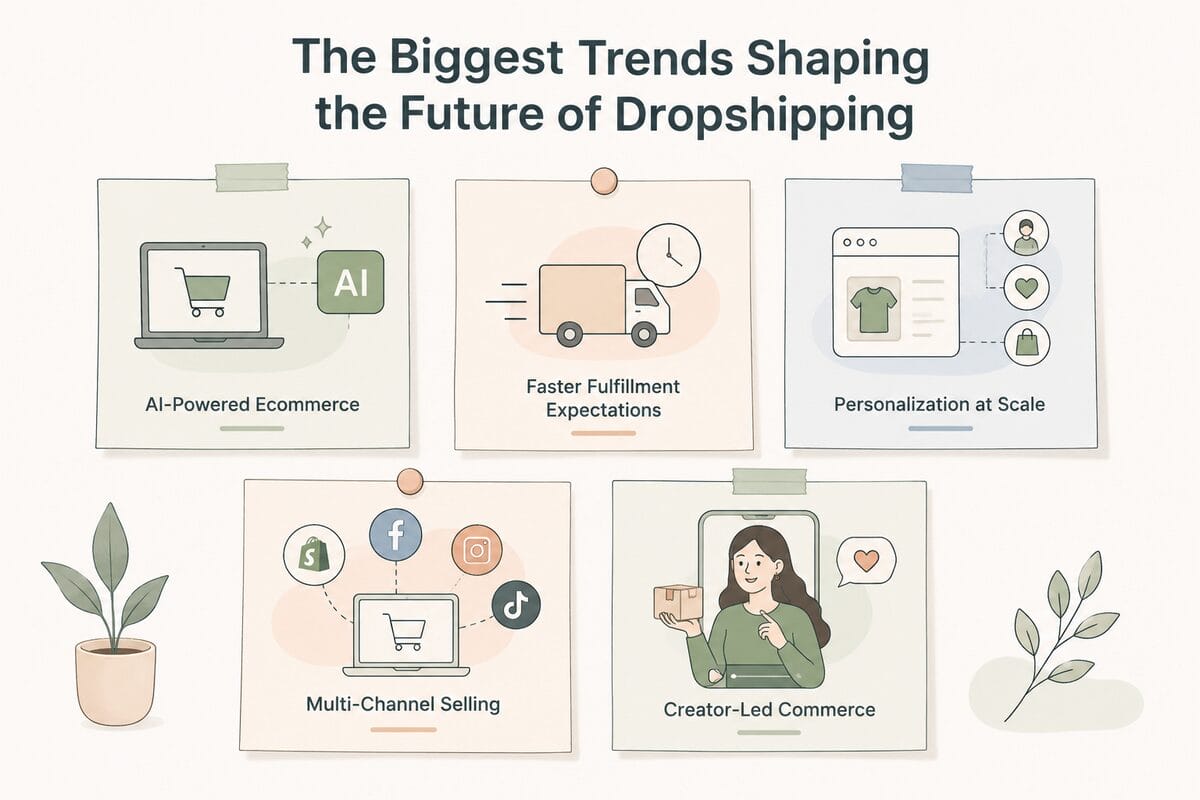
As you can see, there are many things happening at once in dropshipping. There’s no one single trend shaping the future of online selling, but many of them.
We have AI dramatically reducing manual tasks, shipping times getting shorter and shorter, customers expecting personalized and smoother shopping experiences, and social commerce taking over the internet, among other things.
Let’s go through each one of the main dropshipping industry trends you should be aware of.
AI-Powered E-Commerce
It’s 2026, the year of Claude, ChatGPT, and Gemini taking over the internet. It’s not that Artificial Intelligence will define the future of e-commerce. It’s that it is already doing so.
According to McKinsey, by the end of 2025, 78% of businesses were using at least one AI feature, up from 55% in 2024. In e-commerce specifically, another report states that also 78% of online brands have implemented AI in their stores or plan to, and only about 1 in 5 are still on the sidelines.
We all know this by now: tasks that once required hours of manual work can now be completed in minutes. Literally. In dropshipping, this translates into AI-product research, automated fulfillment, dynamic pricing, advanced analytics, and store-building tools.
Now, you can even launch a store in minutes with an AI Shopify store builder, packed with winning products, high-converting product pages, and more.
The math is simple: sellers who use this technology in their workflows save time, scale more quickly, and offer faster, more efficient experiences. Meanwhile, sellers who don’t use it clearly fall behind.
Faster Fulfillment Expectations
Remember when customers were willing to wait three or four weeks for an online order to arrive? Those days are gone. The rise of Amazon Prime and other premium delivery services changed consumer expectations for shipping times. Fast shipping is no longer a bonus like it used to be. 2-3 day delivery is now the standard.
In fact, a recent report states that more than half of consumers (53%) expect standard shipping orders to arrive within two to four days after making a purchase online.
As a result, dropshippers need to pay close attention to fulfillment strategies. More sellers are working with local suppliers, private manufacturers, and warehousing solutions to reduce delivery times and improve the customer experience.
This doesn’t mean traditional international suppliers like AliExpress or Shein are going away. It just means that stores need to prioritize speed and reliability.
📦 Supplier’s Tip: You can use international suppliers for product testing and validation, then transition your winning products to local and private suppliers. This allows you to keep startup costs low while improving quality and shipping speed on products that are worth it.
Personalization at Scale
Modern shoppers are exposed to thousands of ads, emails, reels, and product recommendations every day. Generic marketing simply doesn’t perform anymore.
Look at these striking numbers from a Salesforce report: 80% of consumers say the experience a company provides matters as much as its products. At the same time, 65% expect brands to adapt to their preferences, yet 61% (almost all of them) feel that most companies still treat them like just another number.
That’s why personalization is becoming one of the most important e-commerce trends. AI now makes it possible to personalize shopping experiences at a scale that was previously impossible. Ads can be hyper-targeted, product suggestions can be tailored to individual browsing behavior, and entire customer journeys can be customized based on real-time data.
Think about how Netflix recommends shows for you or how Spotify somehow knows exactly what song you want to hear next. E-commerce is moving in the same direction.
For dropshippers, this creates an opportunity to deliver more relevant experiences through better store structures, email campaigns, social content, and ads.
Multi-Channel Selling
For years, many sellers viewed Shopify dropshipping as their entire business. Some savvy ones even dared to complement it with an Amazon or eBay seller profile. Today, there’s a completely different approach.
Instead of relying on a single storefront, sellers are expanding across multiple sales channels to reach customers wherever they prefer to shop. That might include marketplaces, social commerce platforms like TikTok, mobile apps, and traditional stores operating all together at the same time.
This allows people to shop wherever they want, but it also makes the buying journey much more personalized. A customer might discover a product on TikTok, research it on Instagram, and then complete the purchase through an online store.
Another might do exactly the opposite. They might find a product on Google Shop through organic search, research it on your Shopify store, add it to their wish list, and then find it again through a TikTok ad and buy it directly on TikTok Shop.
Whatever the channels, a Google report states that 8 in 10 online buying journeys involve multiple channels, “making the path to purchase more complex than ever”.
One thing is for sure: the journey is no longer linear, so businesses need to diversify their traffic sources. In other words, putting all your eggs in one basket is not the way to go anymore.
Creator-Led Commerce
A simple Facebook ad with a static image just doesn’t cut it anymore. This is where a new player enters the stage: give it up for influencers!
Influencers have been shaping buying decisions for years; that’s no big news. What’s changing is how deeply creators are becoming integrated into the e-commerce ecosystem.
Consumers don’t really trust traditional ads anymore. Now, they trust creators, niche experts, and online personalities they already follow. In many cases, people are buying products because someone they follow simply recommended it.
Let’s look at the numbers:
- According to a 2024 report from Influencer Marketing Hub, 31% of social media users preferred discovering products through an influencer they follow, over any other format or channel, rising to 43% for Gen Z consumers.
- But here’s where it gets even more interesting: a 2026 report by Sprout Social shows how those numbers went up in just two years. Now, 86% of consumers make at least one influencer-inspired purchase per year, with influencer content consistently outperforming organic brand content.
This trend has fueled the growth of user-generated content (UGC), affiliate marketing, live shopping, and creator partnerships across TikTok, Instagram, and YouTube. And for dropshippers, this creates a huge opportunity to increase sales and reach wider audiences.
Instead of relying solely on paid ads, you can look for creators who align with your niche and collaborate with them. In many cases, a single authentic video can drive better results at a lower cost than a polished advertising campaign that costs thousands of dollars.
How AI Is Transforming Dropshipping
Artificial intelligence is no longer a futuristic concept from a Stephen Spielberg movie (love that one!). Now, it’s not even a premium tool reserved for tech giants. AI has become part of everyday life, for me, for you, and for your store, too (unintentional poetry, but I’ll take it).
Tasks that once required hours of manual work can now be completed in minutes with an AI-powered tool. Let’s see how it impacts the dropshipping workflow specifically.
Product Research
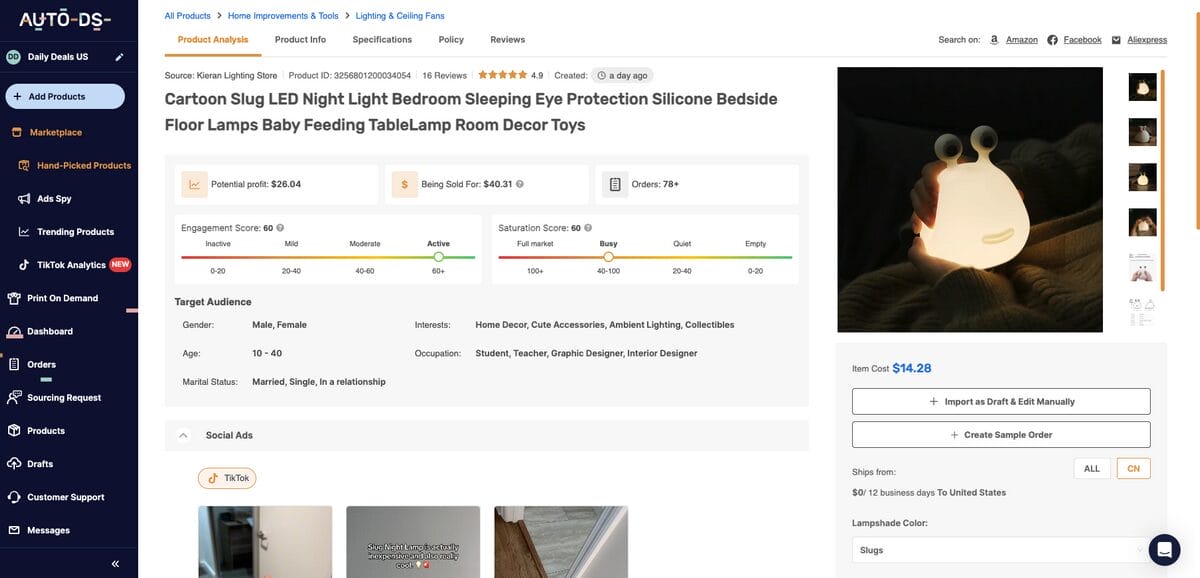
Product research has always been one of the most challenging parts of dropshipping.
Traditionally (and by traditionally I mean last year, not half a century ago), sellers would spend hours scrolling through marketplaces, analyzing competitors, monitoring social media trends, and testing products one by one. Well, with AI, not anymore.
AI dropshipping tools help sellers find winning dropshipping products in minutes. These systems analyze large amounts of market data, identify emerging trends, spot seasonal opportunities, and surface products with strong sales potential much faster than manual research alone.
It’s not that AI sees the future—not at all. But while it can’t predict the next viral product with 100% accuracy, it can significantly reduce the time it takes to identify opportunities.
New feature alert! 🚀 Take AI assistance one step further with AutoDS’s Claude MCP connector, which allows Claude to access AutoDS tools and data to search for products, audit listings, generate reports, and complete supported store tasks.
Store Creation

Building an e-commerce store used to require a combination of design skills, copywriting experience, and plenty of patience to make each product page look at least decent.
Today, AI generates everything from you, from product descriptions all the way to entire stores. For instance, AI store builders generate complete, ready-to-sell stores packed with winning products, product pages, terms and conditions, and even domains, making it easier for beginners to get started.
AI e-commerce tools like AI product title and description generators are also a huge help, optimizing product listings in seconds. Same with product importers: you can import hundreds of listings at once just by copying and pasting a product link.

As a result, tasks that used to take hours are now done in minutes, allowing you to focus less on setup and more on strategy and growth.
Marketing and Advertising
The thing about dropshipping marketing is that it’s a completely different side of the business, and it’s still absolutely essential. No matter how good your products are or how automated your store becomes, if nobody knows you exist, nobody will buy from you.
It usually involves creating ad copy, designing creatives, writing emails, testing campaigns… all things that not all dropshippers know how to manage, especially when you’re also researching products, optimizing listings, looking for new suppliers, and so on.
That’s why AI has become such a game-changer in this area. AI tools can generate ad copy, write email sequences, create social media content, and even produce UGC-style video ads in seconds.
📢 Marketing Tip: Of course, human creativity still matters. While AI can generate most of the assets, it’s still up to you to know your audience and build a brand that stands out. Think of AI as a fast assistant, not a replacement for strategy.
Customer Support
As stores grow, customer support often becomes one of the biggest operational hurdles.
Customers want fast answers about shipping, returns, product info, and order status. And let’s be honest: responding manually can take forever, especially for simple queries.
AI-powered chatbots and support tools are helping sellers handle these questions more efficiently. They can answer frequently asked questions 24/7, provide automatic tracking number updates, and route complex requests to a human.
This improves the customer experience while also reducing your workload. Again, the human factor is still necessary for certain complex scenarios. But 90% of requests can be automated immediately and efficiently.
Operations and Fulfillment

This one is one of my favorites, and where you’ll see the biggest impact of AI in your day-to-day operations.
Many operational tasks in dropshipping are repetitive, time-consuming, prone to human error, and extremely boring. Think inventory monitoring, price updates, order processing, supplier management, and tracking updates. They all require ongoing, extreme attention to detail.
AI and automation are helping eliminate much of this manual work by handling repetitive processes behind the scenes. Instead of constantly monitoring your store, e-commerce automation tools can:
- Track inventory levels automatically.
- Monitor supplier price and stock changes in real time.
- Adjust product prices based on predefined rules.
- Process and fulfill orders automatically.
- Update order status and tracking numbers and notify customers throughout the shipping process.
As a result, most processes stay automated, keeping most of your workflows working on autopilot while you can focus on, let’s say, growth, marketing, and strategy.


What Will Successful Dropshippers Look Like in the Future?
If dropshipping is shifting, so is the stereotype of the dropshipper.
For years, the industry was associated with people chasing quick wins, importing random products, and relying on short-term trends to generate sales. While those strategies occasionally worked, the future of dropshipping belongs to a different type of seller.
Now, the most successful sellers are not necessarily the ones working the hardest, but the ones who know how to apply technology to build smarter workflows and systems.
Let’s zoom in.
The Old Model vs The New Model
To understand where the industry is heading, it helps to compare how stores operated in the past vs today.
| Old Model | New Model |
|---|---|
| Manual product research | AI-assisted product research |
| Single sales channel | Multi-channel selling |
| Generic product listings | Optimized customer experiences |
| Trend chasing | Brand building |
| Manual operations | Automated workflows |
Skills That Will Matter Most
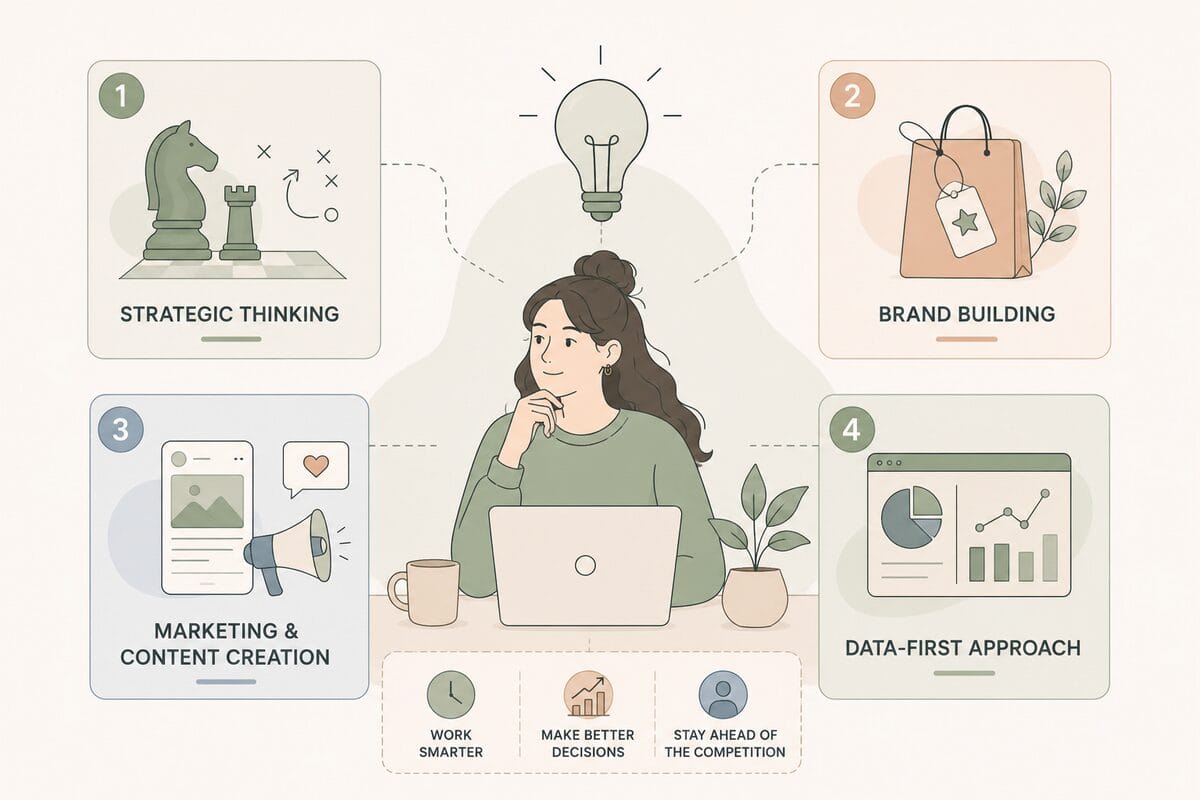
As AI takes over more operational work, certain skills are becoming more and more valuable.
You don’t need copywriting, research, and design skills anymore, at least not to the same extent as before. Many of those tasks can now be assisted or fully automated by AI. Instead, the focus has shifted toward higher-level skills, such as:
- Strategic thinking. If you’re not stuck copying and pasting for hours, then you suddenly have time to sit down and plan your strategy. This includes the ability to identify better opportunities, evaluate markets, and make smart decisions, something AI can’t replace at all.
- Brand building. As more stores gain access to the same products and the same AI tools, creating a memorable brand becomes one of the best ways to stand out.
- Marketing and content creation. These will remain essential. Even if AI takes over the content generation process, you’re still the mastermind behind certain decisions like where to allocate budget, what to prioritize, which influencer to work with, what formats work best for your audience, and how to humanize your brand.
- Data-first approach. E-commerce is generating more data than ever before, and this trend will continue to double in the coming years. Sellers who can interpret that data and act on it quickly will have a significant advantage over competitors.
Skills Becoming Less Important
With new skills taking over, some others are not so necessary anymore, especially as AI takes over some of the tasks that required them.
Skills becoming less important include:
- Manual product research.
- Writing product titles and descriptions from scratch.
- Basic graphic design for product pages and ads.
- Basic store building.
- Manual inventory and price monitoring or order processing and fulfillment management.
Before anyone panics, let’s clarify something: these skills aren’t becoming useless. They’re becoming less valuable in manual workflows. The main difference is that sellers no longer need to spend hours performing these tasks.
The competitive advantage is shifting toward strategic skills, and success is becoming less about execution and more about direction and mindset.
Challenges Facing the Future of Dropshipping
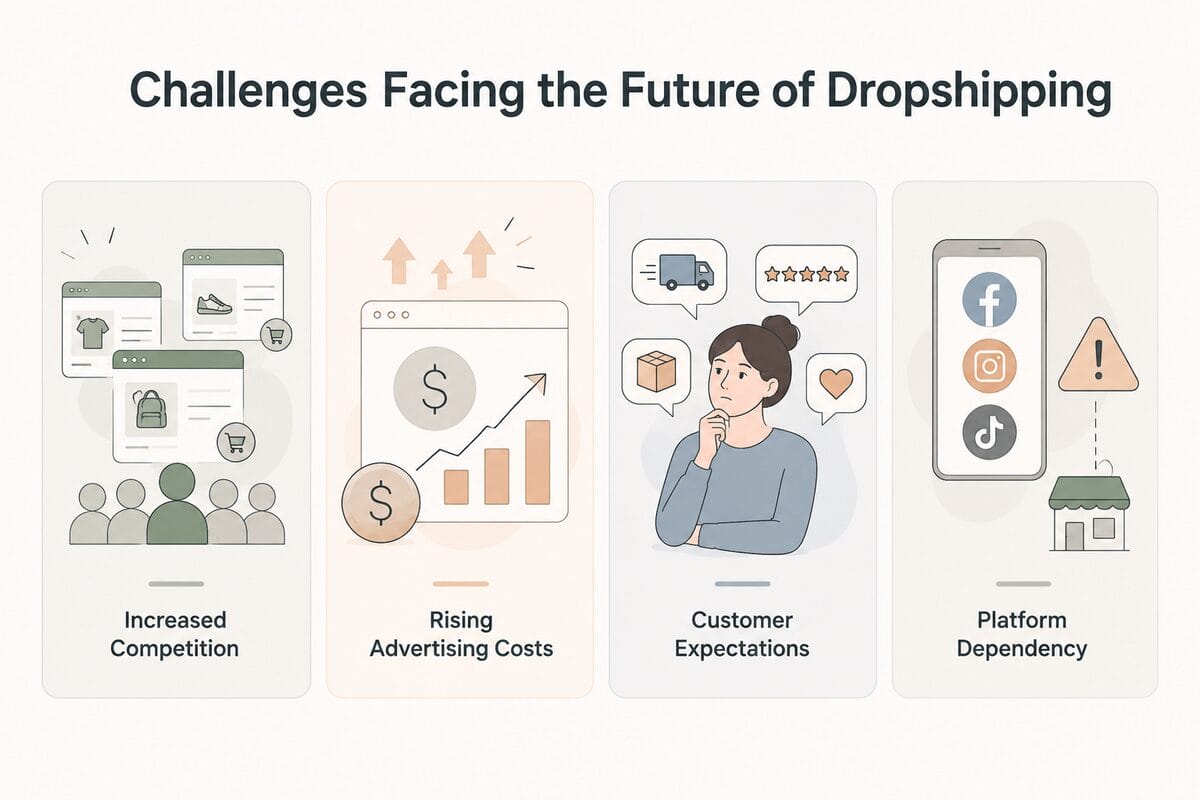
The future of online selling and dropshipping is full of opportunities, but let’s not pretend it’s all sunshine, automation, and AI-generated product descriptions.
As e-commerce becomes more accessible, competition continues to increase, and customer expectations keep rising. The barriers to entry may be lower than ever, but building a successful business still requires overcoming some important hurdles.
The good and most important news is this: these challenges don’t kill dropshipping. They’re still manageable and, if you know how to handle them, they can even become huge opportunities.
Increased Competition
One of the biggest challenges facing dropshippers is simple: more people are entering e-commerce every year. AI e-commerce tools, store builders, and automation platforms have made it easier than ever to launch an online business. That’s great news, of course. But it also means you’re competing with more sellers than ever before.
The solution comes down to one thing: standing out. Rely on branding, customer experience, smart niche selection, unique offers, content creation, and community building to strengthen your presence and cultivate real relationships with your customers.
In the future (and, to be honest, in the present as well), simply listing the same products as everyone else will become a really hard strategy to sustain.
Rising Advertising Costs
Customer acquisition is becoming more expensive across all advertising platforms.
It’s kind of the same logic as the previous point: more sellers means more competition, and as more businesses compete for the same audiences, ad costs naturally increase. At the same time, consumers are exposed to thousands of marketing messages every day, making it harder to capture their attention (let alone generate clicks and sales).
This doesn’t mean paid advertising is no longer effective. It simply means businesses need to be more strategic.
The winning formula looks something like this: combine paid traffic with organic content, email marketing, SEO, influencer partnerships, and affiliate programs. This way, you can build a comprehensive customer journey that attracts them through ads but convinces them with higher-value content.
What I’m saying is this: relying on a single Facebook ad is not enough anymore. Now, it all comes down to smart and creative strategies.
Customer Expectations
We’ve been mentioning this one since we started. Customer expectations have shifted dramatically, and here’s the twist: they will continue doing so.
Do they want fast shipping now? Well, they will want it even faster. Do they require transparent tracking? They will demand it ASAP. Do they expect simple returns? They will judge you by that and leave you a bad review if you don’t provide it. Simple (and harsh) as that.
The tricky part is that customers don’t compare your store only to other dropshipping stores. They compare it to every online shopping experience they’ve ever had. That’s how suddenly the store you’ve launched three minutes ago is competing with Amazon and Walmart.
As a result, future dropshippers will need to place a greater emphasis on customer experience, supplier quality, fulfillment reliability, and post-purchase communication.
📦 Supplier’s Tip: Suppliers are a major part of this. Always order a few samples before officially partnering with one. Check for product quality, packaging, shipping times, and overall delivery experience. While you’re not the one shipping packages, you’re still responsible for the partners you work with.
Platform Dependency
Many e-commerce businesses make the mistake of becoming too dependent on a single platform. Some rely entirely on Facebook Ads. Others depend exclusively on TikTok, Amazon, or Shopify. Others have only a single supplier.
None of that works anymore. Platforms change, algorithms update, advertising costs rise, policies become stricter, and suppliers can disappear from one day to the next. Building a business on a single platform creates unnecessary risks, so you need to be prepared for all those scenarios.
One of the most important strategies for the future is diversification. Spread your risk across multiple suppliers, sales channels, traffic sources, and marketing strategies.
The goal is to avoid putting your entire business in the hands of a platform or partner you can’t control.
💡 Pro Tip: Work with platforms that support multi-store management and integrate with multiple selling channels. For instance, AutoDS connects directly with Amazon, eBay, Shopify, Wix, TikTok Shop, and more, and lets you manage all of your stores from one single dashboard. This centralizes everything in one place.
Predictions for Dropshipping in the Next 5 Years
Based on the current state of e-commerce, AI, consumer behavior, and online shopping, here’s what we expect to happen over the next five years.
What Will Change
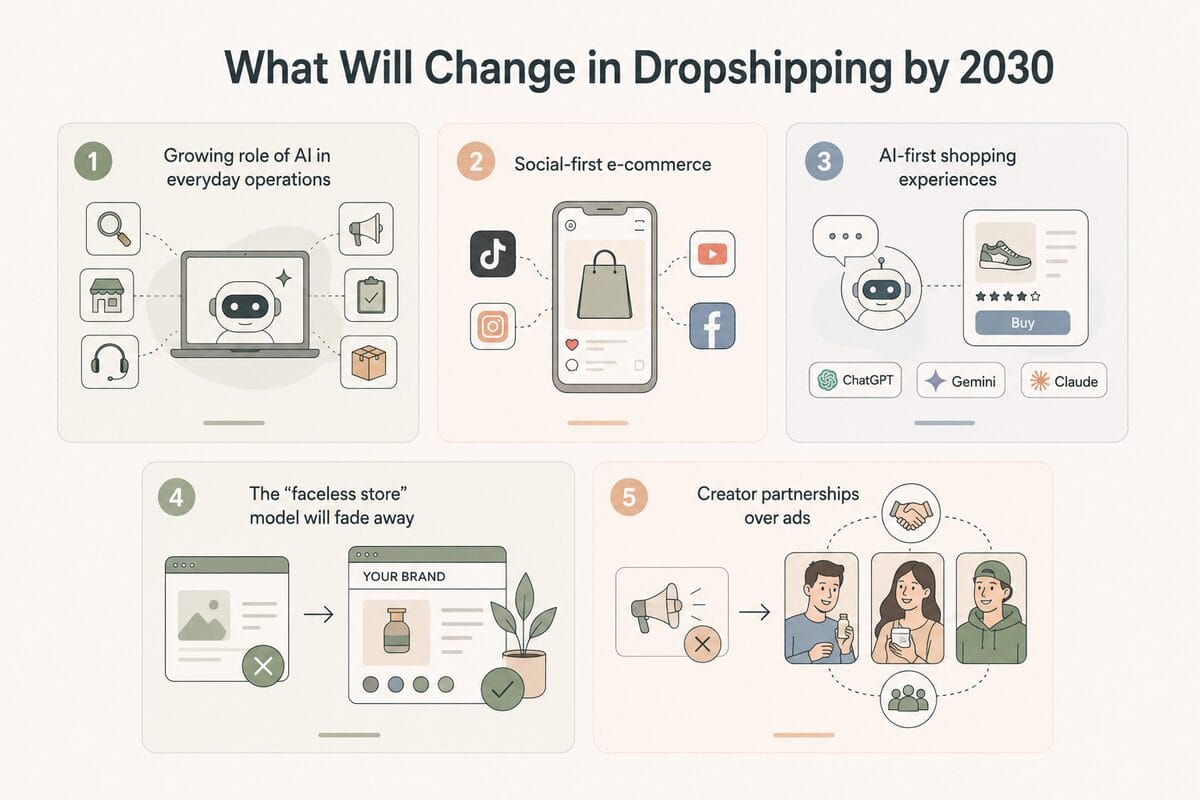
First, let’s see what will change in dropshipping in 2030.
- Growing role of AI in everyday operations. Today, AI is an advantage. In a few years, it will likely be the standard. Product research, store creation, ad generation, customer support, inventory management, and fulfillment will become increasingly automated. This will allow sellers to operate with fewer resources and greater efficiency.
- Social-first e-commerce. TikTok Shop and other social platforms will eat a significant share of Shopify’s dominance. More transactions will happen natively inside social platforms without ever touching an independent storefront. Dropshippers will need to sell where people already are, not just drive traffic to their own stores.
- AI-first shopping experiences. The biggest shift will come from AI assistants like ChatGPT, Gemini, and Claude. These tools are beginning to integrate shopping features, helping users discover, compare, and purchase products directly within conversational experiences. This makes SEO (search engine optimization) and, specifically, GEO (generative engine optimization), more important than ever.
- The “faceless store” model will fade away. Generic stores with no identity will become commercially unviable. Every successful dropshipping operation will look and feel like a brand, with a defined niche, visual identity, tone of voice, and a community.
- Creator partnerships over ads. UGC and influencer campaigns will replace paid ads as the primary acquisition channel. The Facebook ads era is winding down. The next five years will see dropshippers building systematic creator networks. I mean not just one-off influencer campaigns, but ongoing affiliate-style partnerships with niche-specific creators.
What Will Stay the Same
Despite all this new technology, some things won’t change. Customers will still buy products that solve problems, good marketing will still matter, and businesses will still need to provide a positive customer experience.
No AI tool can compensate for a poor product, weak positioning, or a lack of customer demand. Technology can help businesses move faster, but it can’t create value where none exists. Moreover, it can’t do everything for you. You’re still in charge of the strategy, which needs to be yours completely to really stand out.
As you can see, the fundamentals of e-commerce will remain the same. People buy things because they want a solution, a benefit, an experience, or a result. And your job is to offer them exactly that.
The tools may change, but human behavior probably won’t.
New Opportunities for Entrepreneurs
The next five years will likely create more opportunities for sellers than the previous five.
AI is lowering the barriers to entry across e-commerce, making it easier for individuals and small teams to launch and grow e-commerce businesses. At the same time, new opportunities are emerging through creator-led commerce, affiliate marketing, social commerce, and niche communities.
Most importantly, automation is making it easier to scale. Sellers can manage larger catalogs, sell across multiple channels, and serve more customers without increasing their workload. That’s pure scalability, which will be the most valuable asset in the coming years.
All in all, the future of dropshipping will belong to the businesses that adapt the fastest, embrace new technologies, and find creative ways to connect with customers. For sellers willing to evolve with the industry, that’s a pretty exciting opportunity.
How to Prepare for the Future of Dropshipping
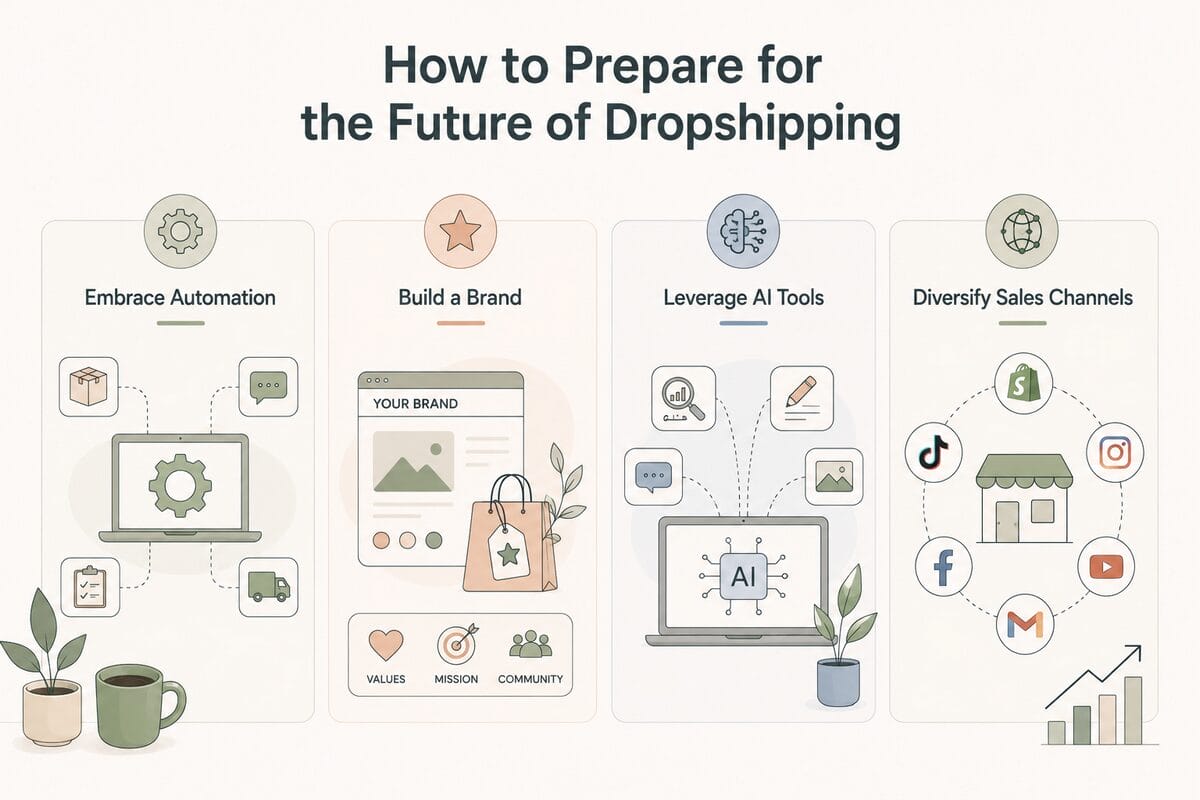
“How to prepare for the future of dropshipping” sounds like getting ready for a meteor strike. Don’t worry: it’s not that dramatic.
A more accurate way to think about it is this: the future is already here. See the technologies you’re already using in your daily life? Well, now it’s time to take them seriously and implement them in your strategy.
AI, automation, social commerce, and multi-channel selling aren’t actually predictions into the long-term future. We’re all already there. We’re looking up stuff on ChatGPT, searching for a party dress on TikTok, and leaving our dishes to a dishwasher, right? Well, now it’s time to do kind of the same with dropshipping. Let’s see how.
Embrace Automation
If there’s one word that was repeated too many times in this article, it’s automation. There’s just no more need to spend hours on repetitive tasks when you can set up a system to handle them for you.
Every hour spent manually updating listings or fulfilling orders could be spent improving marketing, testing products, or building customer relationships.
Platforms like AutoDS help sellers automate the entire workflow, including inventory management, order fulfillment, price monitoring, supplier tracking, and other day-to-day operations. This way, you can scale without increasing one single minute of workload.
You’re not removing yourself from the business here. You’re just removing the part of you that’s acting like an assistant so you can fully become a Sr. manager.
Build A Brand
As AI becomes more accessible, the technology itself will become less of a differentiator. That’s why branding will become more and more important.
Customers rarely remember generic stores. Think about your own experience online: what are the last three stores you remember? Now think about their traits. What makes you remember them is what makes them unique. For example, a clear identity, a specific problem they solve, a memorable experience, you name it.
You don’t need a massive marketing budget or a globally recognized logo. Just consistent messaging, quality products, great customer service, and a clear understanding of the audience are enough.
Leverage AI Tools
I know you love writing your own product descriptions by hand, carefully considering each word, and using your favorite emojis. So do I! But unless writing product copy is your life’s passion, there are probably better ways to spend your time as a business owner.
Use AI to speed up research, create content, analyze data, and automate repetitive tasks. Let it handle the work that takes up the most hours without adding much strategic value.
Then use that extra time to focus on things AI can’t do: understanding your customers, building your brand, testing new opportunities, and making smarter business decisions.
Diversify Sales Channels
One of the biggest risks in any business is becoming too dependent on one single case. In this case, one single platform.
If you rely entirely on one traffic source, one marketplace, or one social network, you’re letting algorithm changes, policy updates, rising costs, and shifting consumer behavior affect you. That’s why diversification is becoming increasingly important.
Consider selling across multiple channels, experimenting with different traffic sources, building an email list, and creating content that can reach customers in more than one place.
It’s not that you have to be everywhere at once, but to avoid leaving your entire business in the hands of a platform you don’t control.
A smart strategy includes a Shopify store, TikTok and Instagram profiles, maybe a marketplace seller account, and an email list, each one with its own strategy. Yes, it takes time, and that’s exactly where AI can help you automate other tasks so you can focus on building a multi-channel strategy.
Frequently Asked Questions
Is dropshipping dying because of AI?
No, dropshipping is not dying because of AI. Quite the opposite, actually. AI is one of the main reasons dropshipping is more viable today than it was five years ago. What AI is killing is the manual, inefficient version of the business. Sellers who embrace AI can speed up operations, scale faster, and increase profits.
What is the future of dropshipping in the next five years?
In the next five years, dropshipping will be shaped by AI, automation, social commerce, faster fulfillment, and multi-channel selling. While competition will continue to increase, sellers will also have access to more powerful tools than ever before, making it easier to automate operations, identify trends, and scale efficiently. The most successful businesses will likely be the ones that combine technology with strong branding, customer experience, and strategic decision-making.
Will AI replace dropshippers?
No, AI won’t replace dropshippers. In fact, AI will replace the tasks, not the people. Product research, listing optimization, order fulfillment, pricing updates, and customer emails are all being automated. But the strategic decisions, brand building, supplier relationships, and creative direction still require a human behind the wheel. Think of AI as removing the grunt work so you can focus on the parts of the business that actually create competitive advantage.
Is dropshipping still profitable in 2026?
Yes, dropshipping is still profitable in 2026. However, success depends less on finding random trending products and more on building a solid business. Sellers who use automation, leverage AI, choose reliable suppliers, and focus on customer experience can still achieve healthy profit margins and long-term growth in an increasingly competitive market.
What skills will future dropshippers need?
The most valuable skills for dropshippers are strategic. Going forward, focus on brand building, audience development, supplier relationship management, data interpretation, and knowing how to direct AI tools effectively rather than just use them passively. Add to that an understanding of social commerce, short-form video content, and customer experience design.
How is AI changing e-commerce businesses?
AI is changing e-commerce business by making e-commerce faster, cheaper, and more efficient. It can automate product research, store creation, marketing, customer support, and fulfillment, while also enabling more personalized shopping experiences. As a result, businesses can scale faster and spend less time on manual tasks.
Will dropshipping become more competitive?
Yes, dropshipping will likely become more competitive as AI and automation make it easier to start an online business. However, the biggest opportunities will remain with sellers who differentiate themselves through branding, customer experience, content, and smart product selection rather than simply competing on price.
What should beginners do to prepare for the future of dropshipping?
Beginners preparing for the future of dropshipping should focus on mastering the fundamentals of e-commerce while leveraging modern tools. Start by using automation and AI to streamline repetitive tasks, build a recognizable brand, diversify your sales channels, and prioritize customer experience.
Get Ready For The Future Of Dropshipping With AutoDS
If there’s one takeaway from this article, it’s that dropshipping isn’t dying. AI, automation, social commerce, faster fulfillment, and changing customer expectations are reshaping the industry, but they’re also creating new opportunities for sellers willing to adapt.
AutoDS combines AI-powered tools, automation, product research, inventory management, fulfillment, and multi-channel selling features into a single platform. This way, it helps you launch more quickly, scale more efficiently, and reduce errors by automating manual, repetitive tasks.
You can start your AutoDS $1 trial today and build a business that’s ready for the future of dropshipping.
In the meantime, you can continue learning with these helpful reads: