A customer wants to return a product you’ve never even touched. You contact the supplier who shipped it, only to discover their return policy doesn’t cover the request. Meanwhile, your customer is waiting for an answer. Who takes responsibility now?
That’s where dropshipping returns can get tricky. Even though your supplier handles the inventory and shipping, you’re the seller responsible for resolving the customer’s request. And the rules change depending on where you sell: on Shopify, you build your own return policy around what suppliers can honor and applicable laws; on eBay, marketplace requirements add another layer of responsibility.
In this guide, I’ll walk you through how to handle dropshipping returns on Shopify and eBay, from setting workable policies to managing refunds and supplier disputes. I’ll also cover practical ways to protect your margins, including when to request photo evidence, when to refund without asking for the product back, and how AutoDS can help manage the process.
The goal? Handle returns confidently, keep costs under control, and give customers a clear answer when something goes wrong.
Your store is responsible for handling dropshipping returns, while your supplier’s policy determines whether you can recover the cost of a customer refund.
Shopify returns require a clear, published refund policy, with conditions aligned with your suppliers’ terms and applicable consumer laws.
eBay returns follow marketplace buyer protections and strict deadlines, with unresolved cases potentially leading to refunds issued by eBay and seller-performance penalties.
AutoDS supports different return workflows for managed orders, private suppliers, and personal buyer accounts, with reimbursements subject to supplier approval.
A reliable returns setup starts before the first sale, with realistic supplier conditions, approved return addresses, and regular monitoring of recurring claims.
Who Handles Returns In Dropshipping, The Store Or The Supplier?
The answer is simple: your store handles dropshipping returns because you’re the seller of record.
Here’s what I’d want you to understand from day one: the customer bought from you, even if a third party packed and shipped the product. So when a return request comes in, you’re responsible for reviewing it, communicating the next steps, and issuing a refund when required.
Your supplier comes into play behind the scenes. Their return policy determines whether, and how much, you can recover after resolving a customer’s request. Refunding the buyer doesn’t automatically mean you’ll get reimbursed.
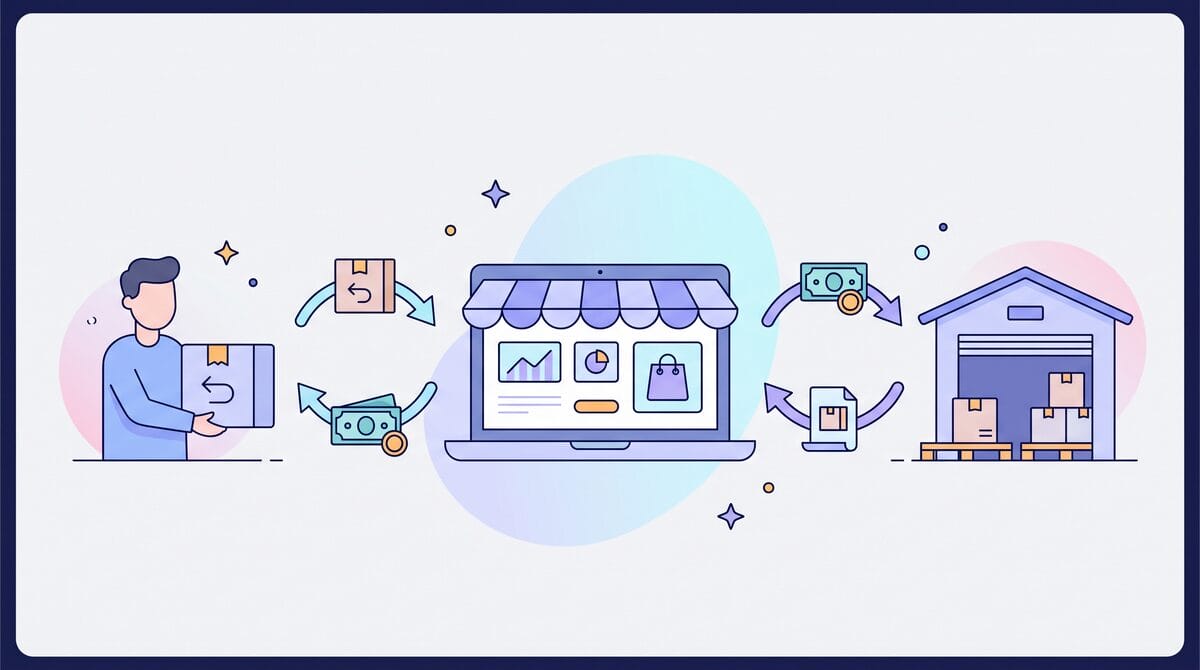
Here’s how the money flows:
- The customer pays your store, and you pay the supplier to fulfill the order.
- If a refund is owed, your store pays the customer back.
- You then seek reimbursement from your supplier, depending on their return terms.
And that’s where your margins come into play. A rejected return, expensive shipping, or an unexpected fee can leave your dropshipping business covering the difference.
To make the responsibilities clearer, here’s how the three parties fit together:
| Party | What they do |
|---|---|
| Customer | Requests the return, explains the issue, provides supporting information when appropriate, and sends the item back if required. |
| Store (you) | Handles customer communication, applies the return policy, arranges the resolution, and issues any required refund. |
| Supplier | Ships the original order, evaluates returns under its own terms, and reimburses you when the request qualifies. |
So, before promising anything to your customers, check what your fulfillment partners actually allow:
- Return window: How long you have to request or send back an item.
- Return shipping: Who covers the cost of sending the product back.
- Restocking fees: Any amount deducted from an approved refund.
- Non-returnable items: Products excluded from returns, often due to hygiene, customization, or category restrictions.
Your return policy should reflect what your suppliers can realistically support, while still respecting your customers’ rights and the rules of the platform you’re selling on.
And speaking of platforms, Shopify and eBay approach returns quite differently. Let’s see what changes when you sell through each one.
Shopify vs eBay Returns For Dropshippers
Your responsibility to the customer stays the same, but the rules change depending on where you sell. Shopify gives you more control over your return conditions, while eBay adds marketplace protections and seller-performance requirements that you can’t simply opt out of.
Here’s how Shopify returns and eBay returns compare from a dropshipper’s perspective:
| Platform | Who's responsible? | Return window norms | What happens if misshandled |
|---|---|---|---|
| Shopify | You set the policy and handle returns, subject to consumer laws. | You choose the window; Shopify supports 14, 30, or 90 days, plus custom or unlimited periods. | Payment disputes, chargeback fees, damaged customer trust, and potential consumer-law violations. |
| eBay | You handle returns under eBay's rules and Money Back Guarantee, regardless of your supplier's terms. | Usually 30 or 60 days, or No returns for eligible change-of-mind requests; certain categories allow 14 days. Buyer protections can override your policy. | eBay may approve returns or issue refunds on your behalf. Unresolved cases decided against you can count as defects and hurt seller performance. |
Notice the difference? On Shopify, your main challenge is setting clear terms that your suppliers can support. On eBay, you also have to meet the marketplace’s requirements, even when your fulfillment partner refuses a return.
That distinction shapes everything from how you write your policy to how quickly you need to respond when a customer reports a problem.
Let’s start with Shopify, where getting those terms right is largely in your hands.
Shopify Returns: Writing A Policy Your Suppliers Will Follow

When dropshipping on Shopify, you’re in charge of setting the return rules. Shopify doesn’t impose a universal 30-day return window, but it does require you to publish clear, accessible refund terms and honor applicable consumer laws.
That freedom comes with a little homework. Imagine promising customers 30 days to return a product when your supplier only accepts it within 14. Those extra 16 days are now your problem.
So, remember those supplier return conditions I covered earlier? Now’s the time to put them to work. Before writing your policy, double-check how each supplier handles these four areas:
- Return window: Start with your most restrictive supplier’s deadline when setting a storewide policy, unless consumer laws require a longer period.
- Return shipping: Explain who pays, where items should be sent, and whether any restocking fees apply.
- Non-returnable products: Identify eligible exclusions, such as certain personalized or hygiene-sensitive items, without overriding statutory customer rights.
- Required evidence: Tell buyers what information helps you review a request, including order details and photos when appropriate.
And what if a supplier refuses returns altogether? You still have options. You can accept the product at your own return address if the costs make sense, or issue a refund without requesting the item back. Either way, you’ll need to cover any refund you’re legally or contractually required to provide, even if your supplier won’t reimburse you.
How To Add A Return Policy In Shopify
Once you’ve worked out the terms, publishing them is straightforward:
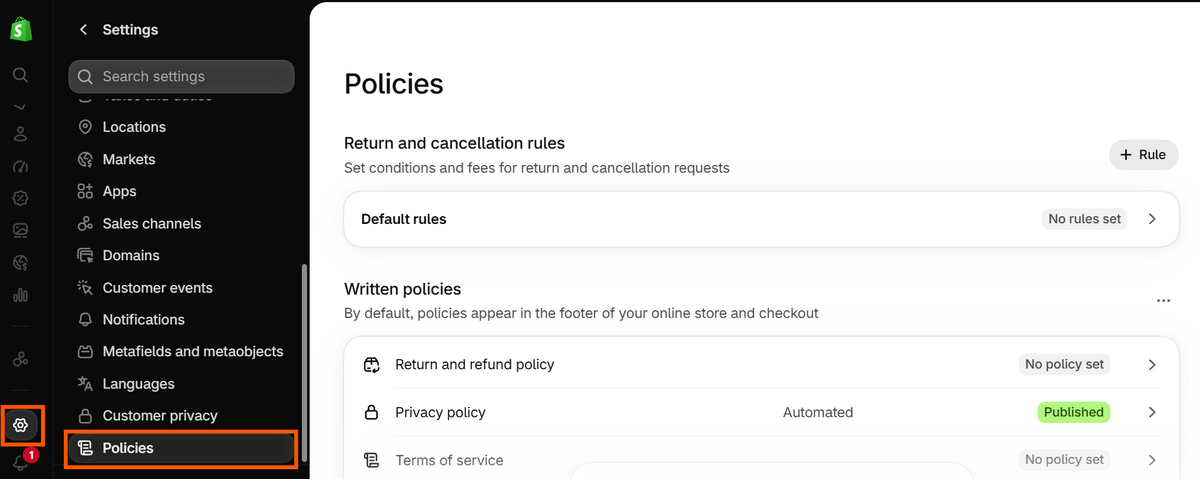
From your Shopify admin, go to Settings → Policies.
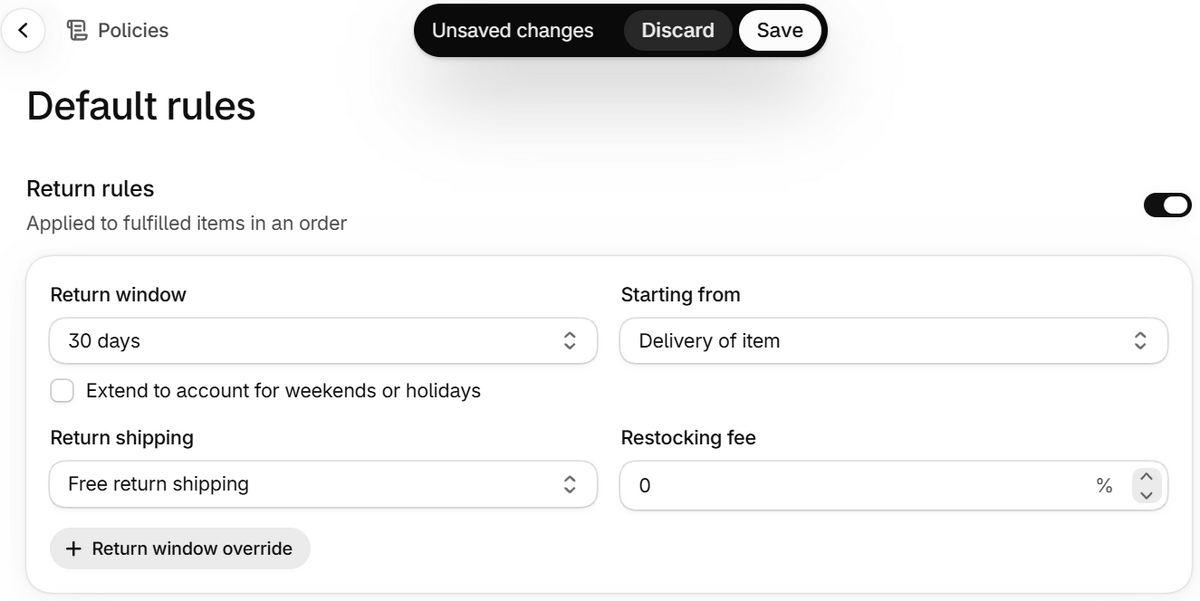
Under Return and cancellation rules, configure your return window, shipping costs, restocking fees, and any eligible final-sale exclusions. Make sure these settings reflect your written policy.
In Written policies, select Return and refund policy. Turn off Use automated policy if you want to write or customize the text yourself. You can also review Shopify’s generated version, but check every detail against your actual supplier arrangements.
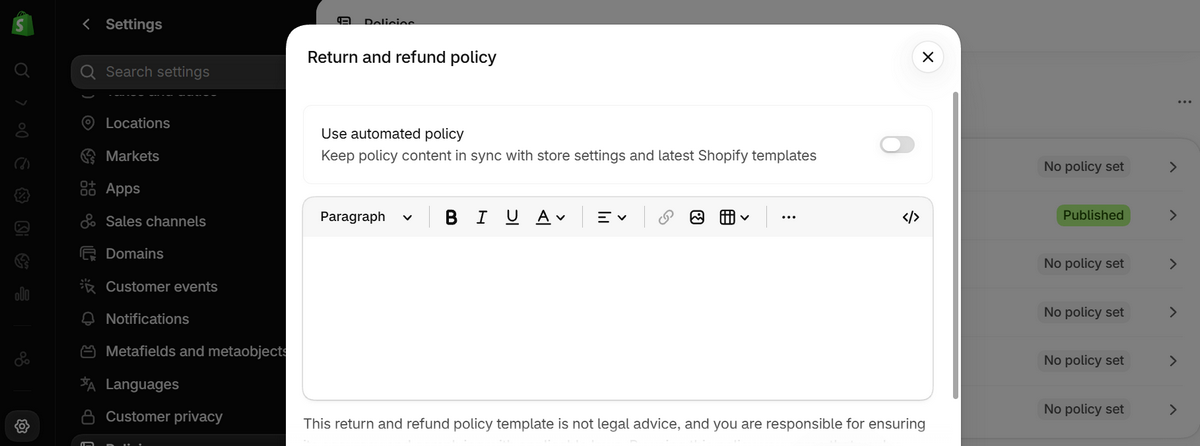
Review and save your policy. Shopify links it in the checkout footer, and you can also add it to your storefront navigation through Content → Menus.
🆕 Beginner’s Tip: Writing your first policy from scratch? This returns and refunds policy template + setup guide gives you a practical starting point. Customize it around your suppliers, products, and customer rights before publishing.
One more feature worth knowing about: Shopify supports self-serve returns, letting customers request returns through their accounts while you review and approve eligible requests. You can activate them under Settings → Customer accounts; the exact controls depend on your store’s admin version. Advanced and Plus merchants with access to the newer editor can also configure availability by market.
Publish your return policy before your first sale, and revisit it whenever your supplier arrangements change. Clear terms set customer expectations upfront and give you a consistent process when a return request comes in.
eBay Returns For Dropshippers
Dropshipping on eBay comes with a responsibility you can’t pass along to your supplier: you’re the seller of record, and every return request is yours to handle. As eBay puts it, sellers are responsible for “providing a resolution when a buyer reports a problem with an order”.
If you’re here as a buyer trying to return a purchase, head to eBay’s official return guide. What follows is for dropshippers managing those requests as sellers.
How eBay Returns Work For Sellers
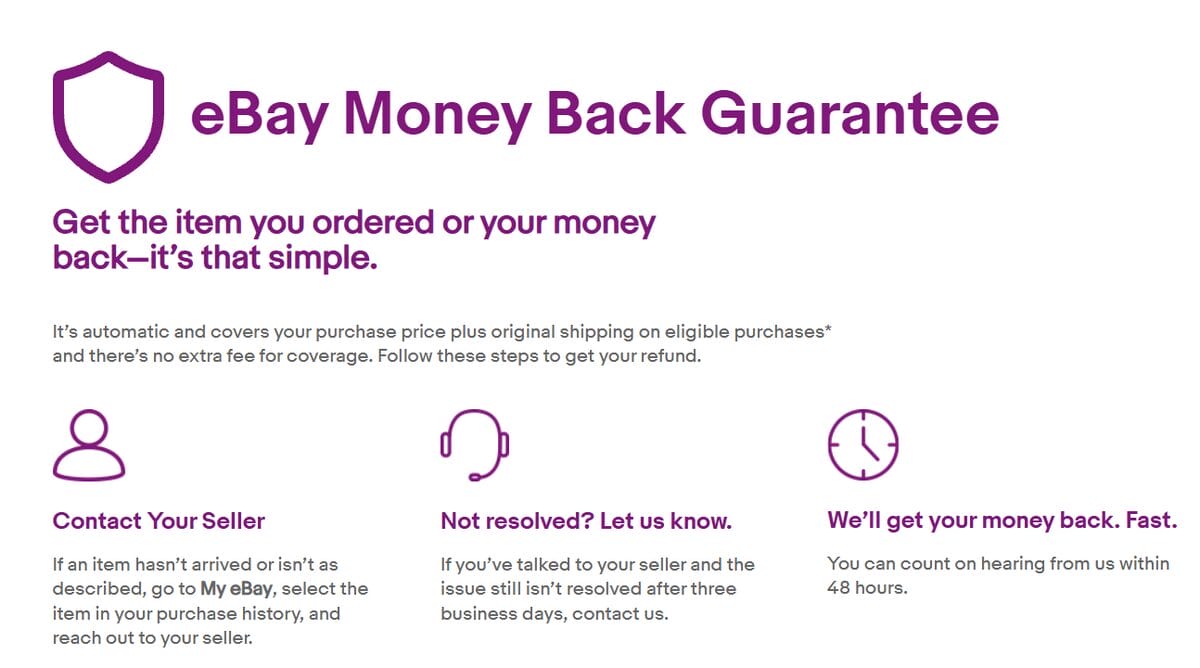
Under the eBay Money Back Guarantee, buyers can return items that arrive damaged, faulty, incorrect, or different from the listing description, even when your policy says No returns. In those cases, you’re responsible for accepting the return and covering return shipping.
For change-of-mind requests, your listing’s return conditions generally apply. But whatever the reason, eBay has deadlines you’ll want to keep close:
- Within 3 business days: Respond to the request and work toward a resolution.
- Within 2 business days of receiving the return: Inspect the item and issue the refund, or ask eBay to step in if there’s a problem.
And those deadlines have teeth. eBay can automatically accept eligible returns, provide shipping labels, and issue refunds on your behalf, recovering the money from your account when applicable.
Here’s the risk that generic eBay returns guides often overlook: when eBay steps in and closes a case against you because you failed to resolve it, that counts as a transaction defect. Repeated issues can hurt your seller level, potentially leading to higher fees or selling restrictions.
Getting The Return Address Right
There’s another dropshipping headache worth anticipating: where does the customer send the product?
Your supplier may have a return warehouse halfway across the country or overseas. Meanwhile, eBay needs a valid return address and an appropriate shipping method. If you haven’t configured an address, returns can default to your registered location.
Fortunately, eBay lets you set return address rules and upload your own prepaid labels when appropriate. That means an eligible supplier return address can be part of your setup, provided the arrangement meets eBay’s requirements. You still manage the request through eBay, including the label, tracking, and refund.
💡 Pro Tip: Supplier addresses and automatically generated labels can get complicated fast. This guide to eBay automatic returns explains the problem and possible workarounds. Just check the current eBay settings before following older interface instructions.
A Few Ways To Keep Return Costs Down
eBay also gives sellers some flexibility to resolve requests without unnecessary shipping:
- Refund without a return: Under Return preferences, you can create rules that automatically refund qualifying low-value orders while letting buyers keep the item.
- Offer a partial refund: If the buyer is willing to keep a product with a minor issue, you can propose a partial refund through the return request. You get one offer per request, and the buyer can accept or decline.
- Deduct for lost value: Eligible sellers, including qualifying Top Rated Sellers, may deduct up to 50% when an item comes back used or damaged. This protection has specific requirements and can’t be used as a general restocking fee.
One final point: eBay’s dropshipping policy allows fulfillment through wholesale suppliers, but prohibits listing an item and then purchasing it from another retailer or marketplace to ship directly to the buyer. Your sourcing model matters just as much as your return process when it comes to keeping your account in good standing.
That brings us to a more practical question: how can you resolve returns while spending as little as reasonably possible? Let’s look at a few tactics worth building into your workflow.
Practical Tactics That Save Money On Dropshipping Returns
A return request doesn’t always have to become an expensive shipment back to the supplier. A few smart decisions can help you resolve complaints faster, protect your margins, and avoid unnecessary costs. Here are three habits worth building into your dropshipping returns workflow.
Ask For A Photo Before You Refund
A customer says their order arrived damaged or contains the wrong product. Before deciding how to resolve it, ask for a little evidence. Request clear photos of the item, the reported issue, its packaging, and the shipping label. A short video can help when the problem involves functionality. This gives you something concrete to review and share with your supplier.
Keep your message friendly and simple:
“I’m sorry there was an issue with your order! Could you send us a few photos of the product, packaging, and shipping label? It’ll help us review what happened and find the best solution“.
Selling on eBay? You can request photos to clarify a claim, but you can’t make them a condition for returns protected by eBay’s rules. Respond within the platform’s 3-business-day deadline, even if you’re still gathering details.
Refund Low-Value Items Without A Return
Sometimes, asking for the product back costs more than keeping it. Here’s a simple calculation to make before approving return shipping:
Return cost = Return shipping + Supplier fees + Time spent handling it
Say an item has a recoverable value of $12, but shipping it back costs $8, restocking fees add $3, and your handling time is worth $5. That’s $16 spent to recover $12. A refund without a physical return makes more financial sense.
For products around $10–$20 or less, this is often worth considering, but use your own numbers. On eBay, you can configure Return preferences to automatically refund qualifying requests while letting buyers keep the item.
Just keep records of these decisions and watch for repeated claims from the same buyer.
Publish Your Return Policy Before The First Sale
The easiest time to establish return rules is before anyone needs to use them. It gives you time to plan for the tricky cases: damaged products, disputed claims, or a supplier who refuses to take the item back.
Your policy should answer six questions:
- How long is the return window?
- What condition must products be in?
- Who pays return shipping?
- How does someone start a request?
- When will the refund arrive?
- Which items are excluded?
Keep those answers aligned with your suppliers, applicable consumer laws, and marketplace requirements.
🆕 Beginner’s Tip: Getting your store ready for its first sale? This dropshipping shipping policy guide can help you out.
How AutoDS Helps With Dropshipping Returns
You’ve seen how much coordination a single return can involve. Fortunately, an automation platform like AutoDS can simplify parts of that process, from requesting a return label to tracking supplier reimbursements. The exact workflow depends on how your order was fulfilled.
Here’s what happens in each case:
- Fulfilled by AutoDS: This service handles eligible supplier purchases through AutoDS-managed buyer accounts. Once an order shows Delivered, open its status menu and select Request Return. If the supplier accepts, a return label typically becomes available within 24–48 hours. After the item is returned, inspected, and approved, the refund is credited to your Managed Balance.
- Private Suppliers: These are suppliers you can source products from through the AutoDS Marketplace. To request a return, go to the Orders page and click Message This Supplier. They’ll review your request and coordinate the next steps if approved. Their return window, shipping conditions, and possible fees are listed on the product page.
- Retail suppliers and Automatic Orders: With Automatic Orders, AutoDS processes eligible purchases through your own retail buyer accounts. Since you own those accounts, you handle returns directly with the retailer, following its policy.
A few limits worth knowing: Fulfilled by AutoDS has a 5% lifetime return-request limit, with stricter rules for certain suppliers. Its standard return window is up to 30 days after delivery, though some products have shorter deadlines. To avoid missing yours, submit requests at least 48 hours before the window closes.
And remember: AutoDS coordinates eligible returns, but supplier approval still determines whether a reimbursement is issued. Your obligations to customers under marketplace rules and consumer laws remain your responsibility.
Which Returns Setup Fits Your Store?
By now, you know that your supplier’s return policy has a big say in how you handle customer requests. But not every sourcing arrangement calls for the same solution.
Here’s how to approach three common scenarios:
| Supplier situation | Recommended return policy | Where returns should go |
|---|---|---|
| Accepts returns | Match the supplier's window and conditions, accounting for platform rules. | The supplier's approved return address, if suitable. |
| Doesn't accept returns | Offer refunds when required; consider refund-without-return for low-value items. | Your own address if you want the item back, or no return required. |
| Located overseas | Factor in international shipping costs and longer processing times. | A local return address when available; otherwise, assess return costs before requesting shipment overseas. |
My rule of thumb? Build your storewide return window around your most restrictive supplier, then adjust wherever consumer laws or marketplace protections require more generous terms. If your suppliers operate under very different conditions, consider product-specific rules where your selling platform allows them.
And before sending customers anywhere, confirm that the return address is approved and can actually receive the package. A little coordination here can save you an expensive shipment to the wrong warehouse.
Common Dropshipping Returns Mistakes
Even with a return process in place, a few missteps can turn a simple request into an expensive problem. Watch out for:
- Promising more than your suppliers will honor. A generous return window sounds appealing until your sourcing partner refuses the item. Check deadlines, exclusions, and fees before setting your terms, while respecting customer rights.
- Waiting until the first complaint to write your policy. Publish clear return instructions before you start selling. Making up the rules while a frustrated customer waits is a recipe for trouble.
- Missing eBay’s response deadlines. You generally have 3 business days to respond and work toward a resolution. Don’t wait for your supplier to get back to you; unresolved cases can escalate and hurt your seller performance.
- Sending customers directly to the supplier. Unless you’ve arranged an approved return process, don’t expect buyers to negotiate with your fulfillment partner. Confirm the correct return address and manage the request yourself.
- Ignoring your return rate. Track which products and suppliers generate repeated claims, then investigate the causes. High return volumes can eat into margins and even affect your eligibility for future return requests.
Frequently Asked Questions
Who handles returns in dropshipping, the store or the supplier?
The store handles dropshipping returns because you’re the seller responsible for resolving customer requests, even when a third-party supplier ships the product. Your supplier’s return policy does determine whether you can recover the cost of a refund.
Does Shopify require a specific return policy?
Shopify doesn’t require a specific return window, but you must publish a clear, accessible refund policy that complies with applicable consumer laws. You can customize your terms under Settings → Policies, making sure they reflect what your suppliers can actually honor.
What happens if I mishandle returns on eBay as a dropshipper?
Mishandling eBay returns can lead to refunds issued on your behalf, transaction defects, and lower seller performance. If you fail to resolve a request within eBay’s deadlines, the platform may intervene and refund the buyer from your funds. Cases closed against you can also affect your seller level.
Should I ask for a return or just refund low-value items?
Refunding low-value items without requesting a return often makes more financial sense when the cost of return shipping, supplier fees, and handling exceeds the item’s recoverable value. For products around $10–$20 or less, compare those costs before deciding, and keep records of repeated claims.
How do I write a dropshipping return policy before my first sale?
To write a dropshipping return policy, check your suppliers’ conditions and define the return window, product eligibility, shipping costs, refund timing, and request process. Publish those terms before your first sale, ensuring they comply with marketplace rules and consumer laws.
Can I redirect a customer’s return request to my supplier?
You can’t transfer responsibility for a customer’s return request to your supplier. You may arrange for the buyer to ship the product to an approved supplier return address, but you must still manage the request, provide the necessary instructions, and issue any required refund.
Handle Dropshipping Returns With Confidence!
Sooner or later, a customer will want to send something back. And when that happens, the decisions you made before the sale will make all the difference: a plan for handling requests without unnecessary expenses, reliable supplier arrangements, and a clear return policy.
On Shopify, you have room to shape that process around your business. On eBay, marketplace protections and response deadlines demand extra attention. Either way, knowing when to request evidence, arrange a return, or issue a refund can help you protect your margins while keeping customers’ trust.
My advice? Treat every return as a chance to make your operation more reliable. Pay attention to recurring complaints, keep your policies aligned with your suppliers, and build an operation that lets you resolve problems confidently as your store grows.
📦 Want to simplify the work behind each return? Test AutoDS for $1 and explore how its order management and supported return workflows can help you stay organized.
Interested in learning more? These articles are worth a look: