


![eBay Dropshipping: How to Start Dropshipping on eBay [2027]](https://pictures.autods.com/OfficialSite/New/20251023094104/How-To-Start-Dropshipping-On-eBay-In-2025.jpg)
I’ve been dropshipping on eBay for years now, and if there’s one thing that surprises newcomers every single time, it’s this: you don’t need a warehouse, a big budget, or even a website to make your first sale. eBay already built the machine: millions of buyers logging in every day, actively looking to spend money. Your job? Show up with the right items and let the platform do the heavy lifting on traffic.
That said, I’m not going to pretend it’s plug-and-play. Sourcing, keeping prices and stock in check, fulfilling orders without letting anything slip through the cracks — that’s where most beginners get overwhelmed. It’s exactly why I lean on tools like AutoDS. Why? Because AutoDS automates the repetitive stuff and frees you to focus on what actually moves the needle: finding winning products and building a catalog people trust.
So here’s what I’m walking you through in this guide: from setting real expectations about costs and eBay’s rules, to the exact steps I use to launch, source, and scale a dropshipping store on eBay in 2027. No fluff, no theory for the sake of theory. Just what works, and why it works.
eBay is still one of the friendliest places to start dropshipping, pairing low upfront costs with millions of active buyers already out there searching for what you’re selling.
Success depends on mastering the basics, from understanding eBay’s fees and policies to validating product demand before listing.
Launching follows a clear process, from setting up your seller account to researching products, sourcing suppliers, and fulfilling orders.
Automation becomes increasingly valuable as order volume grows, reducing repetitive work while improving operational accuracy.
AutoDS provides a complete toolkit for eBay dropshipping, supporting product research, sourcing, fulfillment, and ongoing store management. 👇
What Is eBay Dropshipping?
eBay dropshipping is a fulfillment method where you list products on eBay and a third-party supplier ships them directly to your buyer after each sale. Basically, it’s a way to run a dropshipping business by selling products on eBay’s marketplace instead of building your own store from scratch. You list the item, a customer buys it, and the supplier ships it straight to their door. You never touch the product, never hold inventory, never front the cost of stock sitting on a shelf.
eBay also comes with something the other marketplaces don’t hand you for free: trust that’s already built in. Buyers have been shopping there for decades. They know how returns work, they know their payment is protected, and that means you’re not fighting to convince a stranger your store is legit before you’ve even made your first sale. You’re borrowing eBay’s reputation, and its audience, on day one.
That’s really the whole appeal of this model. Because you’re not stocking anything, the financial risk and the entry cost stay low, but the ceiling on what you can earn doesn’t.
Why Dropship On eBay?
eBay reported 136 million active buyers worldwide in its most recent quarterly results. And what it means for you is simple: there’s already a massive, ready-to-buy audience sitting on the platform before you list a single item.
Compare that to starting your store from zero. There, every visitor is one you have to earn, through ads, SEO, content, and patience. On eBay, you’re plugging into traffic that already exists. I’m not saying it’s free money; you still need the right products and solid listings. But you’re not building the highway. You’re just parking your shop on one that’s already busy.
There’s more working in your favor, too. eBay lets you dropship across multiple regional marketplaces: ebay.com, ebay.co.uk, ebay.de, ebay.fr, ebay.it, ebay.com.au, ebay.es, and ebay.ca among them. I’ve used this myself to test the same product in different markets without rebuilding anything from scratch.
And maybe the part that gets beginners over the hump fastest: there’s no upfront cost to list, so nothing stops you from testing the waters today. Just keep in mind that “free to list” isn’t the same as “free to sell”. Once an item actually moves, eBay takes a final value fee. It’s not money out of your pocket upfront; it just comes out of the sale itself. Either way, you’re not risking anything before you’ve made a dollar. And that’s what matters when you’re just getting started.
Advantages & Disadvantages Of eBay Dropshipping
Like any other business model, eBay dropshipping has benefits and drawbacks. Let’s lay out the trade-offs honestly, because you’re going to run into all of them eventually anyway.
✅ Pros: What eBay does well
Start with the traffic, since it’s the reason most people choose eBay in the first place. With millions and millions of active buyers already shopping on the platform, you’re stepping into a room that’s already full. That alone accounts for most of what makes this model work:
- Free organic visits: Your listings get seen without spending a cent on ads to build an audience first.
- Easy to start: The interface is intuitive enough that beginners can list their first product within an hour of signing up.
- Zero upfront investment: Those free listings I mentioned earlier mean you can test an entire product idea before spending a cent.
- Simple ways to market: Tools like Promoted Listings General and Priority push visibility further without hiring a marketing team.
⛔ Cons: Where eBay falls short:
Now, the flip side. And it matters just as much as the good news:
- Hard to build a real brand: eBay is a marketplace, not your storefront, so customization is limited, and it’s genuinely tough to make your shop feel distinct from the next seller’s.
- Selling limits on new accounts: eBay typically starts new sellers around 10 items or $500 in total value per month, whichever comes first. This is set individually per account and reviewed monthly, so some accounts start even lower. It’s eBay’s way of filtering out sellers who aren’t serious, and you graduate out of it by proving you are.
- No access to customer data: Every buyer who purchases from you is eBay’s customer first. You don’t walk away with their email, so building repeat business takes more creativity than it would in your own store.
None of this makes eBay a bad choice. It just means you’re trading some control for a massive head start on traffic. For most people starting out, that’s a deal worth making.
How Much Does It Cost To Dropship On eBay?
The cost of eBay dropshipping can vary depending on several factors, and I’d rather you know exactly what you’re signing up for before your first sale.
Free Listings
The good news first: eBay lets you list up to 250 zero-insertion-fee listings per month. Whether you’re on no subscription at all or on the Starter Store plan, they’re functionally the same allowance. That’s real room to test a product idea without spending anything on the listing itself.
Once you outgrow those 250, you either pay per additional listing or move up to a paid subscription, whichever makes sense for how fast you’re scaling.
Subscription Fees
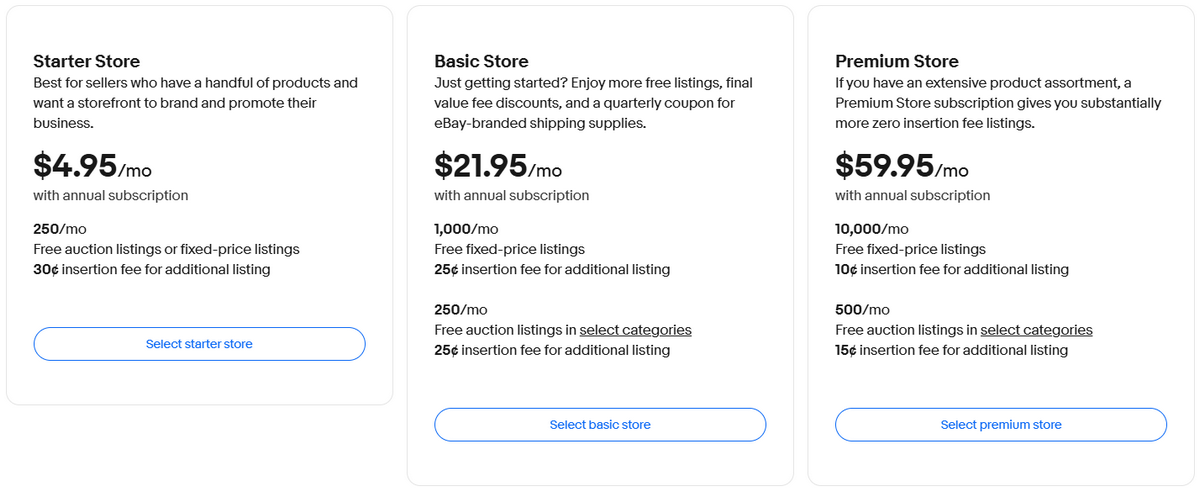
eBay’s store tiers are built for different stages of growth, and picking the right one is mostly about volume:
- Starter – $7.95/month (or $4.95/month billed annually) — best if you’re just getting your feet wet.
- Basic – $27.95/month (or $21.95/month annually) — more listings, lower final value fees.
- Premium – $74.95/month (or $59.95/month annually) — solid middle ground once you’re consistently selling.
- Anchor – $349.95/month (or $299.95/month annually) — built for high-volume sellers who need dedicated support.
- Enterprise (not currently available on a monthly billing plan) – $2,999.95/month, billed annually — this is the large-scale, custom-solution tier.
🆕 Beginner’s Tip: I’ll be honest, most people reading this don’t need to think about Anchor or Enterprise on day one. Start at Starter or Basic, and let your sales volume tell you when it’s time to move up.
Insertion Fees
Each subscription tier comes with its own free-listing allowance, and the additional-listing fee depends on whether you’re running fixed-price or auction-style listings:
- Starter Store: 250 fixed-price listings free, then $0.30 per additional fixed-price listing.
- Basic Store: 1,000 fixed-price listings free (plus up to 250 free auction-style listings in specific categories), then $0.25 per additional fixed-price listing.
- Premium Store: 10,000 fixed-price listings free (plus up to 500 free auction-style), then $0.10 per additional fixed-price listing or $0.15 per additional auction-style listing.
- Anchor Store: 25,000 fixed-price listings free (plus up to 1,000 free auction-style), then $0.05 per additional fixed-price listing or $0.10 per additional auction-style listing.
- Enterprise Store: 100,000 fixed-price listings free (plus up to 2,500 free auction-style), then $0.05 per additional fixed-price listing or $0.10 per additional auction-style listing.
If you’re mostly running fixed-price listings (which, as a dropshipper, you almost certainly are), the auction-style rates won’t affect you much. But it’s worth knowing they exist, so a surprise fee doesn’t catch you off guard.
💡 Pro Tip: Don’t sit there doing this math by hand. I know I don’t. Punch your numbers into AutoDS’s eBay Insertion Fee Calculator and let it spit out the real cost in seconds. One less thing to get wrong before you hit “list.”
Final Value Fees
This is the fee that actually eats into your margin on every sale, so pay attention here. eBay calculates it as a percentage of your total sale amount (item price + shipping), plus a flat per-order fee of $0.40, which drops to $0.30 if the total sale is $10 or less.
The percentage itself shifts by category. Take Men’s Athletic Shoes as an example: if you’re on a Starter Store, you’ll pay 8% on sales of $150 or more (and no per-order fee kicks in at that level) or 13.6% on anything under $150. If you’re on Basic, Premium, Anchor, or Enterprise, those rates drop slightly to 7% over $150 and 12.7% under $150.
Notice the pattern? The higher your subscription tier, the lower your final value fee. That gap is exactly why it’s worth revisiting your plan once your sales volume grows.
eBay Dropshipping Policies
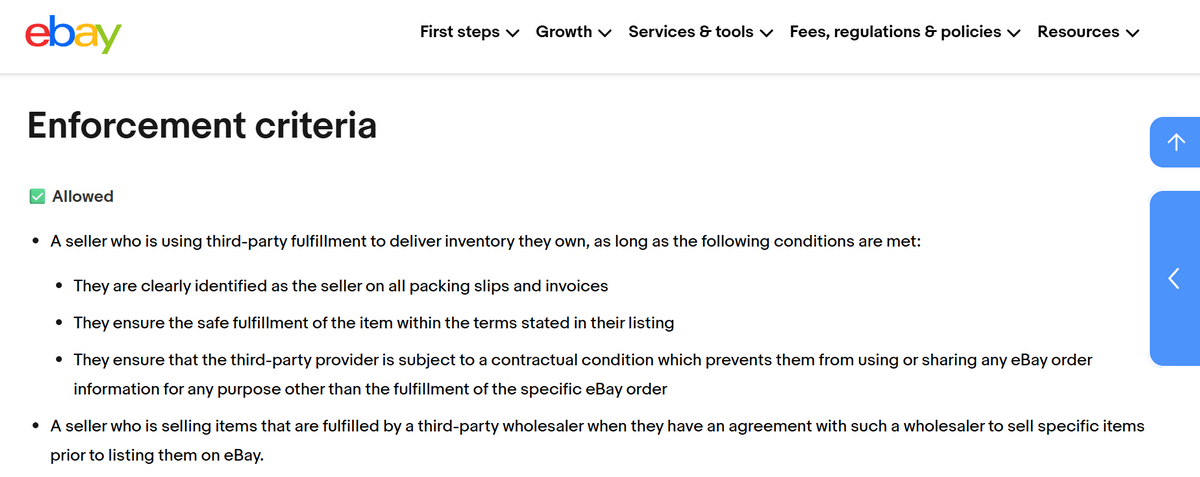
Let’s clear something up: eBay does allow dropshipping, but it prefers the kind where you source from a legitimate wholesale or private supplier.
What eBay doesn’t allow is listing an item and then buying it from another retailer or marketplace that ships straight to your customer. Get caught doing that, and your account may be flagged or suspended.
There are ways to overcome this. But if you’re just starting out, stick to wholesale or private suppliers. It’s the safer path.
The “Bad Buyer Experience” Policy: Why It Matters and How To Avoid Suspension
eBay’s Shipping Performance Policy (the one tracking your “Item Not Received” rate) is not new. What is worth your attention is that eBay folded it into something bigger in August 2025: the Bad Buyer Experience (BBE) rate, which now combines shipping performance with your overall service standards into one evaluation. Sellers with a high BBE rate can face real consequences: listing restrictions, limits on editing or removing items, even a full selling suspension.
So what do you actually do about it? Three things, and all of them are simple:
- Set accurate shipping expectations: Don’t promise 3-day delivery if your supplier takes 10.
- Ship on time, every time: This is non-negotiable.
- Work with suppliers who ship fast: If your supplier is slow, that risk becomes your risk.
💡 Pro Tip: If you end up with your account suspended, don’t panic and don’t guess your way through it. I’ve got a full walkthrough on. I’ve got a full walkthrough on reinstating a suspended eBay account that’ll save you a lot of trial and error.
Products To Avoid Selling On eBay
Compliance isn’t just about where you source; it’s also about what you list. Some items aren’t worth the risk, no matter how good the margin looks, because they can get you suspended or land you in legal trouble. Better steer clear of:
- Copyrighted and trademarked products
- Age-restricted items (alcohol, tobacco, and the like)
- Dangerous products (weapons, ammunition, flammable liquids, choking hazards)
- Medicines, vitamins, and supplements
- Health products using “before-and-after” photos
- Drugs and drug-related products
Copyright and trademark issues are the ones that catch beginners off guard most often. They’re rarely as obvious as they seem, which is exactly what eBay’s VeRO (Verified Rights Owner) program exists to enforce.
So, Is eBay Dropshipping Still Worth It In 2027?
Short answer: yes, but only if you play it straight and smartly. eBay dropshipping in 2027 is profitable for sellers who prioritize wholesale or private suppliers over retail arbitrage, and who actually track their fees instead of guessing at them. What it isn’t anymore is a shortcut. Margins on commodity products are thin, the policies we just walked through are real and enforced, and you’ll never get your customers’ emails.
But “thin margins” is a vague complaint, and vague complaints are exactly what scare people off before they’ve seen a real number. So let’s actually run the math. Say you buy a product for $12 from your supplier and list it at $25.
- eBay final value fee (~13% + $0.40 per-order): $3.65
- Net profit per unit: $9.35
Not life-changing on one sale. Multiplied across 200 orders a month, it’s a real business.
Now, here’s where sellers actually trip up. I won’t pretend risks aren’t real. Retail arbitrage gets accounts suspended, full stop; source from a wholesale or private supplier instead. VeRO takedowns hit sellers who list copyrighted or trademarked items without checking first; a daily-updated compliance check catches that before it becomes a strike. And the race-to-the-bottom pricing that kills margins on saturated products? You avoid it by choosing less crowded niches and competing on service and speed, not just price.
None of this works, though, if you’re doing it all by hand at scale. And that’s exactly the gap automation like AutoDS is built to close.
How To Start Dropshipping On eBay In 2027
Alright, this is the part you actually came for. I’ve been doing this for close to ten years now, and I’m going to walk you through it exactly the way I wish someone had walked me through it back then: no skipped steps, no assumed knowledge.
One thing before we dive in: don’t rush this. eBay is watching new accounts closely. Not in a paranoid way, just in the way any real marketplace vets who’s on it and where the money’s going. I’ve seen sellers try to skip straight to bulk listing on day one, and it almost always backfires.
Take it step by step, in the order I’m giving it to you, and you’ll be fine.
Step 1: Create a Seller Account
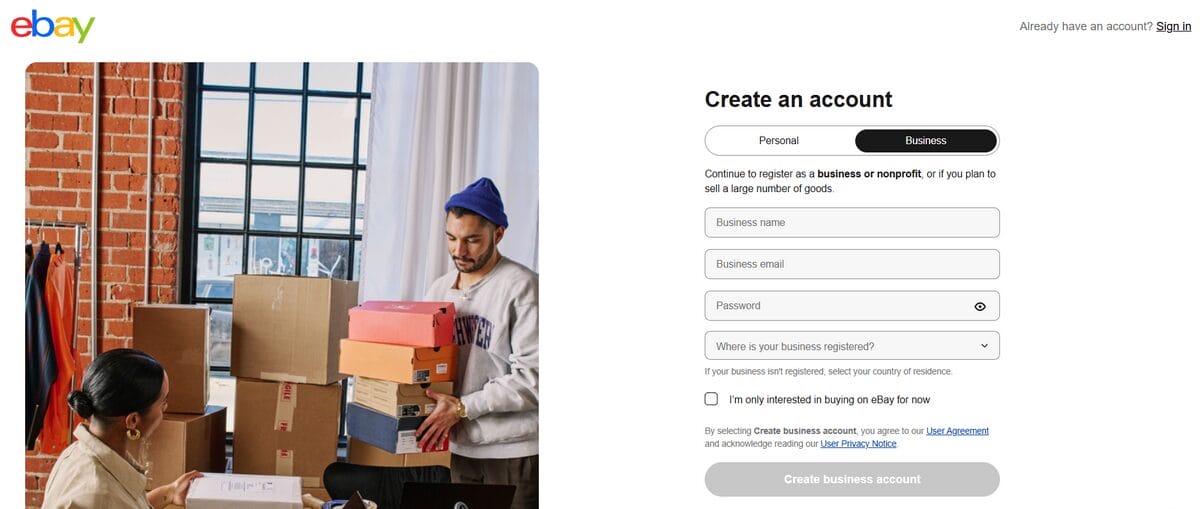
Head to eBay.com and hit “Register” in the top-left corner. You’ll be asked to choose between a personal account and a business account. If this is genuinely your first time doing anything like this, start with personal. It’s simpler, and you can always upgrade once you’re actually moving product.
For a personal account, you’ll need:
- Full name
- Address
- Date of birth
- Social Security Number (if you’re in the U.S.)
For a business account, you’ll need:
- Business name
- Registered business address
- Phone number
- Registration number
- Tax information
One thing worth knowing: if you happen to have an older eBay account lying around (even one you barely used), that history can actually work in your favor. Accounts with age tend to move through the early stages a little more smoothly. But if you’re starting completely fresh, that’s fine too. Everyone starts somewhere; new accounts just need some clean, consistent activity to build trust.
Once you’ve registered, head to “My eBay.” This is your home base going forward: payment methods, business policies, and account settings. On a brand-new account, eBay may briefly hold your funds before releasing them. That’s not a penalty. It’s just how they manage risk with sellers they don’t know yet. It stops once you’ve built a track record of on-time shipping.
Step 2: List Your First Items Manually
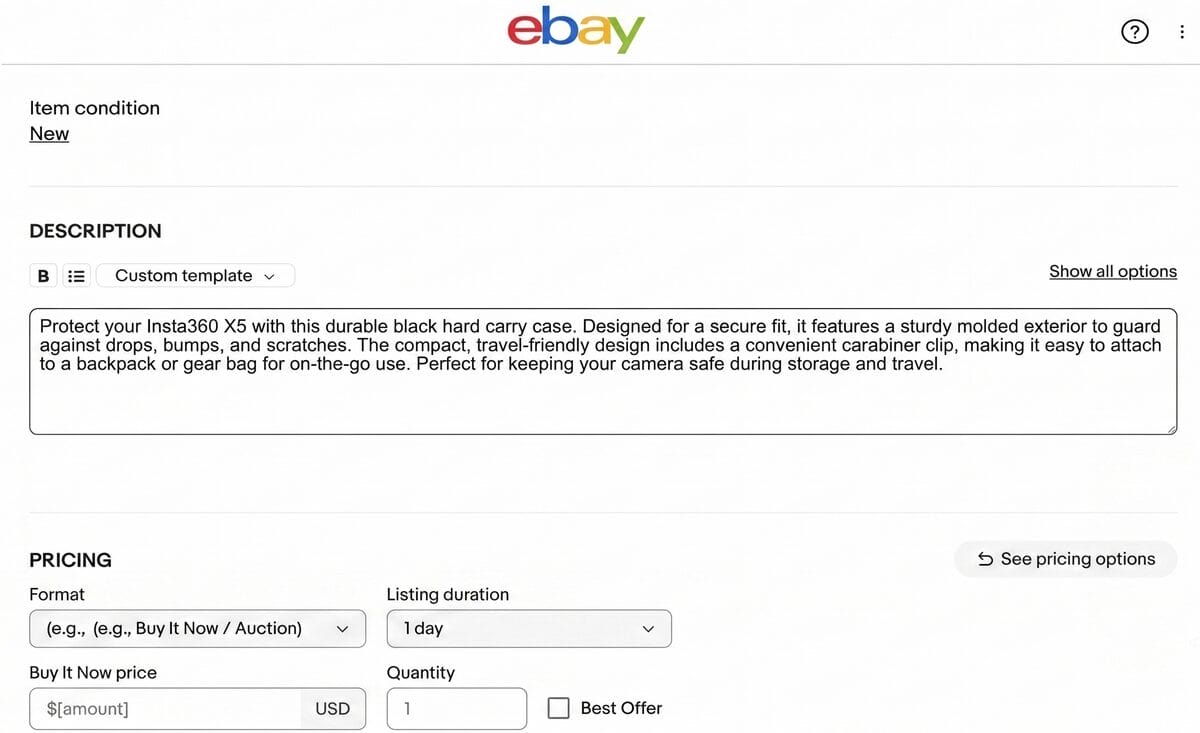
I get it: you want to start selling real products, not busywork. But hear me out: for your first handful of listings, you’re not actually trying to make a sale. You’re trying to show eBay who you are.
Right now, eBay doesn’t know you from anyone. Show up looking like a high-volume business overnight, and you look risky, not ambitious. Show up looking like a normal, low-risk seller, and you build trust the easy way. That’s the whole game here.
So here’s the rule: list something you already own. It should look new, it shouldn’t be branded or copyrighted, and it definitely shouldn’t be electronics. I’ll give you a real example: I picked up a case for my Insta360 camera to list, and as I was photographing it, I realized: wait, this case has “Insta360” stamped all over the packaging. That’s someone else’s trademark. I couldn’t sell the case as an Insta360 product, even though it wasn’t the camera itself. What I could sell was a generic aftermarket case that happens to fit an Insta360. A small distinction, but it’s the difference between a clean listing and a copyright strike.
List two or three items every few days. Take clear photos from a few angles. Write a title that sounds like it belongs to someone who knows what they’re doing. And don’t accept returns on these. You’re not trying to actually sell them, just to build a track record.
Your goal here is ten listings. Once you hit that number, you’re ready for the next step.
🆕 Beginner’s Tip: When you price these first listings, aim a little above what the item’s actually worth. It’s not a trick. You just want the listing live and doing its job of building trust, not sold and gone before you’ve hit your 10.
Step 3: Set Up Your Business Policies
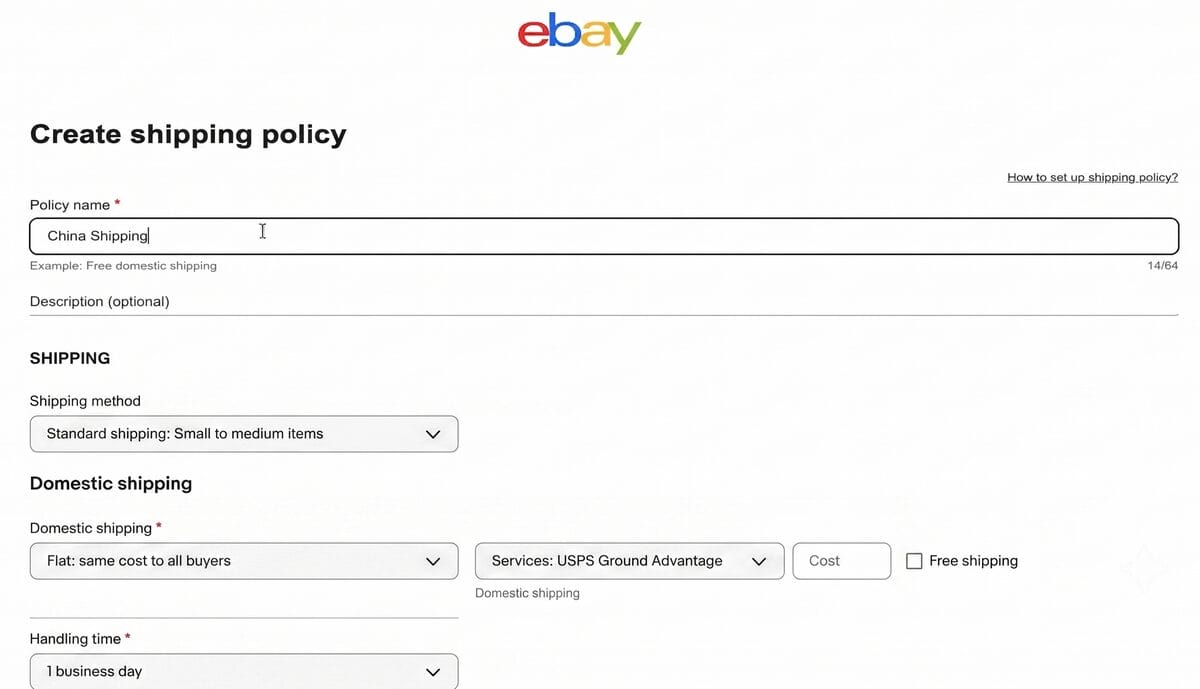
Before you list a single real product, you need three policies in place: shipping, returns, and payments. Think of these as templates. You build them once, and every listing you create from here on just plugs into them. Skip this step, and you’ll end up manually setting shipping times and return windows on every single product, which gets unmanageable fast.
Shipping policy
This is where you tell eBay how you ship and how long it takes. A few things I’ve learned the hard way over the years:
- Always offer free shipping on your default option. Even if your supplier charges you for it, roll that cost into your product price instead of charging the buyer separately. A listing with a shipping charge attached looks worse next to a competitor offering “free” shipping, even if the total price is identical.
- Be honest about handling time. I go with two business days on my own listings, even though most of my suppliers ship same-day or next-day. Why pad it? Because if you promise same-day and one order slips, that’s a late shipment on your record. Promise two days and ship early, and you’ve just made a customer happy instead of nervous.
- Create a separate policy for each shipping origin. If some of your products ship from the U.S. and others from China, don’t apply the same policy to them. The delivery windows are completely different, and setting unrealistic expectations is exactly how you end up with “item not received” complaints later.
📦 Supplier’s Tip: Never select a named carrier like USPS or FedEx in your policy unless you’re certain that’s genuinely how your supplier ships. If the buyer sees “USPS” in your listing and gets a tracking number from a different carrier, that mismatch alone can trigger a case against you.
Return policy
Whatever your supplier offers you, that’s what you offer your buyer. If your supplier gives free 30-day returns, pass that along. If they don’t accept returns at all, create a second “no returns” policy and use it for those specific listings.
One setting I want to flag because it trips people up: toggle on RMA (Return Merchandise Authorization) number in your account preferences. Skip this, and every time a buyer opens a return, eBay will automatically generate and charge you for a return label. With RMA number enabled, you stay in control of getting the actual label from your supplier and handling the return the way it’s supposed to work.
Payment policy
This one’s simple by comparison. Require immediate payment on “buy it now” purchases. There’s no reason to wait for a check or money order in a dropshipping business, and eBay’s managed payments system handles the rest automatically, whether you’re in the U.S. with direct deposit or elsewhere using Payoneer.
Step 4. Find Your Best Sellers: eBay Product Research
Even the best-looking eBay store won’t generate sales if you’re listing products nobody wants to buy. That’s why finding eBay best-selling products is one of the highest-impact skills you can develop as a dropshipper.
And here’s what I love about selling on eBay: you don’t have to trust your gut alone. The platform gives you access to real marketplace data, making it possible to analyze what’s already selling, at what price, and how frequently. Instead of reinventing the wheel, you’re learning from proven demand.
A practical research workflow usually looks like this:
- Discover opportunities. Use product research tools to uncover trending products and emerging categories before they become saturated.
- Validate demand. Search the product directly on eBay and filter by Sold Items to see recent sales, pricing, and overall market activity.
- Test multiple variations. Different colors, bundles, sizes, or price points often perform very differently, even within the same product category.
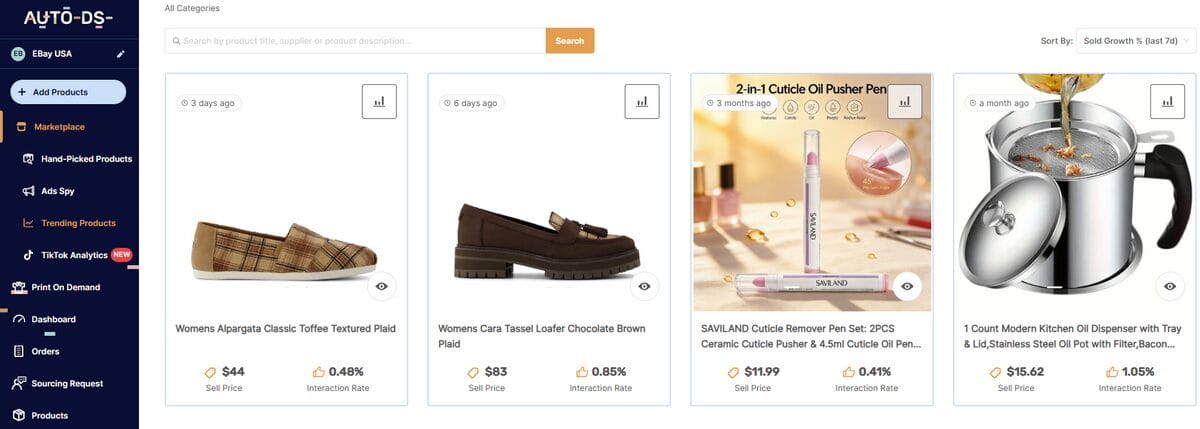
A platform like AutoDS speeds all of this up by putting the research tools in one place instead of a dozen browser tabs. A few I use constantly:
- Trending Products, to catch what’s gaining traction across suppliers and marketplaces before it’s everywhere.
- Hand-Picked Products, curated by AutoDS’s own e-commerce team, with sourcing, pricing, and demand insights already worked out for you.
- Ads Spy Tools, to analyze high-performing social media ads and identify products attracting strong engagement.
The strongest product ideas show up when a few signals line up at once. Something trending on social, selling consistently on eBay, with real margin left over once the fees are paid. That combination is usually worth betting on.
Step 5: Select an eBay Dropshipping Supplier
Once you’ve found a product worth testing, the next question is where you’ll source it from. As I covered earlier, choosing the right supplier is one of the most important steps for delivering a great customer experience and staying aligned with eBay’s dropshipping policy.
So before committing to any suppliers for dropshipping on eBay, make sure they check these boxes:
- Fast, trackable shipping: Tracking protects both you and your customer. It’s your proof of delivery when an order gets disputed.
- A clear return policy. Suppliers offering 14 to 30 days on returns make it a lot easier to handle issues without losing money or trust.
- Responsive communication. How fast they answer before you place an order tells you exactly how much support you’ll get once something actually goes wrong.
- Consistent product quality. Reliable products mean better reviews, fewer returns, and seller ratings that hold up over time.
- More than one sourcing option. Don’t build your business on a single supplier. Stock runs out, prices shift, shipping slows down. Having a backup ready means none of that becomes your emergency.
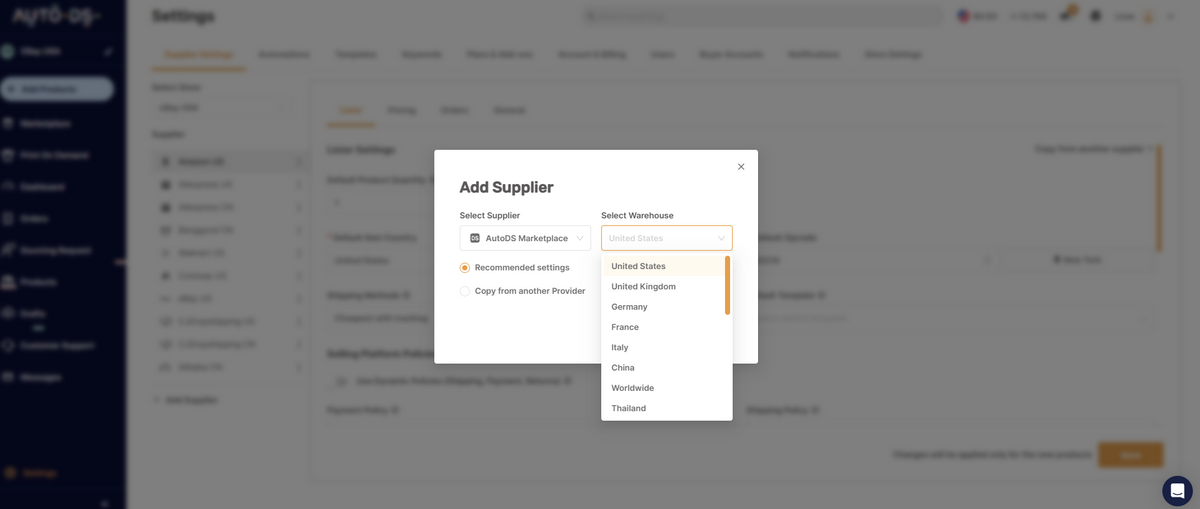
This is exactly where a platform like AutoDS earns its keep. Instead of betting everything on one source, you get access to a curated network of global and private suppliers, the ability to compare sourcing options for the same product, and the flexibility to switch suppliers as soon as inventory, pricing, or delivery conditions change.
That’s what a resilient sourcing strategy actually looks like. And it’s what keeps friction low as your store starts to scale.
Step 6: Import Your Products & Optimize Your Listings
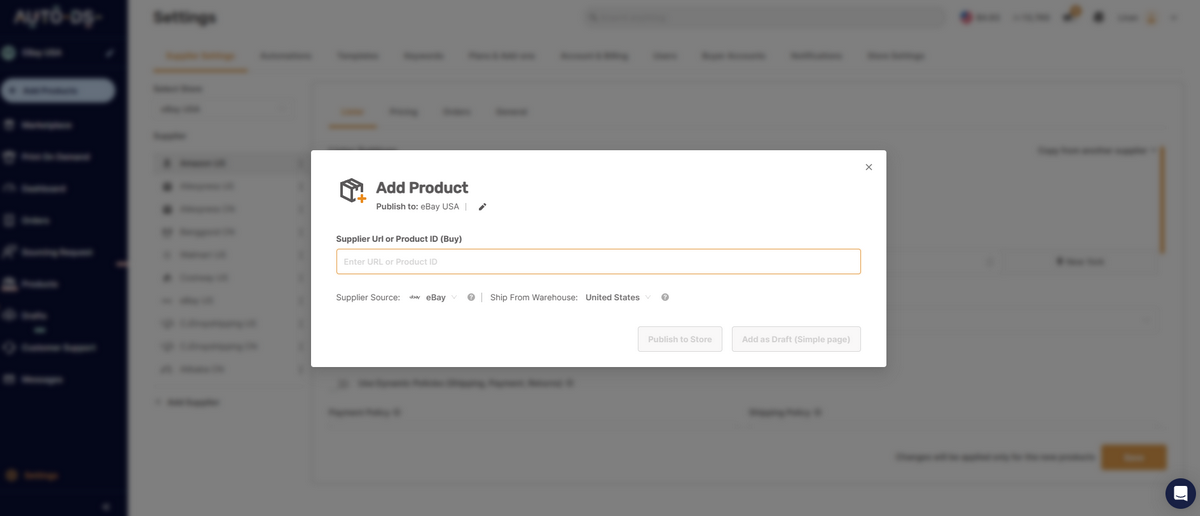
Once you’ve picked a product and a supplier, there are two ways to actually list an item on eBay: manually or automatically. I’ll be straight with you: manual works, but it doesn’t scale. Copying titles, descriptions, and images one field at a time from a supplier’s page is fine for your first ten warm-up listings. It’s not how you get to thousands.
Automation is where this actually gets efficient. With AutoDS, importing takes just a few clicks
1️⃣ Copy the supplier’s product URL.
2️⃣ Choose how you want to import it:
🅰️ Single Product Import when you’re testing one product at a time.
🅱️ Bulk Import when you want to add several at once and build your catalog faster.
3️⃣ Review the imported product in your drafts before it ever goes live.
Importing is only half the job. The real gains come from what you do to the listing before a buyer ever lays eyes on it. To make sure eBay listings are optimized for the Cassini algorithm, I always check:
- The title: Replace generic supplier titles with clear, keyword-rich product names that are easier for buyers to understand.
- The description. Highlight benefits instead of simply copying supplier specifications. AutoDS’s AI Product Title & Description Generator can quickly transform supplier copy into more polished, conversion-focused listings.
- Images: Strip any supplier branding, keep only the sharp photos, and put them in an order that tells a story instead of a random grab bag.
- Pricing: Run the numbers one more time before you publish. Make sure the price on the listing actually reflects the margin you set out to make.
Once all of that checks out, publish the listing. Within minutes, it can start showing up in eBay’s search results, in front of buyers who are already looking.
Step 7: Fulfill Customer Orders
Orders are going to start coming in, and how you handle them from here matters just as much as finding the product in the first place. There are a few ways to do this:
Manual fulfillment
Manual fulfillment means going to your supplier’s site yourself, entering the customer’s shipping details, and checking out, every single time. This is also where mistakes happen. I’ve sent packages to the wrong address more than once simply because I was moving fast and grabbed the wrong saved address. At five orders a day, that’s a minor annoyance. At fifty, it’s a real cost.
Automated fulfillment
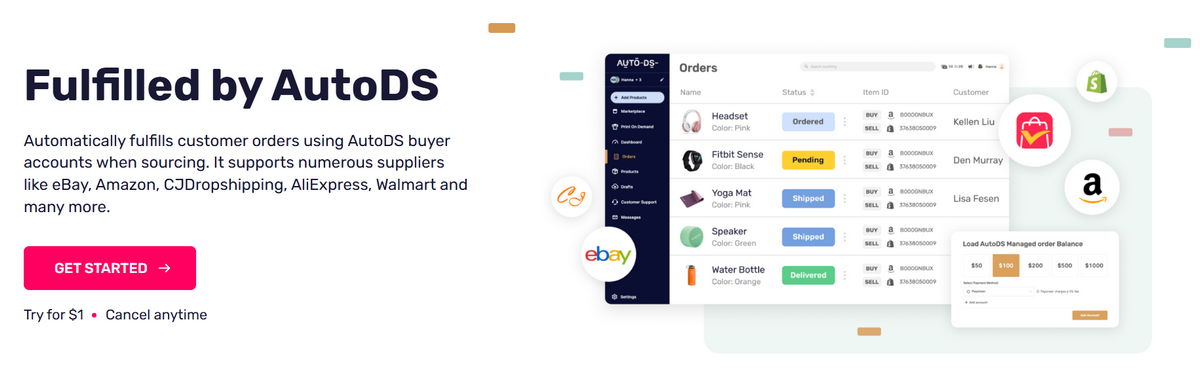
Automation removes most of those repetitive tasks by placing orders and updating tracking information for you. With AutoDS, you can choose between two fulfillment methods:
- Automatic orders, which uses your buyer account on the supplier’s site to place the order automatically the second a sale comes in.
- Fulfilled by AutoDS, which uses AutoDS’s own buyer accounts instead of yours.
This matters more than it sounds. Retailers like Amazon can lock a personal buyer account that starts shipping to a lot of different addresses in a short window, since that’s a clear dropshipping signal they don’t love. Running orders through AutoDS’s accounts sidesteps that risk entirely.
Once configured, orders are processed automatically, tracking numbers are synced back to eBay, and customers receive shipping updates without requiring manual intervention.
💡 Pro Tip: Whichever fulfillment method you choose, get in the habit of checking your orders page daily, not weekly. A slipped tracking upload is invisible until it isn’t. And it’s a lot easier to catch a two-day delay than to explain a two-week one to eBay’s seller metrics.
Step 8: Market Your Listings
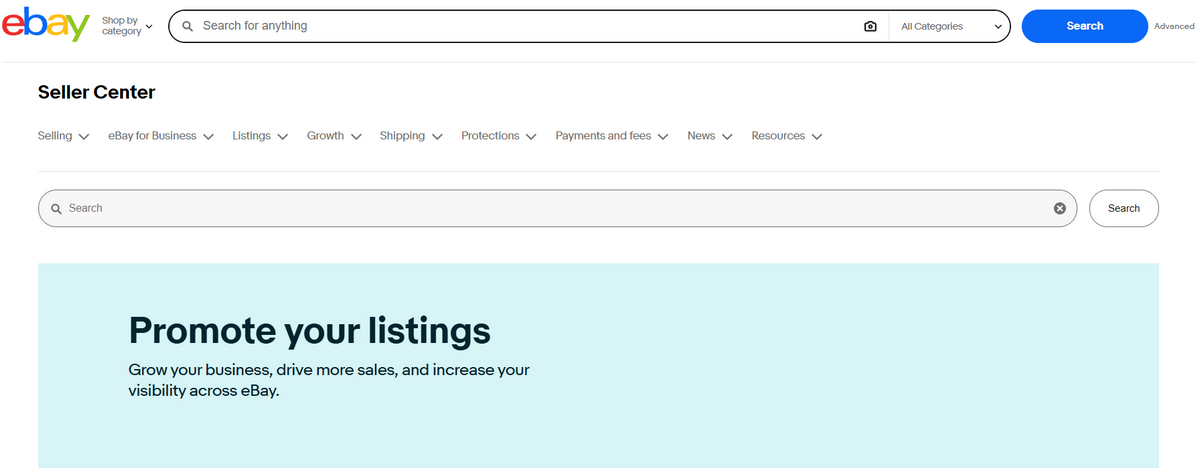
You don’t need to spend money on marketing to make consistent sales on eBay.
eBay’s Promoted Listings General is my actual go-to. You only pay a percentage if the promotion leads to a sale. I run mine at a fixed 5%, continuously, across my whole catalog. There’s also Promoted Listings Priority, which charges a daily budget whether or not it converts; I tried it, barely broke even, and don’t bother anymore.
The other half of my strategy costs nothing: sending offers. When buyers watch a listing without buying, eBay lets you send them a discount directly. Some take it as-is; others counter, and if the number still clears a healthy margin, I’ll usually just accept rather than haggle over a few dollars.
Buyer groups push this further, letting you segment past customers and followers and send each group an automated coupon (I run a standing 5% “welcome back” for anyone who bought six-plus months ago).
What I skip: social media marketing and store newsletters through eBay’s built-in tools. They work, but they demand real manual effort for an automated store, and that time is better spent on product research.
Step 9: Maintain a High Seller Level
Your seller level is the single biggest indicator of whether eBay trusts you. There are three tiers: below standard, above standard, and top rated. You want to live somewhere between the last two. Below standard is where eBay starts watching closely, and it’s avoidable if you handle the basics I’ve already walked you through.
eBay checks a handful of numbers to decide where you land:
- Transaction defect rate: Did you cancel orders you couldn’t fulfill, or lose disputes that had to be settled by eBay stepping in? On my own stores, this sits at 0% because I never sell what I don’t actually have access to, and I never let a case escalate to eBay without trackable proof of delivery.
- Late shipment rate: Did your tracking upload within your stated handling time? Keep this under 3%, and you’re in top-rated territory. Automation handles most of this for you, since orders get processed and tracked the moment they come in.
- Cases closed without seller resolution: Meaning you argued with a buyer instead of resolving it yourselves, and eBay had to decide. Zero is the target, and it’s entirely avoidable if you respond to cases before the deadline.
- Tracking uploaded on time and validated: Not just fast, but real, trackable tracking. I’ve had a supplier slow down on me before and watched this number dip; the fix was simply switching to a faster supplier, not panicking.
Here’s the thing worth remembering through all of this: your job isn’t to worry about every number daily. It’s to build the habits (fast shipping, honest handling times, real tracking, quick responses) that keep these numbers healthy on their own.
Most importantly, remember that maintaining a high seller level is really about delivering a great customer experience. Delays, damaged products, or supplier issues can happen in any business. What buyers remember is how you respond. Clear communication, honest updates, and a willingness to solve problems quickly build trust, reduce disputes, and increase the likelihood that customers will buy from you again.
Step 10: Automate & Scale Your Business
The systems that work fine for ten products rarely survive at a thousand. As your store grows, automation becomes what actually protects your margins, saves your time, and keeps things running tight.
Here’s where I’d focus first:
- Dynamic pricing: Instead of manually adjusting prices every time something shifts, set rules that respond automatically to supplier costs, market conditions, or the margin you’re aiming for.
- Stock and price monitoring: Few things hurt your seller reputation faster than selling something that’s already gone. AutoDS automatically syncs supplier stock and price changes to your eBay listings, so you’re not left explaining a cancellation you didn’t see coming.
- Customer communication: Automated order confirmations, shipping updates, and delivery notifications keep buyers in the loop without you lifting a finger.
- Bulk product management: Editing titles, descriptions, or pricing for one listing at a time works fine for a few products, but falls apart quickly after that. Bulk tools let you optimize dozens or hundreds of listings in the time it used to take for one.
Don’t rush to expand before your operations are actually working. Whether your next move is bringing on a virtual assistant or opening a second store, it’s a lot easier to hand off pieces of your business once you’ve built processes that repeat reliably — and once you understand, from the inside out, exactly how your store runs.
Tips For eBay Dropshipping
If you’ve made it this far, you already have everything you need. But if I had to boil down almost a decade of doing this into the six things that actually move the needle, it’d be these:
Product research never stops
The store that wins in six months is the one that keeps validating new products every single week, long after the initial excitement wears off. Product research isn’t a phase you complete before “real” selling begins. It’s the ongoing engine that keeps your catalog from going stale.
I still spend a chunk of my week doing exactly what I walked you through earlier in this guide: scrolling trending hubs, checking sold listings, running the sales history hack. Sellers who stop doing this once they’ve got a few winners are the ones who watch those winners quietly die a few months later with nothing lined up to replace them.
Customer service is a competitive advantage, not a chore
This is the part of the business that feels the least like “growth” and matters the most for it. A 99% positive feedback score doesn’t happen from having zero problems. It happens from handling the problems you do have before they turn into a bad review.
Anyone can sell a product. What separates a store people come back to from one they forget is how fast and how well you handle when something needs attention. Answer quickly, resolve fairly, and you’re not just closing one case. You’re building a reputation that sells every listing after it.
Fast shipping and easy returns aren’t optional extras
These are literally what your seller metrics are measuring from day one. Your late shipment rate, your return rate, your seller level: all of it traces back to whether your suppliers ship fast and whether you make returns painless instead of a fight.
Get this right early, and it compounds. A store with clean metrics gets more visibility in eBay’s search results, which means more organic traffic, which means you need to spend less on promotion to get the same sales. Get it wrong, and you’re fighting an uphill battle no amount of good product research can fix.
Know your fees cold
If you’re pricing a dropshipping product without knowing your exact break-even (final value fee, category percentage, shipping cost, everything), you’re gambling with extra steps.
This doesn’t need to be complicated. Once you’ve built your break-even math a few times, it becomes second nature, and tools like AutoDS’s fee calculators do the hard job anyway. The only real mistake is skipping this step entirely and finding out your margin after the fact.
Never depend on one supplier
The moment your entire catalog runs through a single source, their bad week becomes your bad month. Suppliers go out of stock, raise prices without warning, or slow down around every major holiday.
This is exactly why I always vet two or three suppliers for anything I’m serious about selling, even if I only launch with one at first. It costs nothing to know what your plan B is before you need one, and everything to scramble for one after an order’s already been placed.
Automate the repetition, not the judgment
Let the software handle pricing adjustments, tracking updates, and buyer messages. The repetitive work that doesn’t need your judgment, just your consistency. What it shouldn’t replace is the thinking: which products to test, which suppliers to trust, which risks are actually worth taking.
Sellers who automate everything blindly and stop paying attention eventually get burned by something they didn’t catch. Sellers who never automate anything burn out trying to do it all by hand. The sweet spot is automating the busywork so your actual time goes toward the one thing software still can’t do for you.
Frequently Asked Questions
Is eBay dropshipping profitable in 2027?
Yes, eBay dropshipping is still profitable in 2027, with typical net margins of 10–25% per order for sellers who source from wholesale suppliers and price with fees in mind. Profitability comes down to three levers: the product itself, your total eBay fees, and what you’re actually paying your supplier. The sellers who best protect their margins are the ones automating repricing and stock monitoring, so a listing never quietly sells below cost.
Is dropshipping legal on eBay?
Yes. Dropshipping is legal and fully permitted on eBay, as long as you’re fulfilling orders from wholesale suppliers. What eBay won’t allow is buying from another retailer or marketplace and having them ship straight to your buyer. That crosses eBay’s dropshipping policy and can get your account restricted, so it’s worth sourcing correctly from the start.
How much money do I need to start dropshipping on eBay?
You can start dropshipping on eBay with $0 upfront. eBay gives you 250 free listings, and you’re only paying for products after a customer has already paid you. That said, realistically budget $50–$200 for your first month to cover final value fees as sales come in, and consider an eBay Store subscription (starting at $4.95/month on annual billing) once you outgrow the free listing allowance.
How long does it take to make your first sale dropshipping on eBay?
Most new sellers make their first sale within 1–4 weeks of listing consistently. New accounts start under selling limits (typically around 10 items or $500), so early momentum comes down to listing a few well-researched products every couple of days, writing keyword-rich titles, and pricing competitively. From there, sales velocity tends to compound as eBay raises your limits and your seller metrics build a track record.
Is starting a dropshipping business still worth it in 2027?
Yes, starting a dropshipping business is still worth it in 2027 for sellers willing to approach it strategically. Success depends on choosing the right niche, validating products, and using automation to streamline day-to-day operations as your business grows.
Do I need a seller license to dropship on eBay?
No, you don’t need a seller’s license to dropship on eBay. However, you must comply with eBay’s policies, and business registration requirements may vary depending on your country or local regulations.
What are eBay’s current dropshipping policies and rules?
eBay’s current dropshipping policy allows you to fulfill orders through wholesale or private suppliers. However, purchasing products from another retailer or marketplace and shipping them directly to customers is prohibited and may lead to account penalties.
How do I set up an eBay store for dropshipping?
To set up an eBay store for dropshipping, create a seller account, configure your payment and shipping settings, choose reliable suppliers, and begin listing products that comply with eBay’s policies. As your business grows, you can also consider an eBay Store subscription for additional selling tools.
What are the best product categories for eBay dropshipping?
The best product categories for eBay dropshipping are those with steady demand and reliable suppliers. Home improvement, pet supplies, home décor, automotive accessories, fitness products, and tools are all popular options for many sellers.
How do I handle eBay’s fast shipping requirements?
You can meet eBay’s shipping expectations by working with suppliers that offer fast processing times and reliable tracking. Just as importantly, provide accurate delivery estimates so customers know exactly what to expect.
What tools can automate eBay dropshipping operations?
Dropshipping automation tools can simplify tasks like product importing, inventory synchronization, price monitoring, order fulfillment, and tracking updates. Platforms like AutoDS combine these features in one place, helping sellers save time and reduce manual work.
How do I maintain good seller ratings while dropshipping on eBay?
To maintain good seller ratings on eBay, provide accurate shipping estimates, respond promptly to customer messages, and work with reliable suppliers that consistently deliver orders on time. Strong customer service plays a key role in maintaining positive seller metrics.
What are eBay’s fees for dropshipping sellers?
eBay dropshipping sellers typically pay insertion fees once they exceed their free listing allowance, plus a final value fee on each sale. Depending on how you sell, you may also pay for an eBay Store subscription or optional promoted listings. For more information, check our eBay Fees guide.
Start Dropshipping On eBay With AutoDS
eBay dropshipping in 2027 comes down to the same fundamentals it always has: source honestly, price with your fees in mind, ship fast, and treat your customers like you’d want to be treated if you were on the other end of that package.
None of this requires a warehouse, a huge budget, or years of experience before you make your first sale. What it requires is being patient with your account in the early days and staying consistent with product research long after the initial excitement wears off. That’s really all there is to it at this stage.
The best part? You don’t have to do it all manually. AutoDS exists to take care of the repetitive part (importing, pricing, tracking) so your time goes toward the one thing that actually moves the needle: scaling your business.
📈 Spend less time managing your eBay store and more time growing it. Try AutoDS for $1 and automate your entire dropshipping workflow.
Why stop here when there’s more to explore? Keep your learning mode on with the following reads: