


AI is quickly reshaping how dropshipping businesses operate. Tasks that once required hours of manual work (like product research, pricing adjustments, listing creation, and order management) can now be handled with intelligent automation.
AI dropshipping means using artificial intelligence to analyze data, automate repetitive tasks, and assist decision-making across the entire dropshipping workflow. From finding trending products to generating product descriptions or monitoring prices, AI tools help sellers analyze data and manage store operations more effectively.
Platforms like AutoDS already integrate these capabilities directly into the selling workflow. AutoDS provides AI-powered product research, listing generation, pricing automation, and store management tools that help dropshippers run their businesses with far less manual work.
This guide explains how AI dropshipping works, which tasks AI actually improves, where human judgment still matters, and how the next wave of AI-powered shopping may transform the entire e-commerce landscape.
AI dropshipping uses artificial intelligence to analyze data, automate repetitive tasks, and support decision-making across the dropshipping workflow.
AI tools can improve product research, listing creation, pricing monitoring, marketing ideation, and operational automation, helping sellers manage stores more effectively.
Successful AI dropshipping still requires human judgment for decisions like niche selection, supplier validation, branding, and marketing strategy.
AutoDS integrates AI-powered product discovery, listing generation, supplier monitoring, and automation tools that help dropshippers manage store operations from a single platform.
What Is AI Dropshipping?

AI dropshipping is the use of artificial intelligence to automate, analyze, and optimize a dropshipping business’s operations.
Instead of relying entirely on manual research and repetitive workflows, sellers can use AI tools to process large amounts of market data and make faster decisions. Algorithms can identify product trends, generate store content, monitor price changes, and even assist with customer support.
AI can assist with many of the tasks that normally slow down new sellers:
- identifying products with strong demand
- generating product titles and descriptions
- analyzing competitor pricing
- monitoring supplier inventory changes
- responding to common customer questions
- optimizing marketing content
That said, AI does not replace strategy. Successful dropshipping businesses still require human decisions around branding, niche selection, and long-term growth.
In practice, AI functions as a decision-support layer that helps sellers analyze data and automate repetitive tasks.
Curious how AI can simplify dropshipping? 🤖 Start your $1 AutoDS trial and explore AI-powered dropshipping.
How AI Dropshipping Works
AI dropshipping works by combining machine learning models, automation tools, and large data analysis to improve each stage of the dropshipping workflow.
Traditional dropshipping requires sellers to manually perform many repetitive tasks. AI tools reduce that workload by analyzing patterns, generating content, and triggering automated actions when certain conditions are met.
As AI tools continue evolving, their role in e-commerce is expanding beyond automation. Emerging technologies like AI shopping assistants and agentic commerce systems may soon influence how customers discover and purchase products online.
Understanding these shifts is essential for anyone planning to build a modern dropshipping business.
How to use AI for dropshipping
Running a dropshipping store involves many moving parts: finding products, building a store, writing listings, managing suppliers, fulfilling orders, and communicating with customers. Artificial intelligence can assist in nearly every one of these steps.
Instead of replacing the seller, AI functions more like a smart operational layer, speeding up repetitive work and highlighting opportunities that would otherwise take hours to discover. When used correctly, AI helps sellers identify opportunities earlier, automate routine dropshipping operations, and manage store performance with greater consistency.
Below is a closer look at how AI fits into each stage of the modern dropshipping process.
🔍 AI for Product Research
Product research has always been one of the most time-consuming parts of dropshipping. Sellers traditionally needed to scan marketplaces, analyze competitors, and manually track trends to identify products with strong demand.
AI tools simplify this process by processing large volumes of marketplace data and identifying patterns that signal potential demand. Algorithms can analyze sales velocity, product engagement, seasonal search trends, and pricing dynamics across different platforms.
Instead of browsing thousands of listings, sellers can focus on a shortlist of products that data suggests may perform well. This narrows the search to products that already show meaningful demand signals.
🔍 Research Tip: Even with AI insights, always validate a product manually. Look at competitor ads, customer reviews, and shipping expectations before committing to a product.
⚒️ AI for Store Creation and Setup
Launching a dropshipping store used to involve multiple steps: selecting a theme, creating pages, importing products, writing descriptions, and configuring store settings.
AI-powered store builders dramatically reduce the time required to launch a new store. These tools can generate store structures, product collections, basic branding elements, and even initial product selections based on a niche or category.
The goal is not to create a perfect store instantly, but to provide a fully functional starting point that sellers can refine.
✍️ AI for Product Pages and SEO Content
Creating effective product pages requires writing titles, descriptions, and feature highlights that attract both search engines and customers. This process becomes time-consuming when managing dozens or hundreds of products.
Generative AI eCommerce tools can produce product descriptions, feature lists, and optimized titles using product attributes and competitive data. These tools help sellers generate structured listings that are easier for both shoppers and search algorithms to understand.
In many cases, AI can also suggest keywords, highlight product benefits, and organize information in a way that improves readability and conversion potential.
It’s always smart to look for an AI title and description generator designed specifically for dropshipping listings. AutoDS uses AI models to generate product titles and descriptions that help sellers publish optimized listings faster while maintaining consistent formatting across their store.
💡 Pro Tip: AI-generated descriptions work best when edited by a human. Add brand voice, emotional hooks, and real product insights to make listings more persuasive.
💰 AI for Pricing, Inventory, and Supplier Monitoring
Dropshipping sellers depend heavily on external suppliers, which means prices and stock levels can change at any time. Managing these updates manually is difficult, especially as a store grows.
AI-assisted automation tools monitor supplier listings and trigger updates when changes occur. If a supplier modifies a price or runs out of stock, automation rules can adjust the store listing accordingly.
These systems help maintain accurate product data and protect profit margins when supplier conditions change.
Tools like AutoDS provide automated monitoring for supplier price and inventory changes. It tracks supplier listings and automatically updates product prices and stock levels to keep store data synchronized.
🚚 AI for Order Management and Fulfillment
Order fulfillment is the operational backbone of dropshipping. Once a customer places an order, the seller must send the order to the supplier, process payment, and track shipping updates.
Automation tools can handle much of this workflow by transmitting order information directly to suppliers and automatically updating tracking details.
While this stage relies heavily on automation rather than pure AI generation, intelligent systems help streamline the process and reduce the chances of human error.
📦 Supplier’s Tip: Always test a supplier with a small number of orders first to evaluate shipping reliability and product quality.
📱 AI for Customer Support
Customer communication can quickly become overwhelming as a store scales. Questions about shipping times, product details, or order status are common in e-commerce.
AI-powered chatbots and support assistants can answer many routine questions automatically. These tools can provide shipping updates, explain return policies, and respond to frequently asked questions.
By handling repetitive inquiries, AI systems allow sellers to focus on more complex customer interactions that require personal attention.
🎨 AI for Marketing and Ad Creative
Marketing is where many dropshipping stores struggle. Creating ad copy, product hooks, and creative visuals often requires multiple rounds of testing.
AI tools can generate ad copy variations, product hooks, and marketing angles based on product features and target audiences. Some systems can even suggest creative directions for videos or product visuals.
These tools help sellers produce marketing assets faster and experiment with more campaign variations.
📢 Marketing Tip: AI can generate ideas quickly, but high-performing ads usually come from testing multiple creative angles and analyzing real campaign data.
What AI Can Actually Help With in Dropshipping
Artificial intelligence works best when it handles data-heavy and repetitive tasks. In dropshipping, many daily operations fall into that category, which is why AI tools can significantly improve efficiency across the business workflow.
Let’s review some of the areas where AI currently delivers the strongest results.
- 💠 Product discovery and trend analysis. AI tools can scan marketplace data, analyze engagement signals, and identify products gaining traction. Instead of manually browsing hundreds of listings, sellers can quickly focus on products that show demand signals such as rising sales velocity, increasing search volume, or strong engagement metrics.
- 💠 Listing creation and content generation. Publishing product pages usually involves writing titles, descriptions, and feature highlights. When managing dozens of listings, this becomes time-consuming. AI content tools can generate structured product information based on product attributes and competitive data.
- 💠 Operational automation. Dropshipping relies heavily on suppliers, which means prices and stock levels can change frequently. AI-powered automation tools help monitor supplier listings and trigger updates when changes occur.
- 💠 Marketing assistance. AI can also support marketing workflows by generating creative ideas and campaign variations.
Where AI Still Needs Human Judgment
Even though AI tools can automate many operational tasks, dropshipping still requires strategic decision-making. Certain aspects of running an online store rely on creativity, long-term planning, and customer understanding.
These areas benefit most from human involvement.
🧑💻 Niche selection
Choosing the right niche involves understanding long-term demand, audience behavior, and market positioning.
AI tools can highlight trending categories, but deciding whether a niche can support a sustainable brand requires human evaluation.
🧑💻 Brand identity and positioning
AI can generate product descriptions or store layouts, but building a brand requires:
- visual identity
- consistent tone of voice
- emotional storytelling
- long-term differentiation
These elements are still shaped primarily by human creativity.
🧑💻 Product validation
AI may detect products with strong demand signals, but sellers still need to confirm important details manually, such as:
- product quality
- supplier reliability
- shipping times
- return policies
- customer expectations
🧑💻 Customer relationships
AI chatbots can answer routine questions about shipping or policies, but complex customer interactions still require human empathy and judgment.
Handling complaints, refunds, and unusual situations often benefits from a personal response.
Best Ways To Use AI for Dropshipping in 2026
The most effective dropshipping businesses treat AI as a powerful assistant, not a fully autonomous system.
Instead of relying on automation for everything, successful sellers combine AI insights with their own market knowledge.
Below are some practical ways to integrate AI into a modern dropshipping workflow.
Use AI to speed up product research
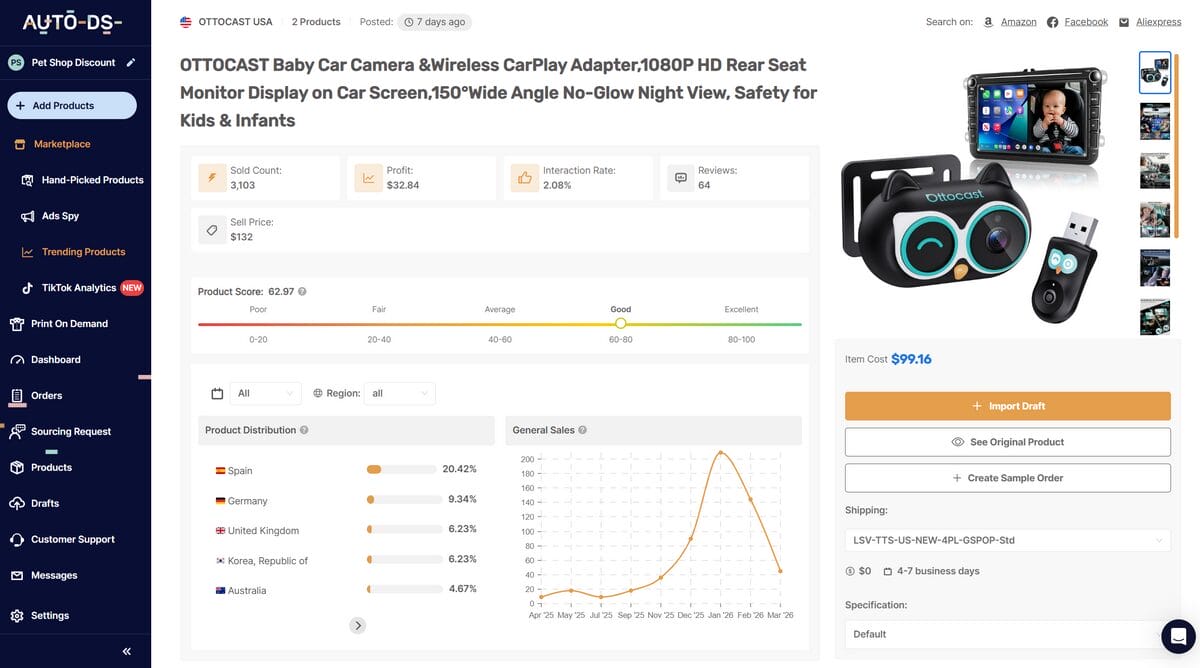
AI tools can analyze large product databases and highlight items showing early demand signals.
A smart workflow looks like this:
- Use AI to identify trending products
- Analyze competitor ads and engagement manually
- Validate suppliers and shipping conditions
- test the product with small ad campaigns
This combination of AI discovery and human validation improves product selection.
Still searching for winning products manually? AutoDS analyzes product data and highlights trending items so you can focus on testing products. → Start your $1 trial now.
Use AI to accelerate store setup
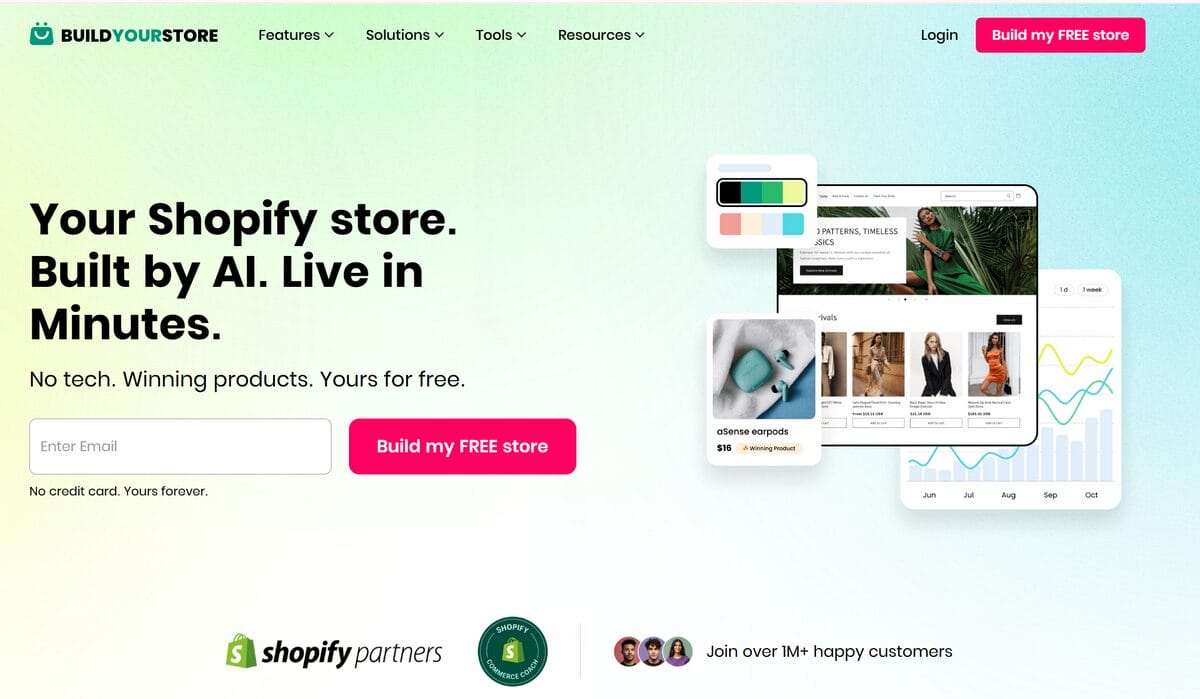
AI-powered store builders can create a functional store structure quickly.
These systems typically generate:
- store layout
- initial product listings
- product collections
- basic branding elements
Use AI to generate and test marketing ideas
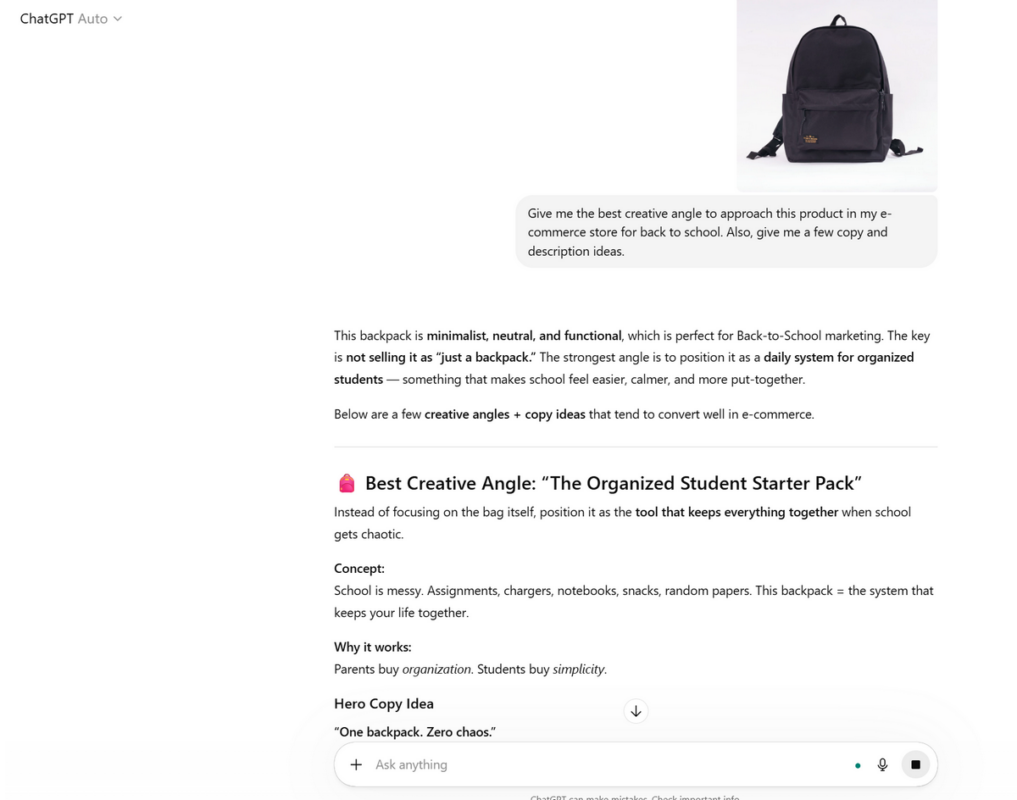
AI tools are extremely useful for rapid idea generation in marketing.
They can quickly produce:
- ad copy variations
- product angles
- hook ideas for short-form video ads
- social media captions
Instead of spending hours brainstorming campaigns, sellers can generate multiple concepts instantly and test them with real ad data.
Use AI for operational automation
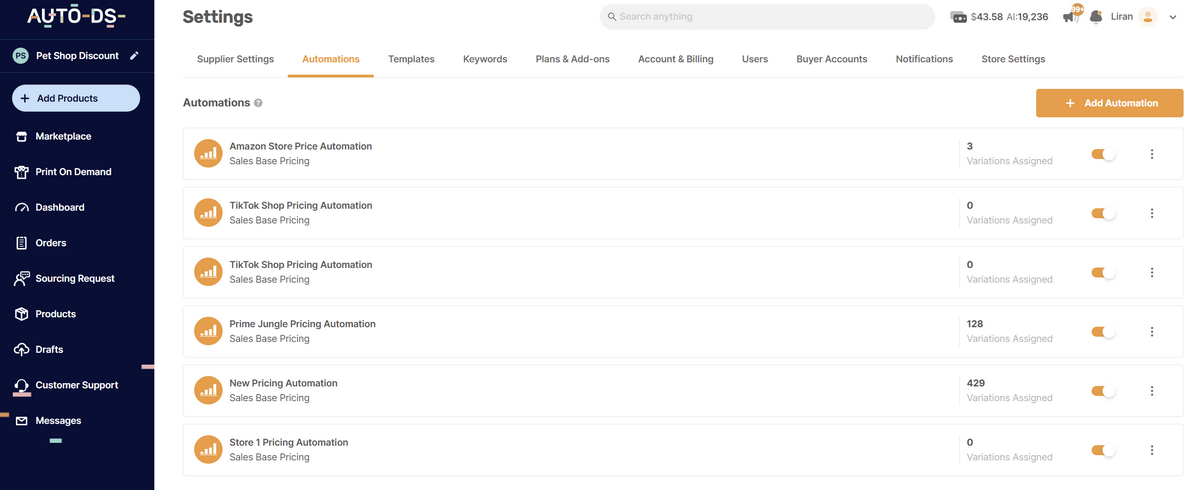
Once a store begins generating orders, operational efficiency becomes critical.
Automation tools help manage tasks such as:
- supplier price changes
- inventory updates
- order routing
- tracking updates
AI Dropshipping Tools and Categories
AI dropshipping does not rely on a single type of tool. Instead, it involves a growing ecosystem of AI-powered platforms that support different parts of the e-commerce workflow. Some tools focus on product discovery, others help with store creation or marketing, and some platforms combine several AI capabilities into a single system.
AutoDS belongs to this latter category. AutoDS integrates AI-powered product research, listing optimization, automation, and fulfillment tools that allow dropshippers to manage multiple operational tasks from a single dashboard. We’ll discuss them in more detail later.
Below are the main categories of AI tools for dropshipping.
🔍 AI product research tools
Product research platforms use AI and data analysis to identify products with market demand potential.
These tools analyze marketplace signals such as:
- sales trends
- engagement metrics
- pricing changes
- product popularity across platforms
Their goal is to surface products showing early demand indicators across multiple marketplaces.
Many dropshippers use these tools as a starting point for product validation, combining AI insights with manual research.
⚒️ AI store builders
Launching a dropshipping store used to require multiple manual steps, including theme selection, product imports, and page configuration.
AI store builders simplify this process by generating a store structure automatically.
Typical features include:
- automatic store layouts
- pre-selected product collections
- generated product listings
- basic branding setup
💬 AI content and listing generators
Content generation tools help sellers produce product listings and marketing text more efficiently.
These tools can generate:
- product titles
- product descriptions
- feature highlights
- SEO keywords
- ad copy variations
🎨 AI marketing tools
Marketing-focused AI tools help sellers generate ideas for ads and promotional campaigns.
Common AI-assisted marketing features include:
- ad copy generation
- product hooks and messaging angles
- social media captions
- campaign testing ideas
🤖 AI automation and operations platforms
Automation platforms combine AI insights with operational tools to streamline daily store management.
Typical capabilities include:
- price monitoring
- inventory synchronization
- supplier tracking
- automated order processing
- shipping tracking updates
AutoDS operates in this category by connecting product sourcing, automation rules, and fulfillment systems. AutoDS centralizes supplier monitoring, product management, and operational automation so dropshippers can scale their stores efficiently.
📦 Supplier’s Tip: When using automated supplier monitoring, always verify the reliability of new suppliers before scaling order volume.
📲 AI customer support tools
Customer support platforms increasingly use AI chatbots to answer common questions and handle routine support requests.
These systems can assist with:
- order tracking inquiries
- shipping updates
- product questions
- return policy explanations
While these tools reduce support workload, complex customer issues still require human responses.
💎 All-in-one AI dropshipping platforms
Some platforms combine multiple AI features into a single system, helping sellers manage their stores without switching between multiple tools.
These platforms may include:
- product research tools
- listing generators
- supplier integrations
- automation systems
- fulfillment management
Next, we’ll talk about the number one all-in-one dropshipping automation solution out there: AutoDS.
How AutoDS Supports AI Dropshipping Workflows
Running a dropshipping business involves multiple stages: product discovery, store creation, listing optimization, supplier management, fulfillment, and marketing. Many AI tools address only one part of this workflow. AutoDS takes a different approach by integrating AI capabilities directly into the operational system that powers the store.
AutoDS combines AI-powered research, listing generation, and automation tools that help dropshippers manage their stores more efficiently from a single dashboard. Instead of switching between separate tools for research, content creation, and operations, sellers can manage the entire workflow within one platform.
Below are some of the key ways AutoDS supports AI-powered dropshipping workflows.
AI product discovery and research



Finding profitable products remains one of the most important steps in dropshipping. AutoDS provides product discovery tools that help sellers identify products with strong market potential.
These tools help sellers:
- explore trending products across multiple suppliers
- analyze product demand signals
- import products directly into their store
By combining product research with direct product importing, sellers can move quickly from product discovery to store listing.
AI product titles and descriptions
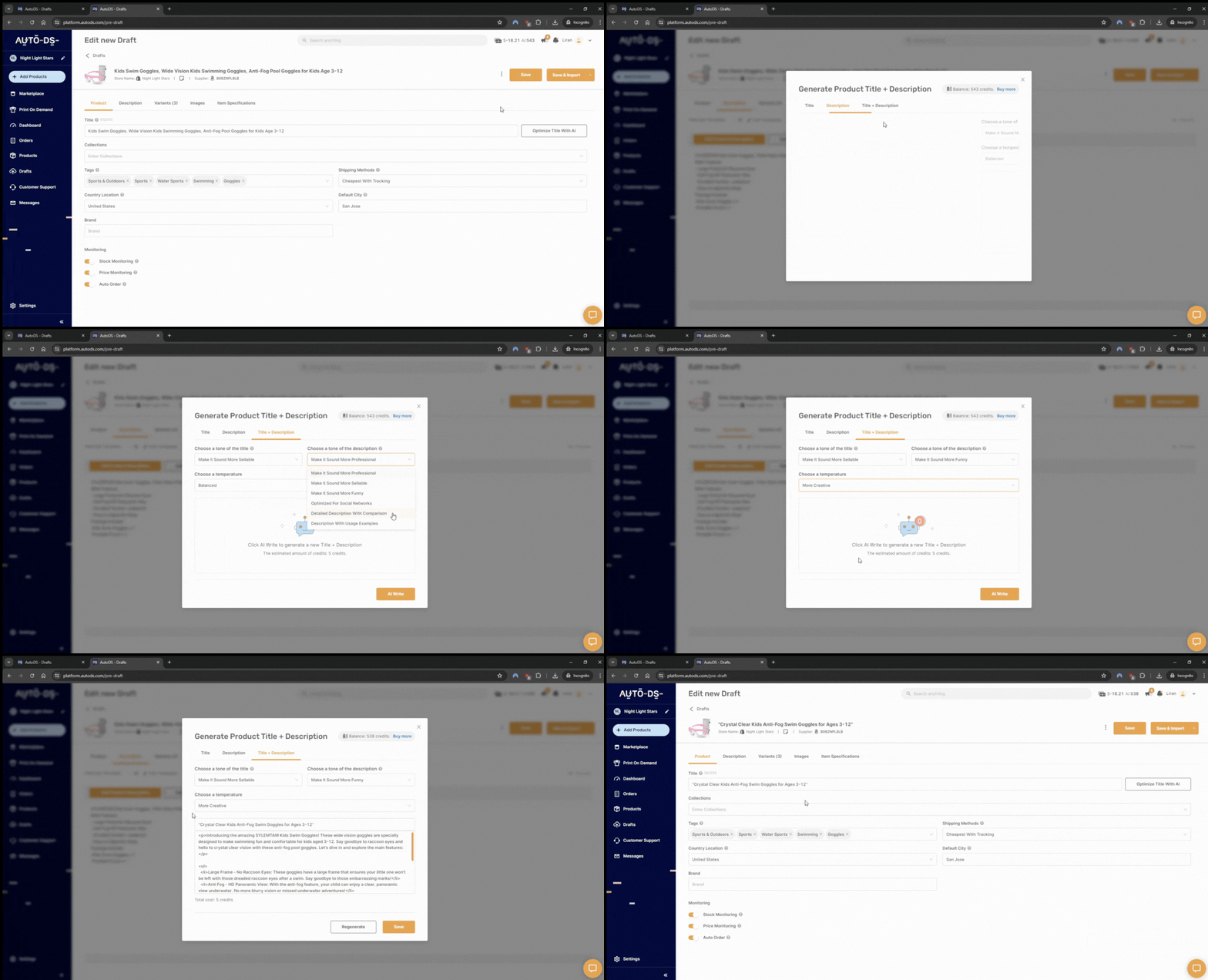
Creating product listings manually can take a significant amount of time, especially when testing multiple products.
AutoDS includes an AI title and description generator that helps sellers produce structured product listings faster. The tool uses product information to generate optimized titles, descriptions, and feature highlights that can be edited before publishing.
This allows sellers to publish product pages with a consistent structure and formatting across their store.
AI-powered store generation
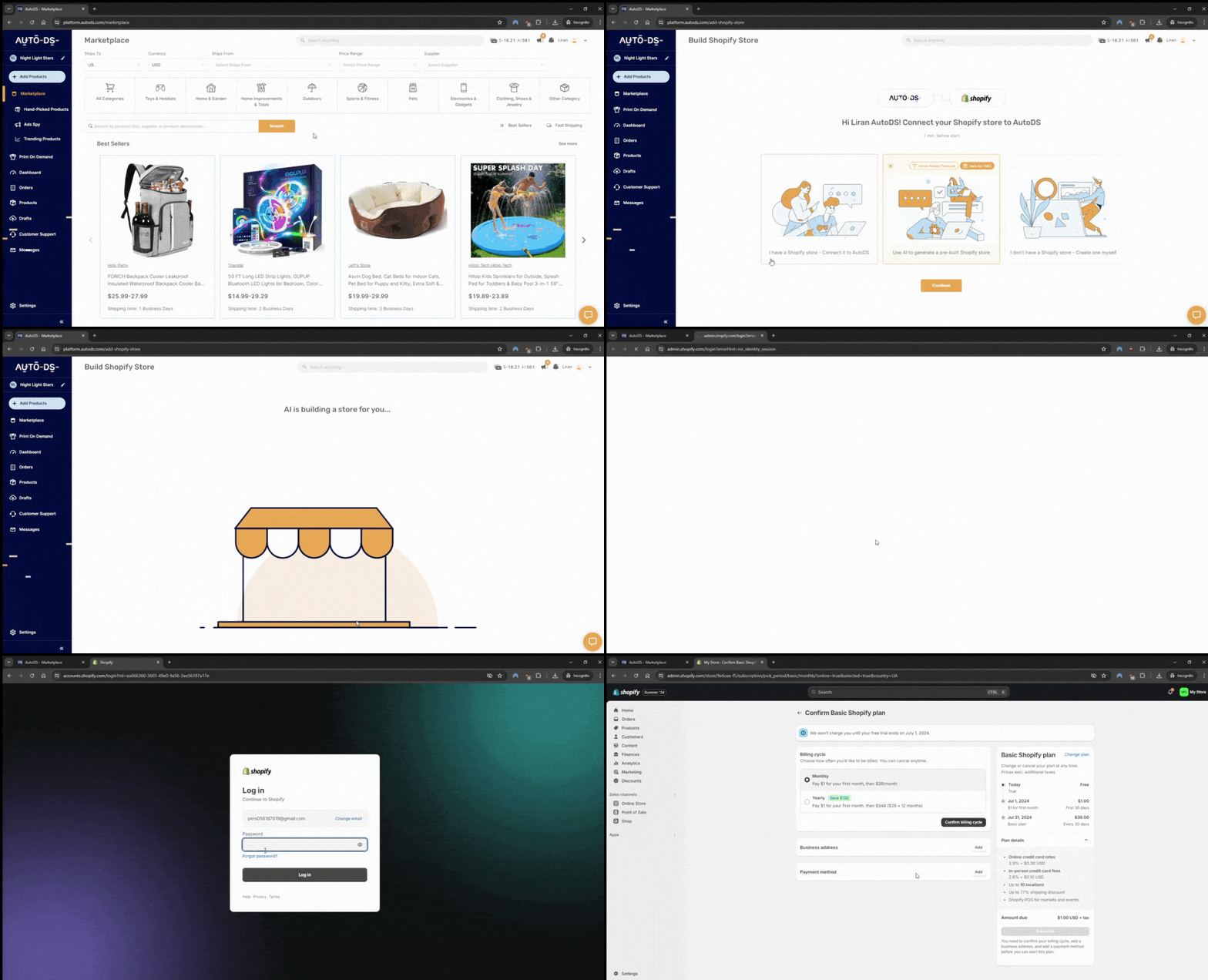
Launching a new store often involves many setup steps. AutoDS simplifies this process through its AI-powered Shopify store builder.
This feature helps sellers generate a functional store environment that includes:
- store layout and structure
- product imports
- collections and categories
- operational settings
AutoDS generates ready-to-launch store structures that allow sellers to start testing products faster.
Supplier monitoring and operational automation
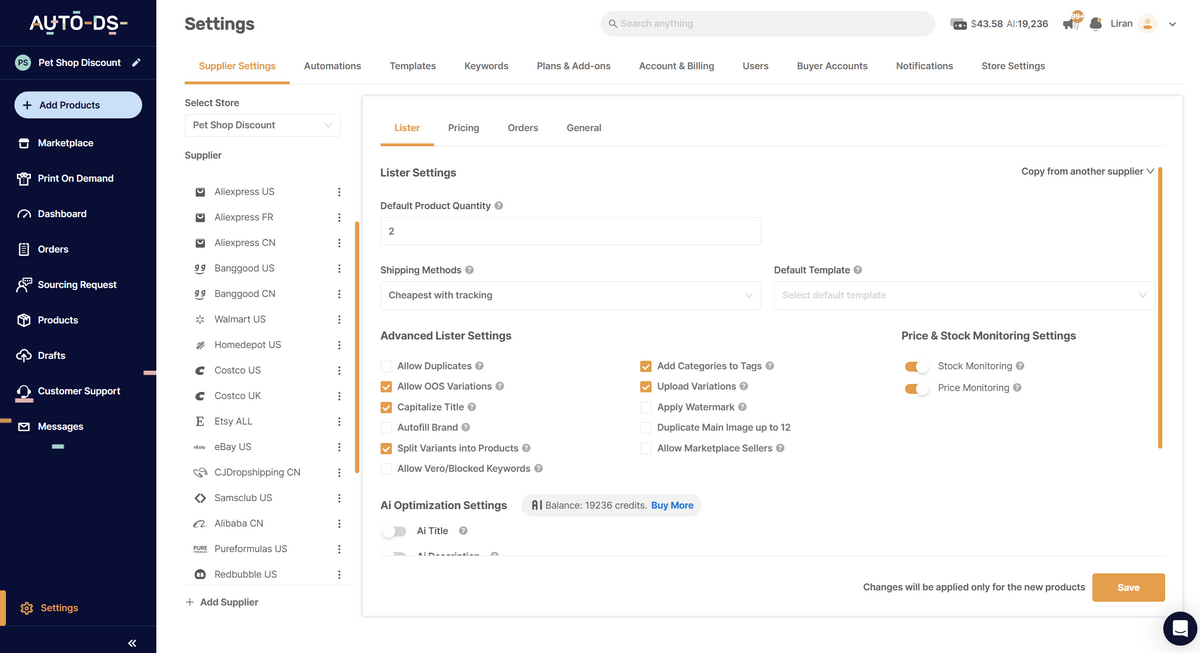
Dropshipping stores depend heavily on supplier data, such as pricing and inventory levels. Changes in these factors can affect profitability and customer experience.
AutoDS automates supplier monitoring and operational updates by tracking supplier listings and synchronizing store data.
Key automation capabilities include:
- supplier price monitoring
- stock level synchronization
- automated product updates
- order processing automation
- shipping tracking updates
💰 Financial Tip: Setting automated pricing rules helps protect margins when supplier costs change.
Order fulfillment and tracking

Order fulfillment can become complex as a store grows. AutoDS simplifies this process by connecting store orders with supplier fulfillment systems.
Once a customer places an order, the platform helps transmit the order to the supplier and manage tracking updates from the same interface.
This centralized approach allows sellers to monitor orders, fulfillment status, and shipping updates without switching between multiple systems.
AI-assisted marketing support
Marketing is another area where AI tools can accelerate workflows. AutoDS includes AI-powered tools designed to help generate marketing content and ad messaging.
These tools help sellers quickly produce:
- ad copy variations
- product messaging angles
- marketing text for product listings
Generating multiple creative ideas allows sellers to test different advertising approaches more efficiently.
AutoDS does not replace the seller’s strategic role, but it dramatically reduces the time spent on repetitive operational work. The platform integrates AI-powered tools and automation systems that allow dropshippers to manage research, store operations, and fulfillment within a single platform.
As artificial intelligence continues evolving, these integrated systems will likely play an even larger role in how online stores are built, managed, and scaled.
AI Shopping and Agentic Commerce: What Changes Next
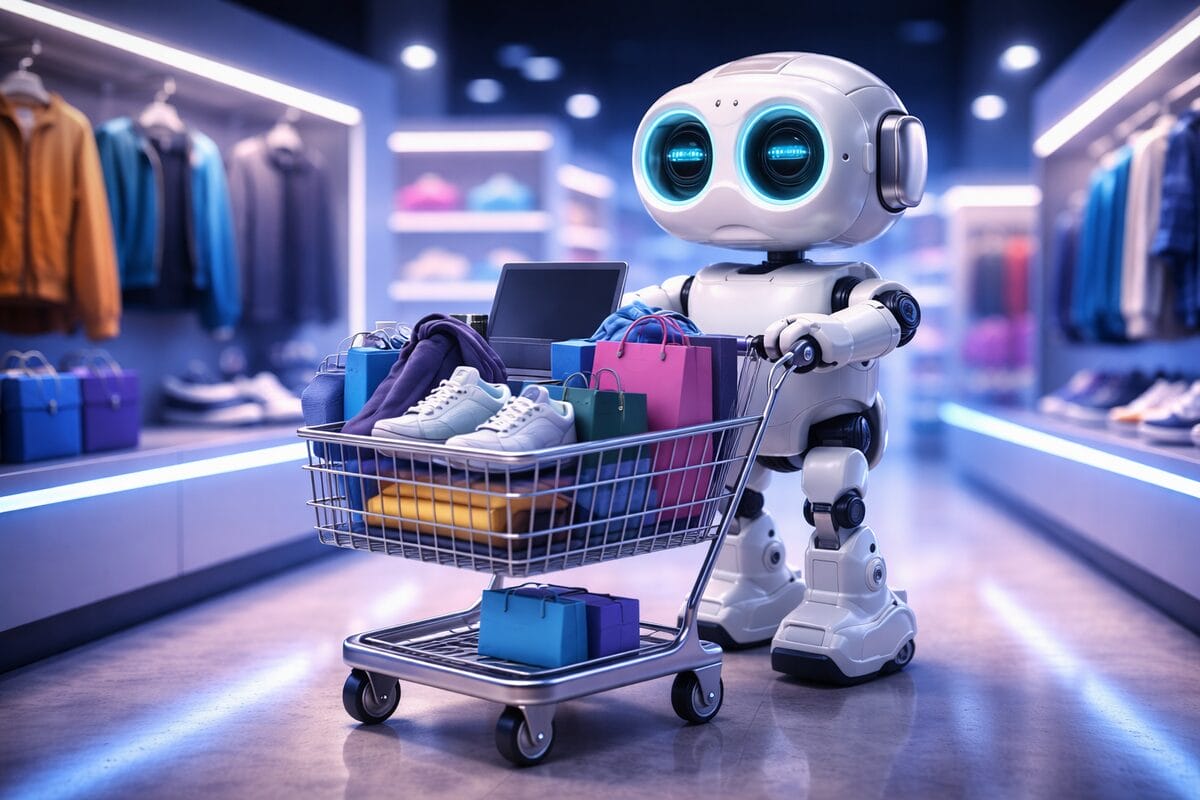
E-commerce is entering a new phase where artificial intelligence is influencing how customers discover and buy products. AI-powered shopping assistants and autonomous agents are beginning to change the way people search, compare, and purchase items online.
This shift is often described as agentic commerce. Instead of manually browsing dozens of product pages, customers can rely on AI systems that research products, evaluate options, and recommend purchases based on preferences, budget, and context.
For dropshippers, this evolution introduces both opportunities and new competitive dynamics.
Connecting AI directly to your dropshipping tools
One practical example of this shift is already available to AutoDS sellers. Through the AutoDS Claude MCP connector, dropshippers can connect their AutoDS account directly to Claude — Anthropic’s AI assistant — and manage store operations through natural conversation. Instead of navigating dashboards manually, sellers can ask Claude to find trending products, check order status, or import a product, and the AI executes the action in real time. This is a working example of agentic commerce applied to the seller side: AI that doesn’t just advise, but acts. As these Claude connectors expand across more ecommerce platforms and tools, the line between “using AI” and “operating a store” will continue to blur.
🤖 The rise of AI shopping assistants
Large AI systems are increasingly acting as shopping advisors. These assistants can analyze product listings, compare prices, summarize reviews, and suggest products that match a user’s request.
In practical terms, this means many purchasing journeys may start with a conversational query rather than a traditional search engine. A user might ask an AI shopping assistant for “the best ergonomic desk lamp under $50,” and the system will analyze product data to present curated recommendations.
For sellers, this trend makes structured product data and optimized listings even more important. AI systems rely heavily on clear product descriptions, accurate attributes, and well-organized product information when selecting which items to recommend.
🔎 From search results to AI recommendations
Traditional e-commerce discovery has always depended on search rankings, ads, and marketplace algorithms. Agentic commerce introduces another layer: AI-driven recommendations generated directly from product data.
Instead of browsing pages of listings, customers may increasingly receive AI-generated shortlists of products that meet their needs.
This changes the competitive landscape. Products with clear value propositions, strong reviews, and well-structured information are more likely to appear in AI-generated recommendations.
For dropshippers, that means product pages must be designed not only for human readers but also for AI systems that interpret product data.
🧑💻 Autonomous buying agents
A more advanced stage of agentic commerce involves autonomous purchasing agents. These systems can complete parts of the shopping process automatically, such as comparing prices across stores or tracking product availability.
In some cases, AI agents may even place purchases on behalf of users when certain conditions are met, such as price drops or restocks.
While this technology is still developing, it points toward a future where product discovery and purchasing decisions become increasingly automated.
🛒 What this means for dropshippers
As AI shopping assistants and buying agents evolve, dropshipping stores will need to adapt in several ways.
Structured product listings become critical. AI systems rely on clear product data to evaluate items. Well-organized product titles, descriptions, and features increase the chances of appearing in AI-generated recommendations.
Operational efficiency becomes even more important. AI-driven shopping environments reward sellers who maintain accurate pricing, reliable inventory data, and consistent fulfillment.
AutoDS helps sellers maintain these operational standards. AutoDS provides automation tools that monitor supplier pricing, synchronize inventory levels, and help dropshippers keep product data accurate across their store.
Speed also matters. Stores that can quickly launch and test products are better positioned to capture emerging demand signals.
💪 Preparing for the next phase of AI commerce
AI shopping and agentic commerce will not replace e-commerce platforms overnight, but they will gradually reshape how customers interact with online stores.
Dropshippers who adopt AI-powered tools today gain a major advantage: they can launch products faster, optimize listings more efficiently, and maintain operational accuracy as the market evolves.
Understanding how AI influences both store operations and customer behavior will be essential for building successful dropshipping businesses in the years ahead.
Is AI Dropshipping Worth It in 2026?
Yes. AI dropshipping is worth it in 2026, but not for the reasons many beginners assume. AI does not run a business automatically. What it does is remove a large portion of the manual work that used to slow sellers down.
Today, many operational tasks in dropshipping can be accelerated with AI tools and automation systems. Product discovery, listing creation, supplier monitoring, and order management can all be handled much more efficiently than they were just a few years ago.
Automation tools play a central role in this shift. AutoDS provides AI-powered product research, listing generation, supplier monitoring, and automation tools that help dropshippers run their stores with far less manual work.
Why AI improves the dropshipping workflow
AI tools help sellers operate faster and test ideas more efficiently. Some of the biggest advantages include:
- ✅ Faster product research through data-driven trend analysis
- ✅ Faster store setup using AI-powered store builders
- ✅ Faster listing creation with AI-generated titles and descriptions
- ✅ Automated supplier monitoring for prices and inventory
- ✅ More efficient marketing testing through AI-generated ad ideas
These improvements allow sellers to launch products quickly and experiment with more opportunities.
Frequently Asked Questions
What is AI dropshipping?
AI dropshipping refers to using artificial intelligence tools to automate and assist key tasks in a dropshipping business, such as product research, listing creation, and supplier monitoring. These tools analyze market data and help sellers manage stores more efficiently.
How does AI dropshipping work?
AI dropshipping works by combining data analysis, automation, and AI-generated content across the selling workflow. AI tools can identify trending products, generate product listings, and monitor supplier prices or inventory changes.
Can AI automate a dropshipping business?
AI can automate many operational tasks, including supplier monitoring, listing creation, and order processing. However, it cannot run a business completely on its own. Strategic decisions like niche selection and marketing still require human judgment. AutoDS automates operational workflows while sellers remain in control of strategy.
What are the best ways to use AI for dropshipping?
The best approach is to use AI to speed up research, generate listings, and automate repetitive tasks while making strategic decisions manually. It allows sellers to test products faster and manage stores more efficiently.
What AI tools do dropshippers use?
Dropshippers typically use AI tools for product research, store building, listing generation, marketing, and operational automation. Some platforms focus on a single task, while others combine several capabilities. AutoDS belongs to the all-in-one category, integrating AI research, listing optimization, and automation tools.
Can AI help with product research for dropshipping?
Yes. AI tools analyze marketplace data and demand signals to highlight products that may perform well. This helps sellers discover opportunities faster than manual research alone. AutoDS includes AI-assisted product research tools that help dropshippers find trending products.
Can AI build a dropshipping store?
AI store builders can generate a functional store structure with layouts, product listings, and collections. These systems provide a starting point that sellers can customize later. AutoDS offers an AI-powered Shopify store builder that helps sellers launch stores quickly.
Can AI write product descriptions and ads for dropshipping?
Yes. AI content tools can generate product titles, descriptions, and marketing copy based on product data. This speeds up listing creation and campaign testing. AutoDS includes AI tools designed to generate optimized titles, descriptions, and marketing text for dropshipping listings.
Is AI dropshipping worth it in 2026?
AI dropshipping is worth it because it significantly reduces manual work in research, listing creation, and store management. Sellers can launch and test products faster than before. AutoDS supports this workflow by combining AI-powered tools with automation systems.
What still needs human oversight in AI dropshipping?
Human judgment is still needed for niche selection, supplier evaluation, product validation, and branding decisions. AI assists with data and automation, but does not replace strategic thinking.
Start Your Dropshipping Journey with AutoDS
AI has quickly moved from a novelty to a core operational advantage in modern dropshipping. Sellers can now discover products through data analysis, generate structured listings automatically, and automate many operational tasks that once required manual management.
The biggest impact of AI is not that it runs a business automatically. It changes how execution happens. Dropshippers who combine AI-powered tools with smart product selection and marketing strategies can launch stores faster, test more products, and scale operations with far less friction.
AutoDS was built to support that workflow. AutoDS integrates AI-powered product research, listing generation, supplier monitoring, and automation tools, enabling dropshippers to manage their stores from a single platform.
If you’re planning to launch or grow a store in 2026, AI-powered workflows can give you a serious operational edge.
Ready to build a smarter dropshipping business with AI? Start your $1 AutoDS trial and explore AI-powered dropshipping today.
For more expert dropshipping-related guides, check these out:
- What Is AI Dropshipping?
- How AI Dropshipping Works
- How AI Fits Into The Workflow
- What AI Can Actually Help With
- Where AI Still Needs Human Judgment
- Best Ways To Use AI For Dropshipping
- AI Dropshipping Tools And Categories
- How AutoDS Supports AI Dropshipping
- AI Shopping And Agentic Commerce
- Is AI Dropshipping Worth It In 2026?
- FAQ
- Conclusion